


A few weeks ago I posted a Note about something I've been wanting to dig into for a while, and the response was immediate. The Note touched on a pattern a lot of us know well: the way our immune systems seem to fail us right after a stressful period ends, on the first day of vacation, on the weekend we finally have nothing to do.
The comments filled up with people saying yes, this happens to me every single time. Some of you shared stories about collapsing into illness the moment the pressure lifted. Others said they'd noticed the pattern for years but never had a name for it, never understood why their body seemed to betray them at the exact moment they'd finally earned a break. It felt like the more you pushed through, the harder you fell afterward. But look, your body wasn't deliberately trying to betray you. It was just doing its job, with incredibly horrible timing.
You know the drill. Exam season hits, and for weeks you’re running on caffeine, adrenaline, and sheer willpower. Somehow you hold it together. You show up, you perform, you power through every late night and early morning.
Then you sit down for that final exam, you put your pencil down on the very last question, and before you even make it home, your throat starts to feel a little scratchy. By the next morning, you’re flat on your back with a box of tissues and the audacity to wonder: why now?
Or maybe it’s not exams for you. Maybe it’s the moment you finally clock out for a long weekend after weeks of back-to-back deadlines, and day two of your vacation you wake up with a full-blown head cold. Maybe it’s the week after the holidays, once the hosting and the travel and the emotional labor of family time finally winds down. Maybe it’s the Monday after you moved apartments, or the day after you handed in a big project, or the morning of the first real rest day you’ve had in months.
The timing always feels like a cruel joke. Like your body waited patiently for you to have a moment to breathe, and then immediately used that moment to fall apart.
There’s a very real physiological explanation for why your immune system holds the line during the hard stretch and then waves the white flag the moment you finally rest. Once you understand what’s actually happening, the whole pattern starts to make a different kind of sense. It also opens up a genuinely useful question: is there anything we can do to make that transition less brutal?
That’s what we’re getting into today.

The Biology of Stress and What It Does to Your Immune System
When your brain perceives a threat, the response begins in the hypothalamus, a small, almond-sized structure sitting at the base of the brain that functions as the master regulator of your hormonal activity. It’s one of those brain regions that doesn’t get nearly enough credit. And yes, unfortunately, your brain doesn’t particularly discriminate between threats. Exam season, an inbox full of unread emails, extended family time, a calendar stacked with deadlines, your body can read all of these as danger signals just as readily as it would an actual predator. We don’t have to be outrunning anything for the alarm to go off.
Personally, the simple act of having to make a phone call is apparently the largest threat to my continued existence, and I’ve made peace with that. It’s just how it is.
Within the hypothalamus sits a cluster of neurons called the paraventricular nucleus, and this is where the stress cascade actually originates. Think of it less like a nucleus inside a cell and more like a command post, a tightly packed group of specialized neurons whose entire job is to detect those threat signals and translate them into a hormonal response.
When the paraventricular nucleus receives those signals, it releases corticotropin-releasing hormone, or CRH, into a specialized blood vessel system that connects the hypothalamus directly to the pituitary gland, a pea-sized structure hanging just below it. The pituitary responds by secreting adrenocorticotropic hormone, ACTH, into general circulation. ACTH then travels through the bloodstream to the adrenal glands, two small triangular structures sitting on top of your kidneys, and instructs them to produce cortisol. That whole chain, hypothalamus to pituitary to adrenal glands, is the HPA axis, and its activation is one of the most consequential hormonal cascades in the human body (Xu et al., 2025).
Running alongside all of this, the sympathetic nervous system activates simultaneously, releasing catecholamines including adrenaline and noradrenaline. These work in tandem with cortisol to redirect blood flow, raise cardiac output, mobilize glucose from storage, and shift the body into a state of heightened readiness.
What’s worth appreciating here is that the system has an elegant built-in brake.
Elevated cortisol signals back to both the hypothalamus and the pituitary to dial down CRH and ACTH production, telling the axis to stand down once the threat has passed. Under normal conditions, this negative feedback keeps the stress response contained and proportionate. The issue arises when the stressor doesn’t resolve, the feedback loop becomes blunted, and cortisol stays elevated far longer than the system was designed to sustain (Xu et al., 2025).
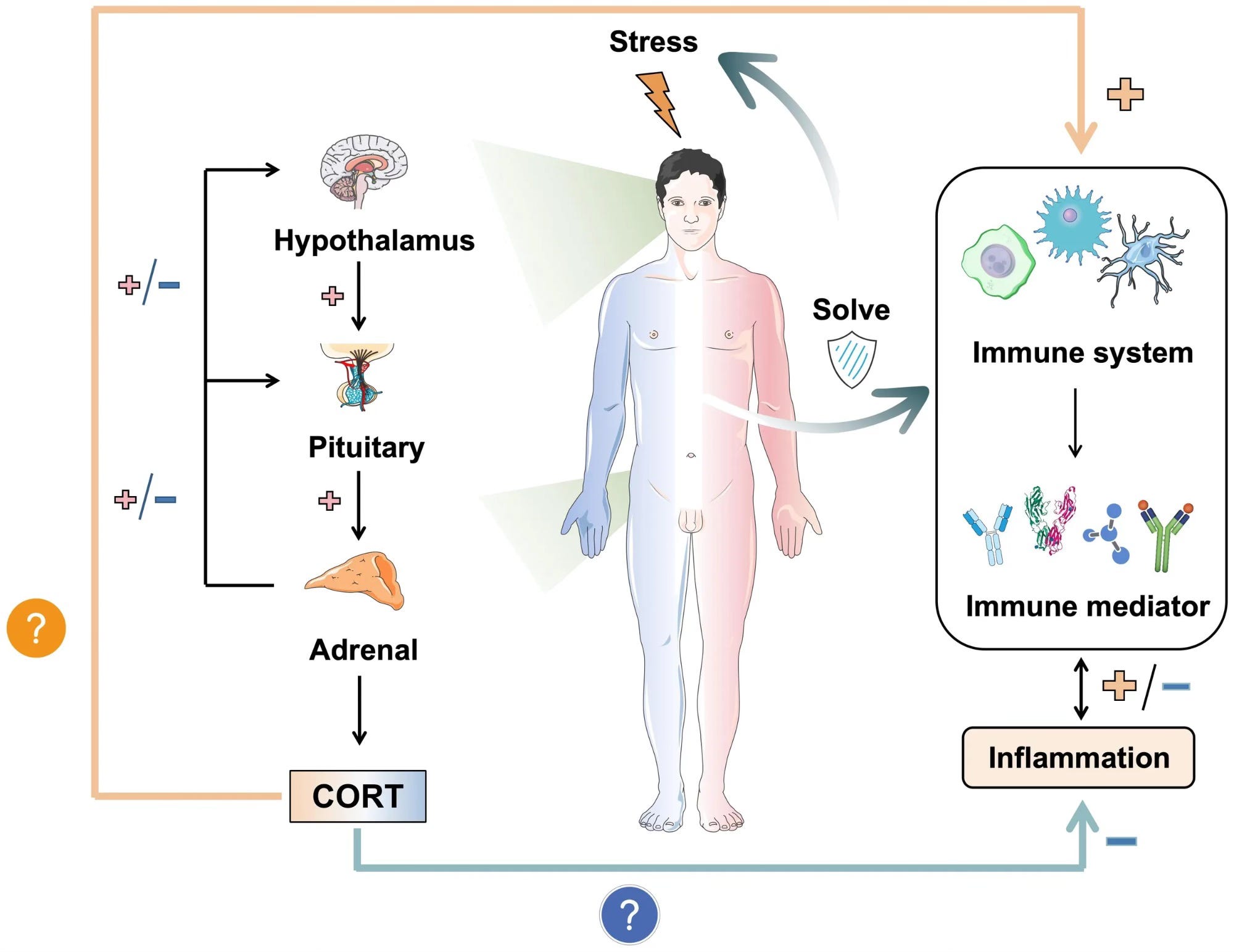
The stress response and its relationship to immune function. When the brain perceives stress, the signal travels down the HPA axis, from the hypothalamus to the pituitary to the adrenal glands, triggering cortisol (CORT) release. Cortisol then modulates immune cell activity, immune mediators, and inflammation, while also looping back to regulate its own production at the hypothalamus and pituitary. The question marks reflect one of the genuinely unresolved areas in stress physiology: cortisol and inflammation are in a bidirectional conversation, but exactly how and when cortisol shifts from anti-inflammatory to pro-inflammatory remains an active area of research. (Adapted from Xu et al., 2025, Frontiers in Endocrinology)
Cortisol’s Relationship with the Immune System
Cortisol’s relationship with immune function is one of the more genuinely complex areas of stress physiology, and the complexity deserves to be honored rather than flattened. Its effects aren’t linear and they aren’t fixed. Duration, concentration, and the state of the tissue all determine whether cortisol is acting as a regulator or a suppressant, and in many cases it’s doing both at the same time in different compartments of the immune system.
During acute stress, cortisol actually provides a short-term enhancement to certain aspects of innate immunity. Natural killer cell activity increases, pro-inflammatory cytokines including IL-6 and TNF-α are upregulated, and the immune system is placed on alert in a coordinated, purposeful way.
Cortisol in this context is helping coordinate a rapid, targeted response while simultaneously preventing runaway inflammation from causing collateral damage to healthy tissue. This is the glucocorticoid system working exactly as it’s supposed to, maintaining homeostasis in the face of a transient challenge (Alotiby, 2024).
With sustained elevation, though, the picture shifts considerably. Prolonged cortisol exposure suppresses T-lymphocyte proliferation, reduces natural killer cell cytotoxic activity, and drives a cytokine shift away from the Th1-dominant cellular immune response toward a Th2-dominant humoral profile.
In practical terms, the branch of immunity responsible for recognizing and eliminating virus-infected cells becomes quieter, while antibody-mediated responses increase. That shift raises vulnerability to viral infections and intracellular pathogens precisely at the time when most people are already running on depleted reserves.
Cortisol achieves these effects primarily through glucocorticoid receptors, which are present on virtually every immune cell in the body. When cortisol binds these receptors, it inhibits the transcription of pro-inflammatory genes, suppresses the NF-κB signaling pathway, and reduces the production of cytokines including IL-1β, IL-2, and IFN-γ (Xu et al., 2025).
IL-2 is particularly significant here because it’s essential for T-cell clonal expansion, the process by which a small number of pathogen-recognizing T-cells multiply into the large population needed to mount a real defense.
When IL-2 signaling is dampened, that expansion slows, and the deficit quietly accumulates over weeks of sustained stress without producing any obvious symptoms.
You’re still functioning, still showing up, still getting things done. Your immune system is just running at a reduced capacity the entire time.
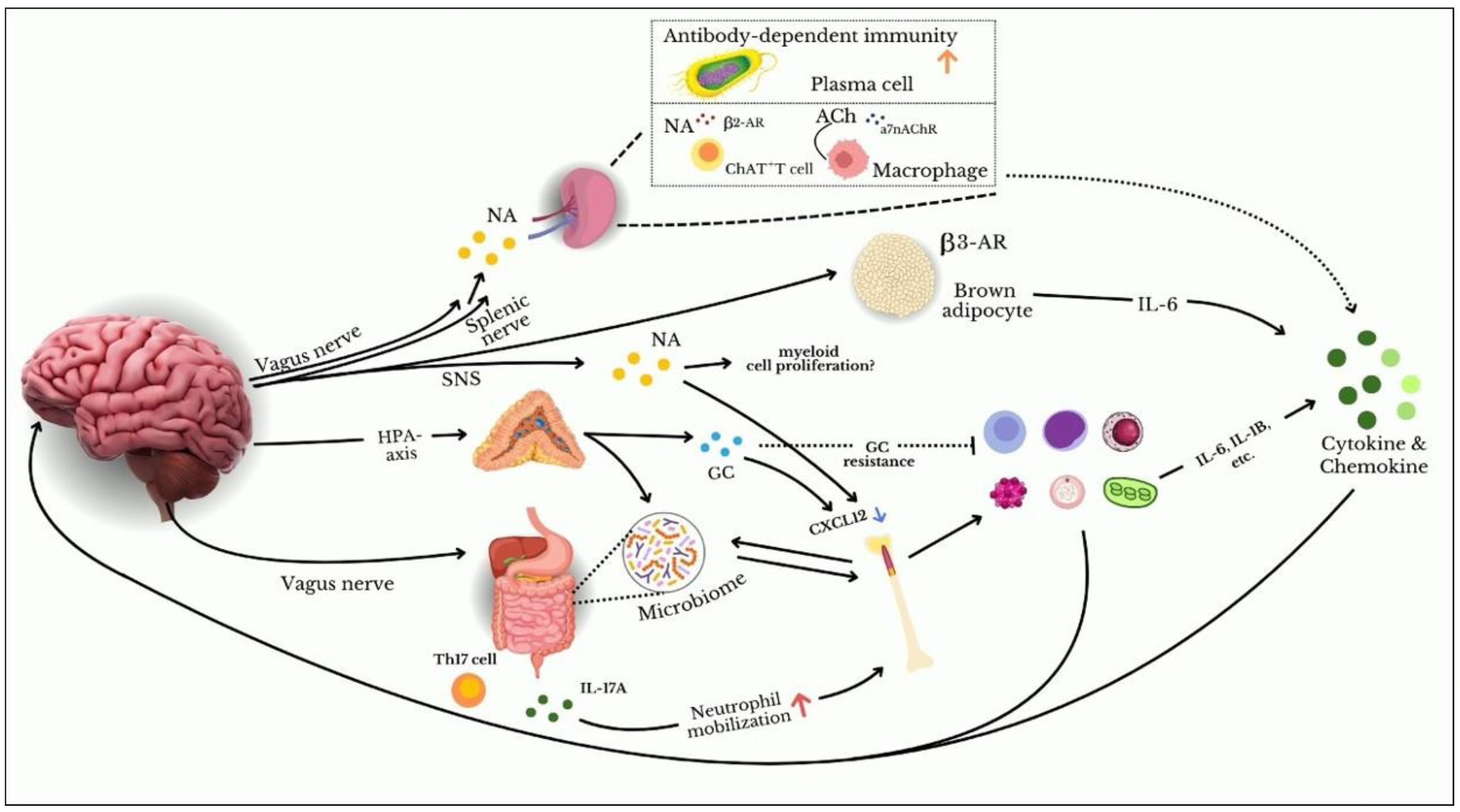
Pathways connecting stress to immune function.
When the Stress Doesn’t Stop
Under conditions of chronic stress, something more clinically significant develops on top of all of that: glucocorticoid receptor resistance. After prolonged exposure to elevated cortisol, immune cells begin downregulating their glucocorticoid receptors as a kind of protective adaptation. The receptors become less sensitive, meaning cortisol can no longer perform its anti-inflammatory regulatory function effectively even when it’s present in high concentrations.
The result is a paradoxical state in which cortisol remains elevated but loses its ability to restrain inflammation, contributing to the low-grade, dysregulated immune activity associated with conditions like rheumatoid arthritis and metabolic disease (Xu et al., 2025). The alarm is still going off. The body has just stopped responding to it the way it should.
This dysregulation also shows up in measurable changes to the diurnal cortisol curve. In a healthy stress response, cortisol peaks sharply in the morning within 30 to 45 minutes of waking, something called the cortisol awakening response, and then gradually declines throughout the day, reaching its lowest point in the middle of the night.
In people experiencing chronic stress, that curve becomes flattened. Morning cortisol is blunted, evening cortisol stays elevated, and the clean diurnal rhythm that governs immune regulation, metabolic function, and cellular repair begins to erode (Alotiby, 2024). Research has linked this flattened slope to elevated inflammatory markers including IL-6, TNF-α, and CRP, which tells us the endocrine and immune disruptions aren’t happening in separate compartments. They’re feeding each other.
So, here’s where we land after all of that.
Weeks of stress means weeks of suppressed T-cell activity, quieter NK cells, a shifted cytokine balance, and a diurnal cortisol rhythm that’s gone flat. The immune system has been running below capacity the whole time, and there have been no obvious signs because cortisol was keeping a lid on everything. When the stressor finally disappears, all of that deferred biological work comes due at once.
Which brings us to why you got sick the morning after your last exam.

When the Stress Lifts: The Rebound
There’s Actually a Name for This
Here’s something that might make you feel significantly less alone in your post-exam, post-deadline, post-holiday collapse: researchers named this. In 2002, Dutch psychologist Ad Vingerhoets and his colleagues at Tilburg University published a pilot study in Psychotherapy and Psychosomatics describing exactly what so many of you wrote in about after my Note. They called it leisure sickness, defining it as the condition of developing symptoms of illness specifically during weekends and vacations, after periods of high work demand (Vingerhoets et al., 2002).
The study surveyed nearly 1,900 Dutch adults and found that roughly 3% reported recognizing themselves in the description of weekend and vacation syndrome. The most commonly reported symptoms were headache, fatigue, muscular pain, nausea, and viral infections including cold and flu-like illness. Most striking was the finding that affected individuals had generally suffered from this pattern for over ten years, with onset typically tied to a specific stressful life event like a new job, a marriage, or the birth of a child. Risk factors pointed clearly toward high workload, a strong sense of responsibility about work, and difficulty making the psychological transition from working to not working.
That last point is worth sitting with for a second, because the inability to shift out of the working state, the nervous system refusing to change gears even when the circumstances did, turns out to be deeply relevant to the physiology underneath it all.
What’s Actually Happening: Parasympathetic Rebound
To understand why the crash happens when it does, we need to talk about the autonomic nervous system, specifically the relationship between its two main branches.
You’ve probably heard of fight-or-flight, which is your sympathetic nervous system. What gets less attention is its counterpart, the parasympathetic nervous system, sometimes called rest-and-digest. These two branches are in a constant reciprocal relationship, meaning when one is dominant, the other is suppressed. During sustained stress, your sympathetic nervous system is running the show. Heart rate is elevated, blood pressure is up, glucose is mobilized, and cortisol and catecholamines are circulating. The parasympathetic system is quieted down to make room for all of that.
When the stressor finally resolves, and that sympathetic dominance drops away, the parasympathetic system doesn’t just return to baseline. Research on autonomic nervous system dynamics shows that during recovery from a stressor, parasympathetic activity can actually overshoot resting levels in what’s been described as vagal rebound, a compensatory surge in parasympathetic tone that exceeds what was there before the stress began (Djuric et al., 2000). This is parasympathetic rebound, and it’s a predictable feature of how the autonomic nervous system recalibrates after a prolonged period of sympathetic dominance.
The IU International University of Applied Sciences captured this cleanly in their 2025 leisure sickness study: during periods of stress, the sympathetic nervous system becomes overactive and the body suppresses symptoms of illness. When stress levels and hormone production decrease during leisure time, immune function returns to normal, meaning suppressed symptoms can emerge and exhaustion becomes noticeable. They name it directly as parasympathetic rebound (André, IU Study, 2025).
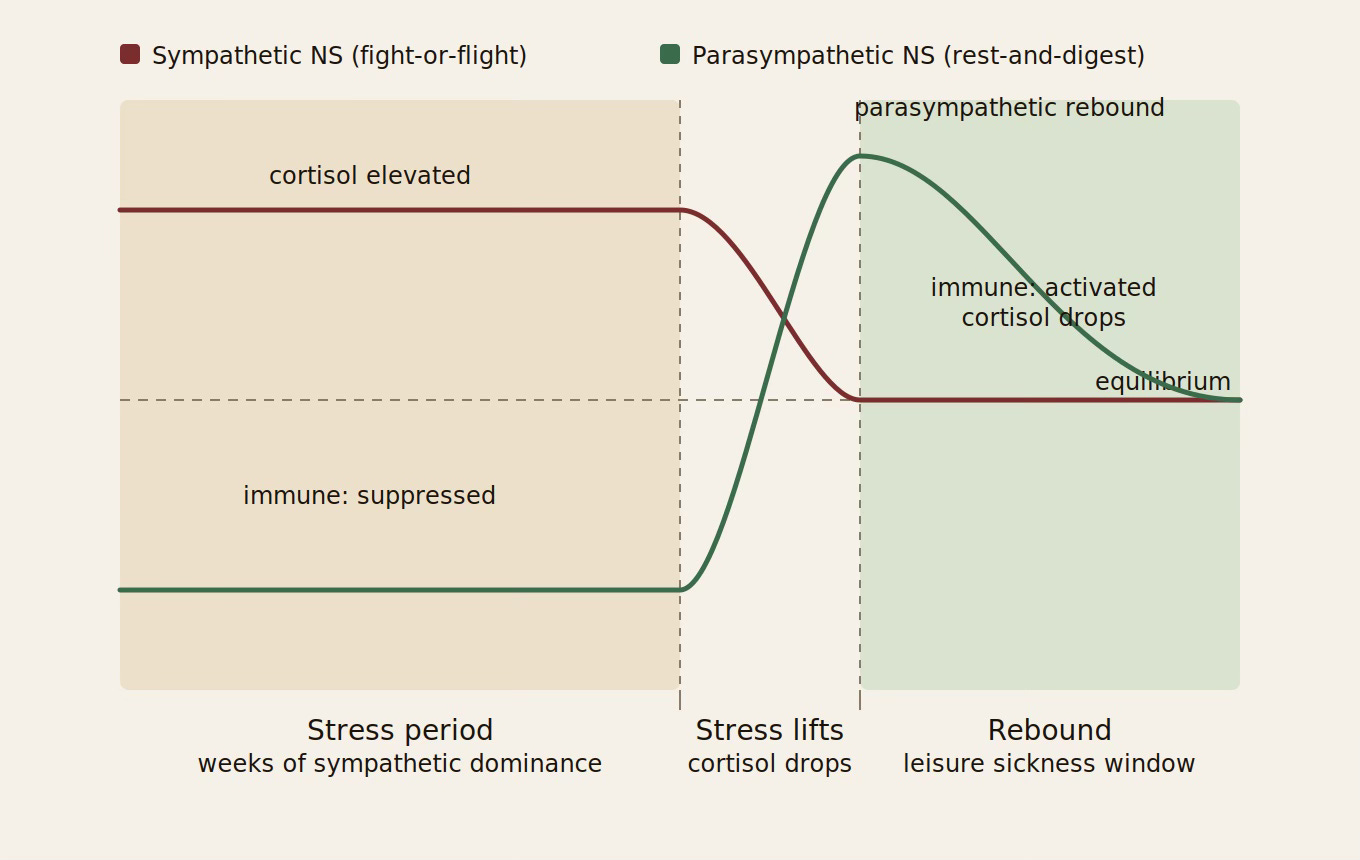
The Cortisol Drop and the Immune System’s Response
The autonomic shift is one part of the story. The other part is the cortisol drop, and these two things happen at the same time, which is part of why the crash can feel so sudden and complete.
Remember what we covered in the last section: during the stress period, cortisol was actively suppressing T-cell proliferation, quieting NK cell activity, and holding the immune system at a reduced capacity. Running a full immune response is metabolically expensive, and cortisol was making a real-time energy allocation decision, redirecting those resources toward keeping you functional under pressure. The immune system was always going to come second to survival.
When cortisol drops, that suppression lifts. The immune system, which has been sitting in the wings for weeks, gets the green light to mobilize. And because it’s been accumulating a backlog of work the entire time, the response can be rapid and outsized. T-cells begin proliferating. Inflammatory signaling increases. Any pathogen that had gained a foothold during the immunosuppressed period now meets a full immune response. Any latent virus your body has been quietly managing, herpesviruses like HSV-1 or Epstein-Barr being particularly well-documented examples, can reactivate when the glucocorticoid lid comes off (Wang, 2022).
This is also why the symptoms of leisure sickness aren’t always a fresh infection. Sometimes what you’re experiencing is your immune system finally processing things that were already there. The cold sore that appears the week after finals. The fatigue that rolls in the first day of a vacation. The migraine that shows up the Saturday after a brutal work week. These aren’t new attacks so much as they’re the immune system catching up on deferred maintenance, and the cortisol withdrawal is what opened the door.
Why Some People Are Hit Harder Than Others
One of the more interesting findings from Vingerhoets’ original work was that not everyone experiences leisure sickness equally. The people most affected weren’t necessarily the ones working the longest hours. They were the ones who had the hardest time disengaging, the high achievers, the perfectionists, the people with a strong sense of responsibility who couldn’t fully switch off even when they technically had time off (Vingerhoets et al., 2002).
Physiologically, this tracks perfectly. Someone who never fully transitions out of sympathetic dominance experiences a far more abrupt autonomic shift when they finally do stop, meaning the cortisol drop is steeper, the parasympathetic rebound overshoots more dramatically, and the immune recalibration hits harder and faster. Compare that to someone who can genuinely decompress gradually over a few days, giving their nervous system time to ease out of high alert rather than slamming from full speed into a complete stop the moment they hand in their last assignment.
For a meaningful subset of people this also means that leisure time doesn’t actually feel restorative, at least not initially, because the biological transition itself is uncomfortable. Layered on top of that is the cultural expectation that rest should feel immediately good, that the vacation should deliver relief from the first day, which can add a real layer of frustration to what is already a physiologically difficult recalibration process.
Understanding that this is a named, studied, mechanistically explainable phenomenon doesn’t make the sore throat feel better. But it does reframe the question.
Instead of asking why your body keeps failing you at the worst possible moments, the more useful question becomes: what can we do to make that transition less violent?
Which is exactly where the herbs come in.
The rest of this article is for paid subscribers.
Below the fold, we get into the part that actually changes how you approach the next stressful stretch. We break down exactly what reishi and astragalus are doing at the cellular level, why timing your herbal support matters more than which herb you choose, and what the clinical evidence actually shows when you strip away the marketing language.
As a paid subscriber, you also have access to:
The Buffalo Herbalist Library, a growing archive of deep-dive articles organized by body system, so you can always find what you’re looking for
The Body Systems Index, a reference guide to the physiological foundations behind everything we cover here
The Materia Medica Index, a plant-by-plant reference covering mechanisms, evidence, contraindications, and clinical considerations
Field Notes, the weekly short-form series where I share clinical observations, research updates, and things I’m thinking about between full articles
If this kind of science-first, hype-free herbalism is what you’re here for, I’d love to have you on the inside.
Read more about immunomodulation here:
Immunomodulation and Herbal Medicine: How Herbs Support the Immune System with Balance and Intelligence

As you move a little deeper into your herbal studies and eventually find yourself tangled in the web of the immune system, you might notice a pattern. First, you are submerged in T cells, those pac-man style macrophages, and the ever-vigilant NK cells. You come up for air for a moment, only to slip right back under when you stumble across the term “