


Once you’re a little further into your herbalism journey, learning about Marshmallow is one of those fun, wait…what?! moments. You hear the name and immediately picture that perfectly toasted, golden-brown marshmallow, gooey and molten in the middle, nestled between a square of melting chocolate and a crisp, honey-sweet graham cracker. Then comes the real surprise: you can actually make marshmallows out of marshmallow. The original inspiration for that soft, pillowy confection came from this very plant. Consider that your newest herbal trivia gem.
Beyond the sweet nostalgia, marshmallow is a plant that teaches. It’s often a reader’s first introduction to mucilage, that slippery, soothing plant compound, and to the practice of cold infusions. Where most herbs give up their medicine in hot water, marshmallow prefers the opposite. Cool water pulls out its demulcent properties slowly, in a way that feels almost alchemical. It’s a gentle lesson in herbal actions and in the many ways we can prepare and work with our plant allies.
A plant that inspired a beloved treat and a foundational herbal preparation? Now that’s one to remember.
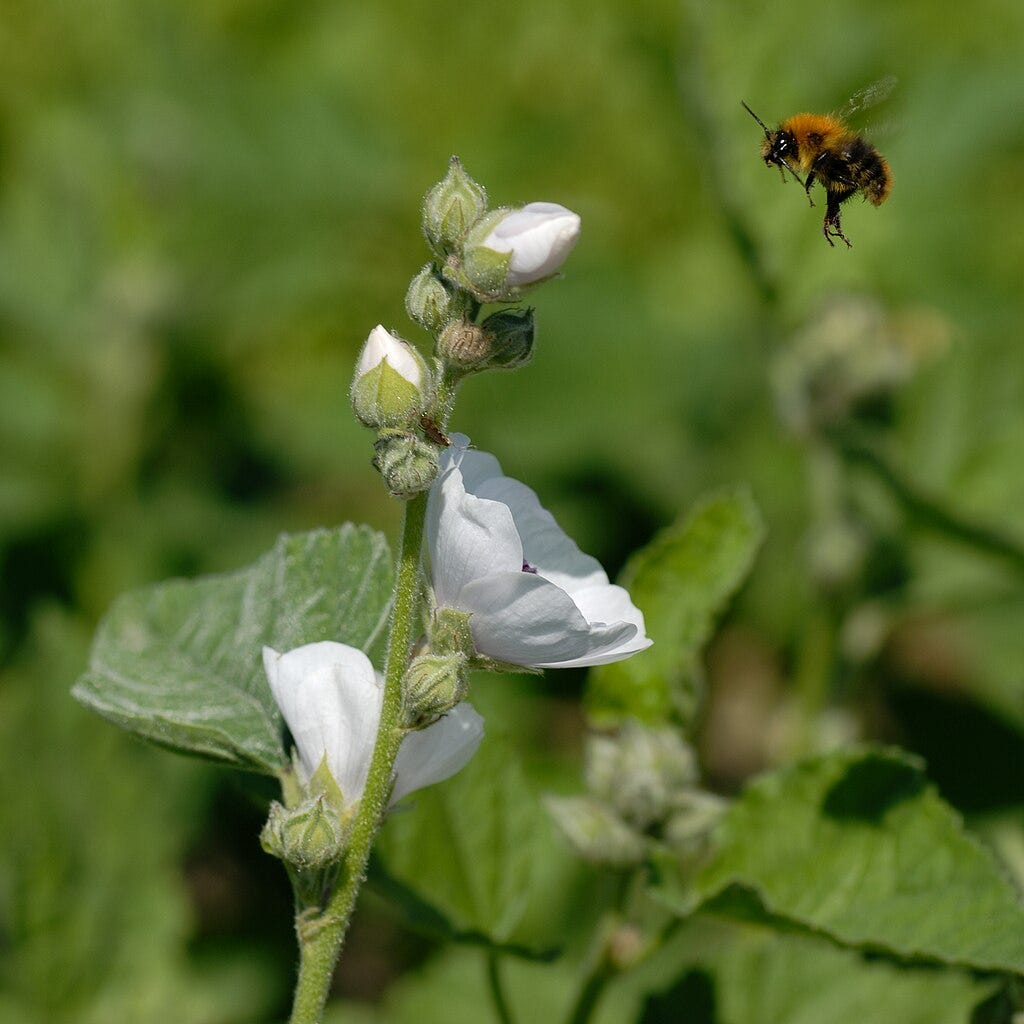
Soft, Healing, and Steeped in History: Meet Marshmallow
Marshmallow (Althaea officinalis) has a history as rich as its roots. Native to the salt marshes of coastal Europe, it has since made itself at home in North America, thriving along inland waterways, ditches, and any place where moisture lingers. A true botanical globetrotter, this plant has been valued for centuries for both its medicinal and culinary uses.
The roots and leaves are packed with mucilage, along with pectins, sugars, flavonoids, tannins, salts, and phenolic acids. Beyond its therapeutic properties, marshmallow has been used as a nourishing food for over two thousand years. The Romans considered it a delicacy.
Even its name tells a story. The family name, Malvaceae, comes from the Latin mollis, meaning “soft,” an ode to its velvety leaves and soothing nature. Its genus, Althaea, traces back to the Greek altheo, meaning “to heal” or “to cure.” Fitting for a plant that’s been in the medicine cabinet for millennia.
Marshmallow has some well-known botanical relatives. The elegant hollyhock (Alcea rosea), the classic rose of Sharon (Hibiscus syriacus), and various hibiscus species all belong to the same family. These relatives are sometimes used as substitutes for marshmallow when the true species is harder to source.
A Soothing Remedy, Rooted in Tradition
For centuries, Althaea officinalis has been a trusted ally in herbal medicine, especially in Europe, where it has long been used to ease coughs, sore throats, and inflamed mucous membranes. Modern research has caught up with what herbalists have known for a long time, and the studies on this plant are worth looking at closely.
At the heart of its medicinal activity are water-soluble polysaccharides (5–11%), including galacturorhamnans, arabinans, glucans, and arabinogalactans. These compounds form a bioadhesive, mucin-like layer over irritated tissues, coating and protecting them from further inflammation. The root also contains flavone glycosides, phenolic acids, tannins, pectin, starch, and the coumarin compound scopoletin, all of which contribute to its anti-inflammatory and tissue-protective properties.
Clinical reviews have reinforced what herbalists have observed for generations. Mucilage-rich extracts calm, coat, and protect delicate tissues, easing irritation from the inside out. Whether it’s the throat, stomach, lungs, or urinary tract, this plant’s ability to relieve discomfort has real mechanistic grounding behind it.
What Exactly Is a Demulcent?
Before getting into the benefits of marshmallow, let’s define demulcents. Understanding how they work makes their effects that much more interesting.
Demulcent herbs are rich in mucilage, a slippery, gel-like compound that soothes and protects irritated or inflamed tissues. When applied topically, demulcents are called emollients. Internally, they act as a protective barrier for delicate mucous membranes.
Here’s where things get interesting. Pharmacology doesn’t offer a fully satisfying explanation for how demulcents work throughout the body. Mucilage is made up of complex polysaccharides that become thick, slimy, and gummy when mixed with cold water. That physical property is easy to picture in the digestive tract, where demulcents coat the lining of the intestines and soothe inflammation through direct contact.
Their effects beyond the digestive system are harder to explain. Some demulcents, including marshmallow, seem to soothe the lungs, urinary tract, and even the bladder, places far removed from where they’re absorbed. How they get there is still being worked out in the literature.
What we do know is that mucilage-rich demulcents share some consistent actions:
Soothe and protect the entire length of the digestive tract
Reduce sensitivity to gastric acids and bitter compounds
Help stabilize intestinal function
Relax digestive spasms that cause colic and cramping
Ease coughing by soothing bronchial tension
Relieve painful spasms in the bladder and urinary tract
As we’ll see with marshmallow, this class of herbs offers wide-reaching benefits, whether through direct contact or some systemic effect that hasn’t been fully mapped out.
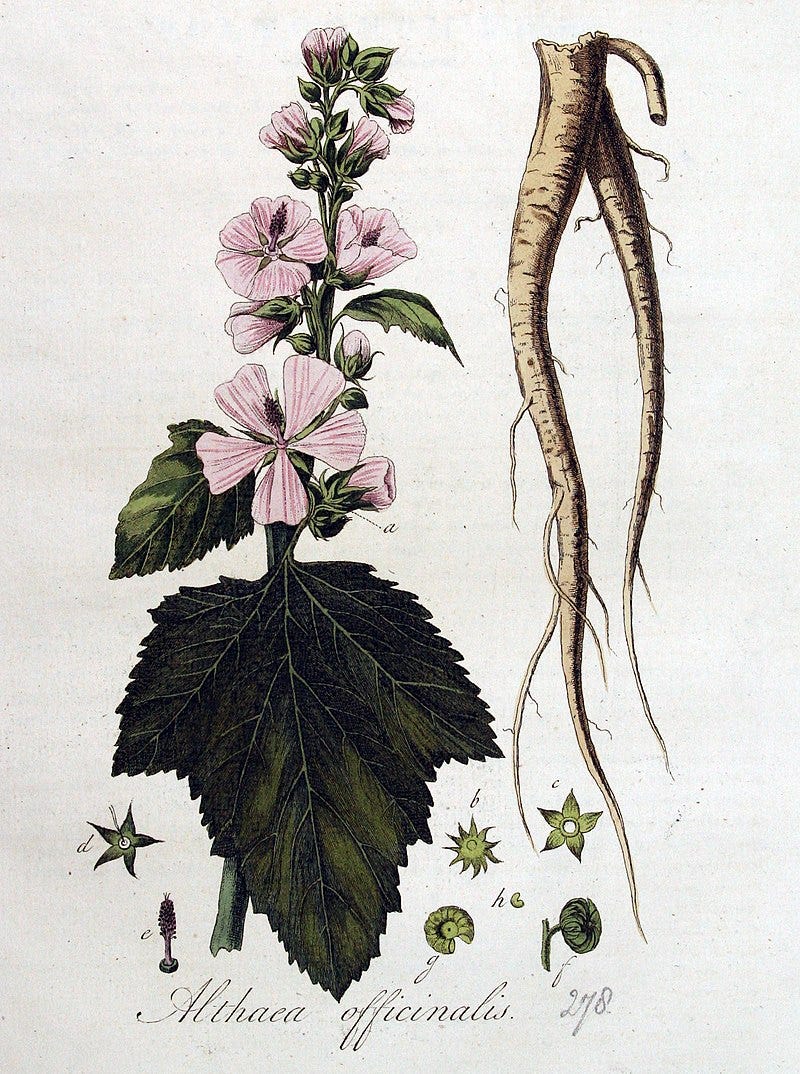
Marshmallow: The Ultimate Soother
Marshmallow is the quintessential mucilaginous herb. Every part of the plant carries its demulcent properties, though the root is the real star. This mucilage-rich medicine coats and calms irritated tissues from the mouth all the way down the digestive tract. While not curative, it’s a valuable ally for easing heartburn, gastric discomfort, and inflammation along the GI tract.
Remember how marshmallow prefers salty marshes? Herbalists see this as an example of the Doctrine of Signatures, the idea that a plant’s appearance, growing conditions, or other natural traits hint at its medicinal uses. As herbalist Kat Mair explains, “The maxim that water follows salt is invaluable when you want to bring fluid to an area and loosen what has concretized.” Marshmallow, with its deeply hydrating, emollient properties, fits that description well.
Take certain respiratory conditions as an example. Thick, hardened mucus can build up in the lungs, restricting oxygen exchange and leading to dyspnea (difficulty breathing). Marshmallow has long been used to help loosen that stuck mucus and make it easier to expel. The same principle applies to congested lymph nodes. When they become swollen, sluggish, or full of “sludge,” marshmallow’s ability to soften and mobilize fluids makes it useful for supporting the gut-lymph connection.
Marshmallow is also one of the most demulcent diuretics, which makes it a gentle addition to kidney and urinary tract blends. It eases the pain of kidney stones, urinary tract infections, and other hot, irritating conditions. A classic urinary support formula:
2 parts uva ursi (Arctostaphylos uva-ursi)
1 part corn silk (Zea mays)
1 part marshmallow root
One note: skip cranberry juice with this formula. Cranberry acidifies the urinary tract and can interfere with the medicinal actions of these herbs.
Marshmallow Root & Mucosal Healing: The Science Backs It Up
For centuries, herbalists have turned to marshmallow (Althaea officinalis) to soothe irritated mucous membranes. Modern research is catching up to what tradition already knew. A recent study looked at how aqueous extracts of marshmallow root and its mucilaginous polysaccharides interact with epithelial cells, the cells that line the respiratory and digestive tracts.
Marshmallow root contains rhamnogalacturonan-type polysaccharides, which form a bioadhesive, mucin-like layer over inflamed tissues. The protective barrier itself is well-documented. What researchers wanted to understand was whether marshmallow actively influences cellular behavior to support healing, or whether it’s simply a passive coating.
To find out, Deters et al. (2010) tested aqueous marshmallow extract (AE) and raw polysaccharides (RPS) on human epithelial cells (KB cells) and dermal fibroblasts (skin connective tissue cells). They analyzed three things:
Cell viability and proliferation, to see whether marshmallow encourages cell growth
Gene expression changes, to see whether it triggers a healing response
Cellular absorption, to determine whether these polysaccharides penetrate cells or just coat them
The Research
The study showed that epithelial cells responded positively to marshmallow extract. Even at low concentrations (1–10 μg/mL), both the aqueous extract (AE) and raw polysaccharides (RPS) significantly improved cell vitality. The polysaccharides were absorbed by epithelial cells without pushing them into excessive proliferation, which suggests a gentle, supportive effect rather than overstimulation.
The research also confirmed marshmallow’s bioadhesive properties. The polysaccharides formed a protective, mucin-like layer over dermal fibroblasts, reinforcing their role in shielding and soothing irritated tissues.
Gene expression analysis added another layer to the picture. Researchers observed an upregulation of proteins involved in cell adhesion, growth regulation, extracellular matrix formation, cytokine release, and apoptosis. Translated from lab speak, marshmallow appears to play an active role in tissue repair, not just form a passive coating over it.
The study found no effect on fibroblasts. While marshmallow clearly supports mucosal tissue, it didn’t stimulate fibroblast activity, which tells us its effects are specific to epithelial cells, the ones that line and protect our airways, gut, and urinary tract.
A plant that not only soothes but potentially signals repair? Modern science is just catching up to what herbalists have known all along.
What This Means for Herbal Medicine
These findings line up with marshmallow’s traditional uses for sore throats, digestive irritation, and respiratory inflammation. The polysaccharides create a soothing barrier over irritated tissue and actively support epithelial cell function, which translates to better mucosal healing.
What starts as a simple coating turns out to be something more active at the cellular level, and that’s worth sitting with.
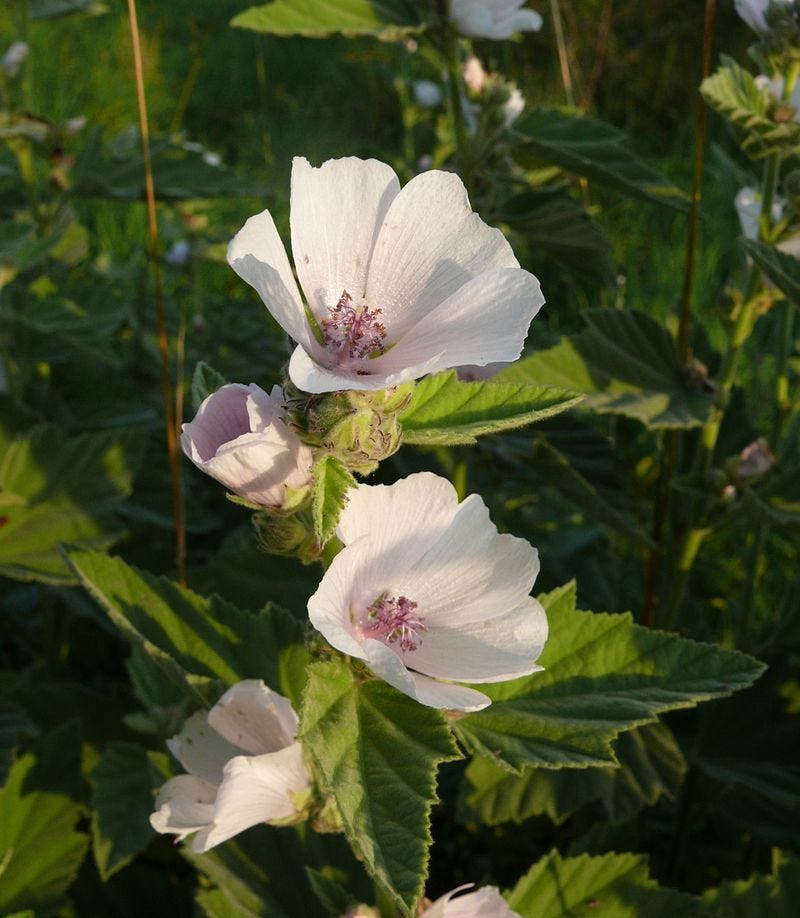
How to Prepare Marshmallow: The Cold Infusion Matters
Marshmallow is best known for its mucilaginous properties, and how you prepare it determines what compounds you’re actually extracting. Cold infusions are the gold standard for pulling out the soothing polysaccharides that make marshmallow such a useful demulcent.
Cold Infusion: The Best Way to Extract Mucilage
A cold infusion primarily extracts the mucilaginous polysaccharides, which coat and soothe irritated tissues. Simmering the root will also extract starches, which isn’t necessarily a problem, but a cold infusion gives you a cleaner, more concentrated mucilage extract.
How to make a cold infusion:
Add 4 tablespoons of dried marshmallow root to 1 quart of cold water
Let it sit for at least 4 hours, or overnight
Keep it in the fridge while steeping for maximum extraction
Strain and drink as needed
Hot Infusion: Best for Leaves and Flowers
Marshmallow leaves and flowers can be prepared as a hot infusion, but avoid boiling them. High heat can degrade the beneficial polysaccharides, so steeping in warm rather than boiling water is the way to go.
If this piece was useful to you, tap the heart, drop a comment, or restack it. It’s the easiest way to help more herbal-curious folks find this kind of work, and it means a lot to me when you do.
I want to hear from you on this one. Have you worked with marshmallow before? Do you have a way of preparing it that’s become your default, a story about when it surprised you, or a question that’s been sitting in the back of your mind? The comments are where the best conversations happen, and this plant in particular has a way of drawing them out.
A quick look at what’s coming up. Later this week, we’ll get into the gut-brain axis and how deeply the gut and nervous system are wired together, along with the herbs that can support that connection. Friday’s post for The Buffalo Herbalist community continues the gut health thread with a look at the gut-liver axis and the role of pre- and probiotic herbs in keeping the microbiome happy.
If any of these threads are pulling at you, drop your questions in the chat. Gut-brain, gut-liver, probiotic herbs, whatever’s on your mind — I read everything, and I’ll do my best to fold your questions into the upcoming posts.
Until next time,
— Agy | The Buffalo Herbalist

It helped a lot when my Morbus Crohn was active.
Thanks!! 🙏🏾