


The nervous system is essential in a way that goes past the medical and lands somewhere closer to existential, because it is the thread that ties every part of us together, mind and body, sensation and thought, memory and movement, and it shapes how we perceive the world and, in a lot of ways, how we experience being alive inside it. It is through the nervous system that we connect with one another, with nature, with spirit.
Some call the brain the seat of consciousness, though I tend to think of it more as a meeting ground, the place where the physical and the unseen intersect, where souls glance across synapses and recognize one another, and not only in humans but across every living thing.
As I have mentioned before in this publication, my work is about making the body and its brilliance feel more accessible, which is a translation question more than anything. I want the physiology to land as something warm and familiar, recognizable enough to live with, without flattening any of what makes it remarkable in the first place.
So here is my invitation. The nervous system is vast and intricate and layered, and we are starting small, the way you would test the temperature of unfamiliar water before wading in any further. Just a toe in.
Here is a quick link to an earlier article I wrote on how to support an overstimulated nervous system with herbs:

Nerves, Signals, and the Spark of Being
The nervous system is how your body listens, speaks, remembers, and reacts. It’s how we sense the world around us and how we respond to it, both consciously and outside of awareness.
Whether you’re pulling your hand away from a hot stove, catching your breath after a surprise, or digesting a meal, your nervous system is involved. It’s not limited to thinking and feeling. It also quietly manages heart rate, breathing, digestion, and how the body responds to stress behind the scenes.
At its most basic level, this intricate system is made up of billions of nerve cells called neurons. The brain alone contains roughly 100 billion of them.
Each neuron functions like a living wire. It receives information, processes it, and sends signals onward through branching structures called dendrites and long projections known as axons, some of which can extend several feet through the body. These signals allow you to feel pain, move a finger, or sense when something in your internal or external environment needs attention.
There are two main branches of the nervous system:
The central nervous system (CNS)—which includes your brain and spinal cord
The peripheral nervous system (PNS)—which includes all the other nerves that extend out into your body like a vast web
Together, these systems support both voluntary and involuntary functions.
The voluntary side, known as the somatic nervous system, governs actions you consciously direct, such as walking, talking, smiling, or lifting your arm. These are movements you initiate intentionally.
Alongside this operates the autonomic nervous system, which manages processes that unfold without conscious effort. It supports heart rhythm, breathing patterns, digestion, and other background functions that keep the body running smoothly.
This system is continuously active, adjusting moment by moment to meet the body’s needs. When body temperature rises, it supports cooling through sweating. When a sense of threat appears, it can increase heart rate and muscle tension before conscious awareness catches up.
The autonomic system has three key parts:
Sympathetic – your gas pedal; kicks in when you’re stressed, scared, or in danger (“fight or flight”)
Parasympathetic – your brakes; helps you rest, digest, heal, and return to baseline
Enteric – sometimes called your “second brain,” this system lives in your gut and manages digestion almost completely on its own
These systems are often described as having different roles, one supporting activation and the other supporting rest, but they also work together. Both are essential. Together, they create a dynamic rhythm that allows the body to mobilize when action is needed and settle when recovery is appropriate.
When this rhythm becomes strained or uneven, its effects can show up across daily life. Changes in mood, energy, sleep, and digestion are common signals that regulation has shifted. In the next section, we’ll explore what it looks like when the nervous system moves out of rhythm and how those changes can be experienced as anxiety, depression, or chronic overwhelm.

Mood, Anxiety, and the Brain: What’s Really Going On?
Depression and anxiety are not just in your head, at least not in the dismissive way that phrase usually gets used. They are rooted in a layered interaction between brain chemistry, nervous system wiring, hormonal feedback loops, and genetic influences, and when people talk about mental health as a chemical imbalance, they are really only scratching the surface of what is going on.
At the core of both mood and anxiety disorders are disruptions in the nervous system’s communication network. Neurotransmitters like serotonin, dopamine, norepinephrine, and GABA act as the messengers that let different parts of the brain talk to one another, and in people experiencing depression or anxiety, those messages can become distorted. Signals may come through too intense, too muted, or just poorly coordinated, and the downstream effects show up across mood, motivation, and the way the body handles stress.
These shifts are happening in regions of the brain that are deeply tied to emotion, memory, and decision-making. The limbic system, often called the emotional brain, includes the amygdala, which scans for threats and governs fear responses, the hippocampus, which helps regulate memory and plays a central role in stress feedback loops, and the prefrontal cortex, where we make decisions, regulate behavior, and interpret social and emotional cues. When these systems fall out of sync, it becomes harder to regulate mood, manage fear, or even access the feeling of pleasure or motivation in the first place. The prefrontal cortex normally helps quiet the emotional intensity of the amygdala, and under chronic stress or trauma that balance can break down, and over time the brain starts to wire itself for hyper-vigilance, emotional numbness, or persistent low mood.
Neurotransmitters & Neuropeptides: The Chemical Messengers of Emotion
Put simply, the brain communicates through neurotransmitters, the chemical messengers like serotonin, dopamine, norepinephrine, glutamate, and GABA, and when the signaling between these systems shifts, changes in mood tend to follow close behind. Low serotonin is often linked with depression, low GABA or excess glutamate can drive anxiety and restlessness, dopamine is tied to motivation and reward in a way that, when it dips too low, has us losing our spark, and norepinephrine helps with focus and alertness, though too much of it starts to feel like anxiety in overdrive.
Alongside neurotransmitters, the brain also relies on neuropeptides, which are larger signaling molecules that help fine-tune emotional and physical responses. CRF, or corticotropin-releasing factor, is a major stress signal that is often elevated in chronic anxiety and PTSD. NPY, or neuropeptide Y, helps regulate stress resilience, and lower levels have been found in people with depression. Oxytocin and vasopressin are connected to bonding, attachment, and the sense of social safety. Galanin and CCK influence pain, digestion, and mood, and they are often found altered in anxiety and depression states.
These chemical messengers do not work alone, they are part of a vast network connecting the brain to the body. One of the key pathways in that network is the HPA axis, the hypothalamic-pituitary-adrenal axis, which is the system that governs how we respond to stress. It is essentially a feedback loop between the brain and the adrenal glands that regulates cortisol, your main stress hormone. In depression, the HPA axis often becomes hyperactive, flooding the body with stress hormones until the system is running on fumes. In PTSD, it can swing the other direction and become underactive, as if the system burned itself out from the chronic overload.
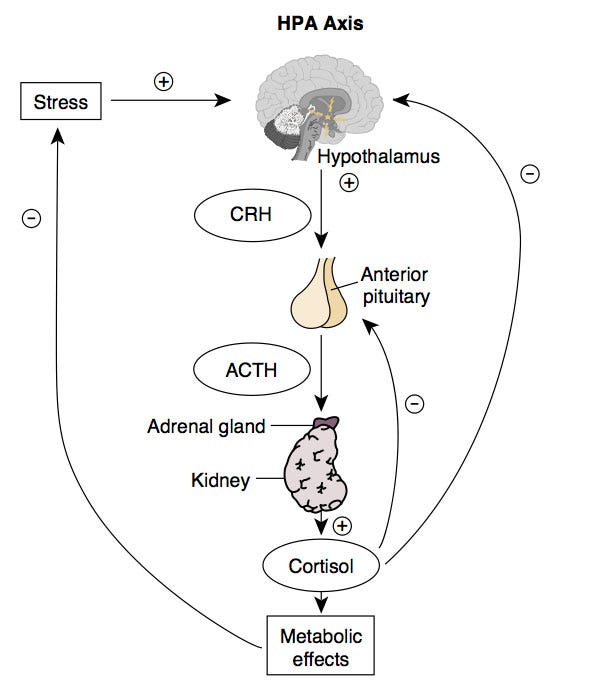
HPA axis

The Autonomic Nervous System and Emotional Regulation: A Two-Way Street
When we talk about mood and mental health, it is easy to picture the brain as the central hub, though your autonomic nervous system, the part of your nervous system that controls involuntary functions like heart rate, breathing, and digestion, is just as deeply involved in how you feel, move, and respond to the world around you.
The ANS plays a central role in motivation, stress responses, and emotion regulation, and it is often divided into two branches, the sympathetic nervous system, which runs your fight or flight mode, and the parasympathetic nervous system, which handles rest and digest. Here is where it gets interesting though, because these two systems do not actually operate as a simple see-saw, and they are not locked into constant opposition the way the textbook version sometimes suggests. At times they activate together, at times one eases back while the other becomes more active, and at times they shift independently, each responding to internal signals and external context in real time.
This model, called autonomic space, is what helps us understand why some people freeze in fear while others lash out, or why one person recovers quickly from a stressor while another stays stuck in it for days.
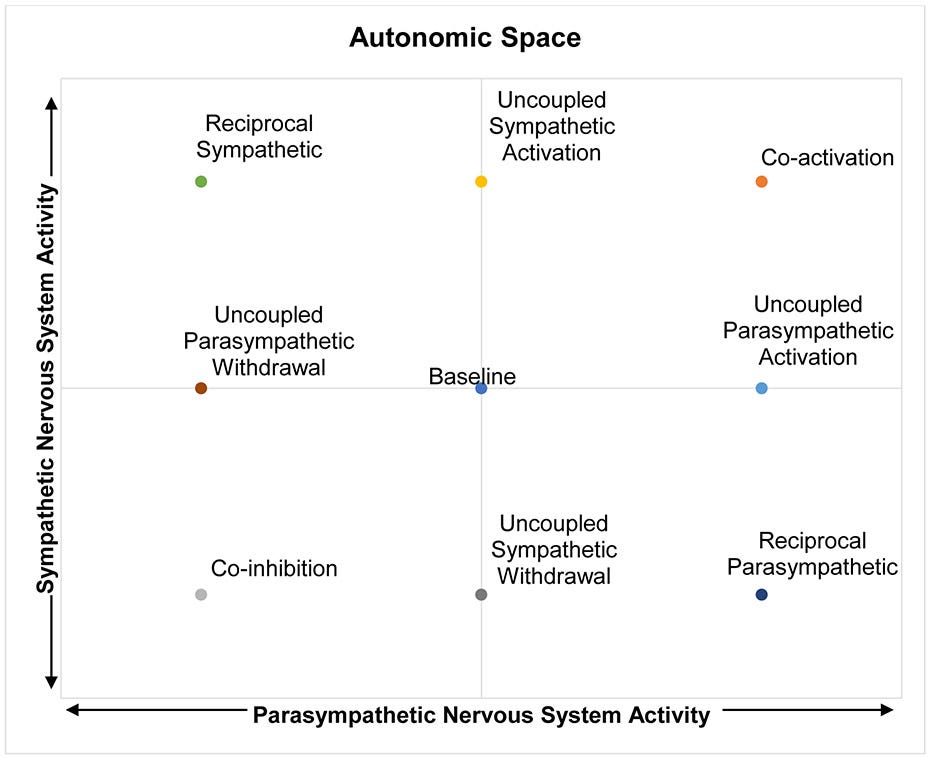
Autonomic Space
Heart rate is a good example here, because it can climb not just from sympathetic activation, the gas pedal, but also from parasympathetic withdrawal, which is more like lifting the brake. When both branches happen to be active or inactive at the same time, the effects can cancel each other out or create those unusual, sometimes paradoxical states of tension layered with fatigue that are so hard to describe when you are in them.
The vagus nerve, which is a major component of the parasympathetic system, plays an important role in mood regulation and social engagement. Higher vagal tone, often measured through respiratory sinus arrhythmia (RSA), is associated with greater emotional flexibility, more efficient recovery from stress, and a steadier sense of connection with the people around you.
Polyvagal theory, popularized by Dr. Stephen Porges, takes this a step further and suggests that vagal tone is not just a marker of physical health, it is tied to our capacity to feel safe, seen, and socially connected in the first place.
Genes, Trauma & Environment: The Roots of Vulnerability
Genetics can shape susceptibility to mood and anxiety disorders, though they do not determine outcomes on their own, which is an important distinction to hold onto. Rather than thinking in terms of inherited disorders, it tends to be more useful to think in terms of predispositions, which are genetic patterns that can increase sensitivity to certain stressors or influence how the brain processes neurotransmitters and regulates hormones.
Epigenetics, the study of how genes are turned on or off, shows us that environment, diet, stress exposure, trauma, and even our relationships can influence which genes are expressed over time. That is part of why two people with similar genetic backgrounds can respond very differently to the same life experiences, the underlying code might be comparable while the way it is being read is not.
Research in children has shown that different anxiety traits, things like social inhibition, separation anxiety, or panic-proneness, often reflect distinct combinations of genetic and environmental influences, and there is no single pattern that captures all of them. Individual context matters in a way that statistics tend to flatten.
When the nervous system gets caught in patterns of overactivity, or starts to shift toward under-functioning, it shows up in the body in very real ways. Anxiety, depression, brain fog, fatigue, and that particular kind of disconnection from yourself and the people around you, all of these tend to reflect how the system has been responding over time. They can be read as signals from a body that has been adapting to prolonged stress, doing the best it can with the conditions it has been given.
Looking at the interplay between the brain, the neurotransmitters, the hormones, and the lived experience layered on top of all of it is what lets these states come into clearer focus, and that clarity is part of what makes a more patient, more compassionate approach to care possible in the first place.

Through an Herbalist’s Eyes: Listening to the Nervous System
As a clinical herbalist, I am not just asking what the diagnosis is, I am asking what your nervous system is actually doing. Are you frozen or frazzled, wired or wilted? Does your heart race before you speak up in a meeting? Do you feel steadier after a walk, or more depleted by it? What actually helps you settle back into your body when you have been pulled out of it?
As we learn how the sympathetic and parasympathetic systems work together, and how differently people experience stress on the inside, it becomes pretty clear why herbal support is never one-size-fits-all. One person may benefit from a cooling nervine like linden. Another may need grounding adaptogens to give the system something to lean against. Someone else may need digestive or gut support to help the enteric system shift out of a defensive pattern that has been holding for a long time.
Understanding how autonomic activity shapes mood and emotion is also part of why herbs that get labeled as calming do not feel calming for everyone, because the response depends entirely on the underlying pattern, whether the system is running hot, running flat, or doing something more layered in between.
This is where herbal medicine actually shines. It works with the body instead of trying to override it, and it supports transition and responsiveness and regulation by paying close attention to the signals the body is already expressing, rather than imposing a result from the outside.

By Ivar Leidus - Own work, CC BY-SA 4.0
As you move through the rest of your week, I want to invite you to notice your nervous system. Step outside if you can. Let your bare feet touch the ground for a minute. Feel the wind on your skin. Notice how your breath changes when you hear birdsong somewhere in the distance, or how your shoulders soften in the presence of trees, often before you have consciously registered that they have.
Ask yourself what safety feels like in your body. What ease sounds like in your breath. You do not need to analyze any of it, just observe. Let nature co-regulate you for a few minutes. Let your nervous system remember something it already knows, that you are part of the living world, and you belong to it.
If this piece resonated with you, I would love to hear from you. Feel free to like, comment, or restack to share it with someone who might need this reminder too. Your engagement is what helps this space grow, and what keeps these conversations rooted in community.
Until next time,
— Agy | The Buffalo Herbalist
Bibliography
Weissman, D. G., & Mendes, W. B. (2021). Correlation of sympathetic and parasympathetic nervous system activity during rest and acute stress tasks. International Journal of Psychophysiology, 162, 60–68. https://doi.org/10.1016/j.ijpsycho.2021.01.015
Brigitta, B. (2002). Pathophysiology of depression and mechanisms of treatment. Dialogues in Clinical Neuroscience, 4(1), 7–20. https://doi.org/10.31887/dcns.2002.4.1/bbondy
Martin, E. I., Ressler, K. J., Binder, E., & Nemeroff, C. B. (2009). The Neurobiology of Anxiety Disorders: brain imaging, genetics, and Psychoneuroendocrinology. Psychiatric Clinics of North America, 32(3), 549–575. https://doi.org/10.1016/j.psc.2009.05.004
Institute for Quality and Efficiency in Health Care (IQWiG). (2023, May 4). In brief: How does the nervous system work? InformedHealth.org - NCBI Bookshelf. https://www.ncbi.nlm.nih.gov/books/NBK279390/
Thank you for explaining the connection between the sympathetic and parasympathetic nervous system. Very interesting, looking forward to learn more. Especially about how people respond differently, the connections to the nervous system, and how to recognize this.