


You don’t even need to wander through the supplement aisle to find St. John’s Wort. These days, it’s everywhere, circulating on social media in cute, trendy, copy-paste posts designed more for engagement than education. The kind that casually pairs a long list of ailments with a single herb that’s “good for it.” And without fail, St. John’s Wort always ends up next to depression.
Is it a strong ally for depression? Absolutely. I won’t be denying that here. In fact, we’ll explore that relationship in depth. But before we get there, I want to make something very clear:
I don’t think St. John’s Wort is a beginner herb.
Let me paint the picture. A beginner herbalist, in my view, is someone who has just begun to dig their hands into this work, who has opened their eyes to the magic and science of plant medicine and is falling in love with it. Maybe they’ve started making home remedies. They know plantain helps bug bites. Chamomile is a gentle friend after long days. Dandelion is a misunderstood backyard treasure.
But maybe they haven’t yet dug into the science behind these actions. Maybe the complex cascade of reactions that gives us those effects isn’t on their radar quite yet. Maybe pharmacognosy is a term they’ve heard once or twice, but haven’t studied. And maybe the concept of drug-herb interactions still feels like something reserved for pharmacists or professionals, not something that could show up in their kitchen apothecary.
And this, this, is the kind of herbalist who should not be using or recommending St. John’s Wort.
Especially not in the way it often shows up online.
Depression is something that far too many people are battling, often silently. When someone sees a list that casually pairs “St. John’s Wort = depression,” it might feel like a lifeline. It might be the thing they were desperately searching for. But a suggestion like that, when shared without context or care, is dangerous. When it's made without explaining how the body metabolizes this plant, or the way it interacts with medications and enzymes, it stops being herbal education. It becomes negligence.
Let me explain why that matters.
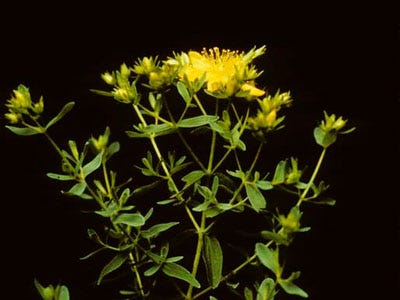
St. John's Wort
What St. John’s Wort Actually Does in the Body
Before we get into why I don’t think this herb is appropriate for beginners, let’s talk about what it actually does. Because it isn’t gentle. And it isn’t simple.
St. John’s Wort (Hypericum perforatum) is often flattened into a single idea: “the natural antidepressant herb.” But what this plant does in the body goes far beyond that. It’s working on your neurotransmitters, your liver, your enzymes, and your drug metabolism pathways. This isn’t just a sleepy tea to sip at bedtime, but a pharmacologically active plant that can change the way your body processes medicine.
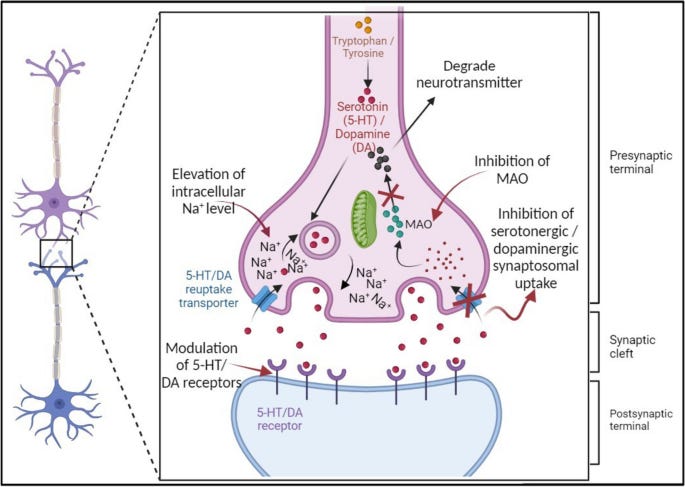
Its therapeutic power lies in its chemistry. St. John’s Wort contains compounds like hypericin, hyperforin, and a range of flavonoids. These constituents are believed to work primarily by inhibiting the reuptake of key neurotransmitters, including serotonin, dopamine, and norepinephrine.
This means those mood-regulating messengers stay in circulation longer, which may contribute to feelings of improved mood and emotional balance. It functions in a way that is similar to some antidepressant medications. But the action is not mild.
St. John's Wort Pharmacognosy
There is more to the story.
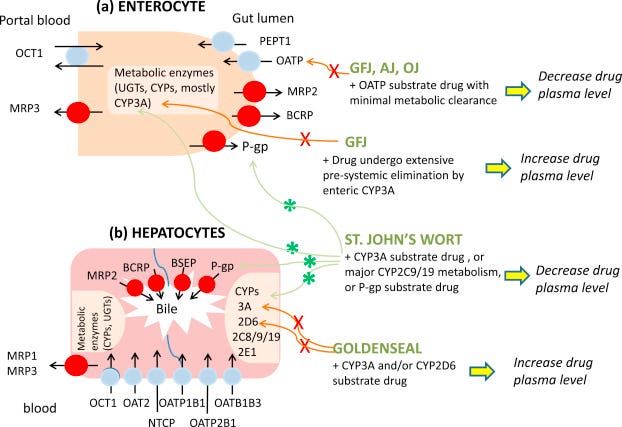
St. John’s Wort also activates something called the pregnane X receptor, or PXR. When this receptor is triggered, it signals the liver to increase production of certain enzymes in the cytochrome P450 system, especially CYP3A4, along with a drug-transport protein called P-glycoprotein (more on this later). These are involved in how the body processes and clears many pharmaceutical drugs.
This means that St. John’s Wort can speed up the metabolism of certain medications, sometimes to the point where they no longer work as intended. This has been well documented.
It has been shown to reduce the effectiveness of oral contraceptives, HIV medications, immunosuppressants, benzodiazepines, and antidepressants. In some cases, this kind of interaction has caused serious complications.
That only covers the metabolic side.
Research also suggests that St. John’s Wort may inhibit monoamine oxidase (MAO), which can raise norepinephrine levels in the brain. It may also influence GABA receptors, affecting how the nervous system responds to calming or inhibitory signals. These additional effects may add to its therapeutic potential, but they also increase the likelihood of unintended outcomes, especially when used alongside other medications or supplements that act on the nervous system.
Another factor to consider is the wide variability in herbal preparations. Hyperforin, one of the key active compounds, is often concentrated in commercial products, but may be inconsistent or unpredictable in homemade formulas. Some reviews have even shown that higher hyperforin content doesn’t always lead to better results. In other words, the relationship between preparation and effect isn’t straightforward.
Clinically, we know that St. John’s Wort interacts with major metabolic and neurological pathways, and that the way it behaves depends heavily on how it’s prepared and who is using it. It is not regulated in the same way as prescription drugs, even though it acts on many of the same systems. And yet, it continues to be casually recommended online for one of the most complex conditions a person can experience.
Drug-Herb Interaction
That’s where the concern comes in.
The rest of this article is for paid subscribers.
We’ve taken a close look at what St. John’s Wort does inside the body—but that’s just the beginning.
In the second half of this piece, I dive into:
The real risks of herb-drug interactions, drawn from clinical cases and pharmacology reports
Why casual recommendations in wellness spaces can be misleading, especially on social media
How regulation and standardization vary between countries and what that means for safety
A deeper reflection on why working with herbs—especially powerful ones—requires care, context, and training
If this kind of thoughtful herbal education resonates with you, consider becoming a paid subscriber. Your support helps sustain this work and gives you full access to my Library of materia medica, safety guides, herbal deep-dives, and educational tools designed for learners and practitioners alike.