



The Endocannabinoid System Series
Part Three: The Molecular Conversation
The reason plants can affect your nervous system is not because they are powerful.
It is because your body was already prepared to receive them.
Your body knows how to speak to plants.
This communication exists at a level deeper than cultural tradition, empirical observation, or even the slow accumulation of herbal knowledge across generations. Those things matter deeply, and they remain woven through everything that follows. But there is something else happening as well. Something quieter. Something older. Something written into the architecture of your cells long before anyone thought to give it a name.
Your body contains receptor sites designed to recognize specific molecular shapes. You can think of them as pre-designed locks, built into your cells long before you ever encountered a plant medicine. These receptors are active every day, responding to compounds your own tissues create, guiding processes like stress recovery, sleep regulation, and inflammatory balance with a chemical fluency you never have to consciously manage.
And then, sometimes, a plant compound fits those same locks.
The structure is close enough. Familiar enough. The molecule can participate in a conversation your body is already having with itself.
This is molecular recognition.
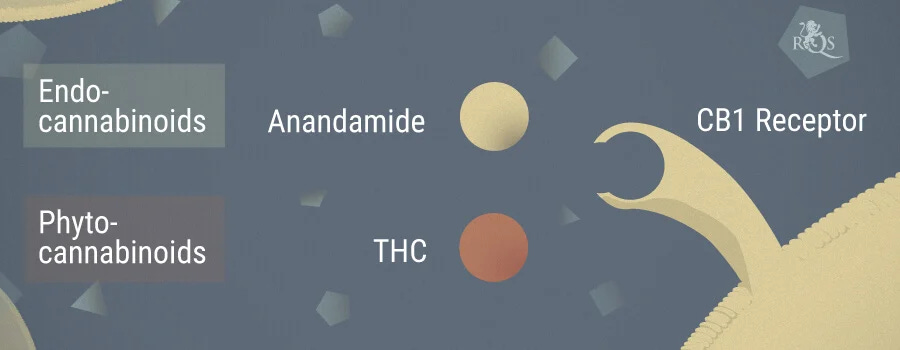
Endo/Phytocannabinoid Receptors
The endocannabinoid system evolved to maintain balance through the body’s own signaling molecules. Plants did not create this language for us. Rather, human biology evolved in constant dialogue with the chemistry of the natural world. Because of that shared history, plant compounds are able to participate in one of the most elegant regulatory networks we know.
In the first two parts of this series, we explored what the endocannabinoid system is and how it supports everyday resilience. We followed its role in stress recovery, sleep architecture, and immune balance. We saw it function as a collaborator rather than a commander. A system that tunes rather than dictates, practicing regulation through timing, proportion, and adaptation.
Now, we turn our attention to the molecules themselves.
The endocannabinoids your body synthesizes each day. The phytocannabinoids plants produce through their own biochemical pathways. And the meaningful overlap between them that makes botanical medicine both possible and precise.
This is where chemistry becomes conversation.
What follows is detailed, because these molecules deserve care and clarity. It is also practical, because understanding how the body’s own messengers work reshapes how we approach plant medicine. Plants do not impose balance on the body. They participate in regulatory systems that are already active, already responsive, and already skilled at self-adjustment.
In this part of the series, we begin with the body itself. With the molecules it makes every day to regulate stress, memory, inflammation, and repair. From there, we look briefly at CBGA, the plant compound that sits at the beginning of cannabinoid synthesis, before pausing the phytocannabinoid discussion for later work.
We begin where regulation begins, with the signals the body produces in service of balance as a lived, ongoing process.

What Are Endocannabinoids?
Before we look at individual molecules, it helps to pause and name what an endocannabinoid actually is.
Endocannabinoids are signaling molecules made by the body itself. They are lipid-based compounds derived from the cell membrane, synthesized only when needed, and broken down once their message has been delivered. They are not stored for later use, and they are not released on a fixed schedule. Their appearance is responsive, contextual, and temporary by design.
This matters because endocannabinoids do not behave like classic neurotransmitters. There are no dedicated “cannabinoid neurons” and no permanent cannabinoid pathways. Instead, nearly every cell contains the raw materials needed to produce endocannabinoids when circumstances call for them. The signal emerges locally, acts briefly, and then resolves.
In this way, endocannabinoids function less like commands and more like corrections. They help adjust tone rather than impose direction, nudging systems back toward balance in response to stress, inflammation, injury, or heightened neural activity.
Endocannabinoids also differ fundamentally from phytocannabinoids, the cannabinoid compounds produced by plants. While plant-derived molecules can interact with the same receptors, they are not part of the body’s baseline signaling system. The body does not rely on them for daily regulation. Instead, they enter a system that is already active, already communicating, and already skilled at self-adjustment.
This distinction matters. Endocannabinoids represent the body’s own language of regulation. Phytocannabinoids participate in that language because their chemical structures are close enough to be recognized, not because they replace or override endogenous signaling.
Understanding this difference allows us to approach both with clarity. We can appreciate the elegance of the body’s own messengers while also recognizing why plant compounds can feel supportive, disruptive, or neutral depending on context.
With that foundation in place, we can now turn to the two primary endocannabinoids the body uses most often and explore how each shapes regulation in its own way
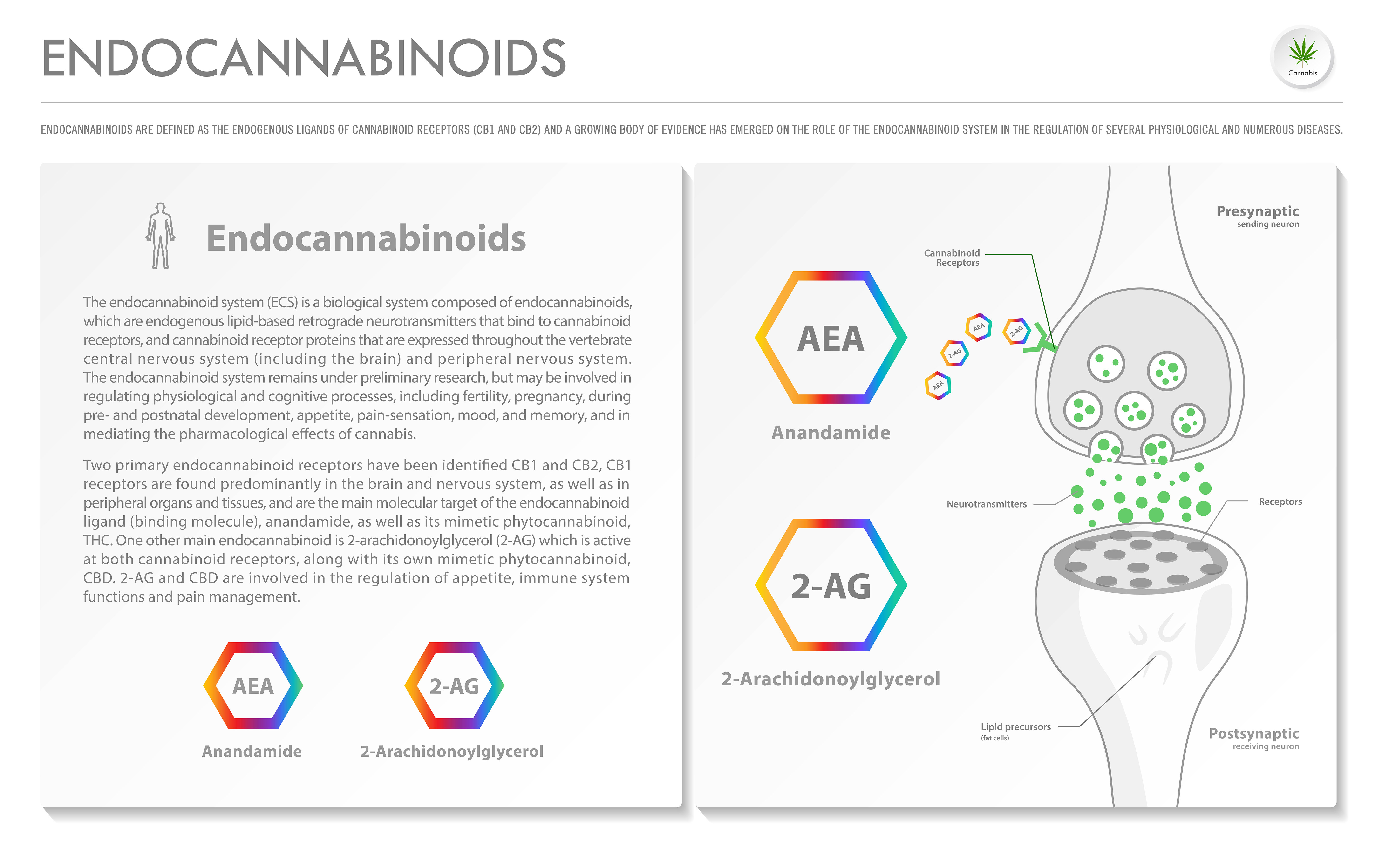
Source Unknown
The Body’s Two Messengers: Anandamide and 2-Arachidonoylglycerol
When we talk about the endocannabinoid system in practical terms, two molecules carry most of the signal.
The body produces many lipid messengers, but anandamide and 2-arachidonoylglycerol, often shortened to 2-AG, are the primary endocannabinoids responsible for cannabinoid signaling in humans. Both are made from components of the cell membrane, released only when conditions call for them, and broken down once their work is done.
Both anandamide and 2-AG interact with the same cannabinoid receptors that respond to plant-derived compounds like THC. This shared receptor activity is what allows phytocannabinoids to influence the system at all.
But once released, these two molecules behave very differently.
Anandamide tends to operate at lower concentrations, shaping background tone rather than commanding response. It plays a central role in emotional regulation, stress buffering, and sensory modulation through subtle adjustments in signaling. Its effects are brief and measured, designed to soften intensity rather than override it.
2-AG, by contrast, is present in far greater abundance and is released when physiological demand is high. It is deeply involved in rapid neural feedback, immune signaling, and metabolic coordination. Where anandamide fine-tunes, 2-AG responds decisively, stepping in when systems are active, stressed, or under load.
These two messengers give the endocannabinoid system its range. One maintains continuity. The other enables response. Together, they allow regulation to remain flexible, responsive, and proportional to what the moment requires.
To understand how the endocannabinoid system supports balance in real life, we have to understand how these two signals move through the body.
Let’s start with anandamide, the first endocannabinoid identified and the molecule most closely tied to emotional tone, stress recovery, and quiet recalibration.
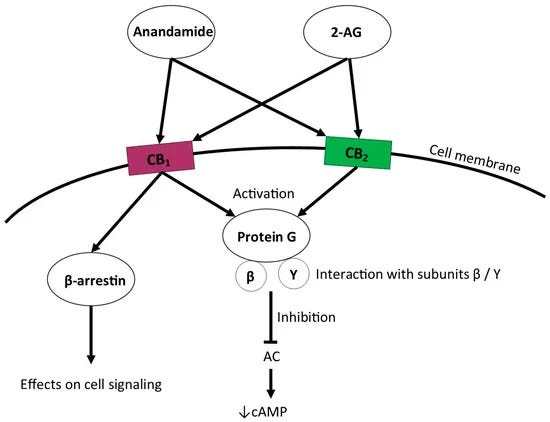
Signaling pathways induced by endocannabinoid receptors activation.
Anandamide: The Subtle Messenger
In 1992, researchers identified the first molecule produced by the human body capable of activating cannabinoid receptors. Isolated from brain tissue, it was named anandamide, from the Sanskrit ananda, meaning joy or inner bliss.
The name reflects how the molecule behaves. Anandamide supports emotional regulation, stress relief, and reward without overwhelming the system. It does not flood the brain or linger in circulation. Its presence is brief, measured in minutes rather than hours. It appears when needed, acts locally, and resolves quickly. This impermanence is not a flaw. It is the point.
Anandamide is a lipid-based signaling molecule produced directly from the cell membrane. Neural activity, stress, or tissue strain prompt its release.
Once formed, it acts close to where it is produced, subtly adjusting nearby signaling rather than broadcasting effects throughout the body. This localized action allows for precision rather than dominance.
Emotional Tone, Stress, and Recovery
Much of anandamide’s influence is felt through emotional tone and stress recovery. People with naturally higher baseline levels of anandamide tend to show lower trait anxiety and steadier emotional regulation. When anandamide signaling is reduced, stress responses are often more intense and slower to resolve.
Rather than removing stress, anandamide influences how deeply stress embeds itself in the nervous system. It softens excessive reactivity and supports the return to baseline after challenge. At the receptor level, it acts gently, engaging cannabinoid receptors without driving them to their maximum response. This allows the nervous system to adjust without shutting down essential functions like threat detection or protective pain.
Beyond stress, anandamide participates in learning and adaptation. In the brain, it helps regulate how strongly neurons communicate, supporting flexibility over rigidity. This includes involvement in fear extinction, the process by which emotionally charged memories lose their grip over time.
Pain modulation is another key area of influence. Anandamide does not eliminate pain, but it raises the threshold at which pain becomes overwhelming, allowing discomfort to exist without escalating into suffering.
One of the clearest examples of anandamide in everyday life appears during sustained aerobic exercise. The calm, ease, or mild euphoria sometimes referred to as the runner’s high is now understood to depend largely on endocannabinoid signaling. Anandamide levels rise during movement, reinforcing behaviors that support long-term health by making them feel rewarding.
Anandamide does not manufacture happiness. It supports the conditions under which emotional flexibility, recovery, and ease become possible. It is a quiet messenger, shaping balance moment by moment rather than imposing it outright.
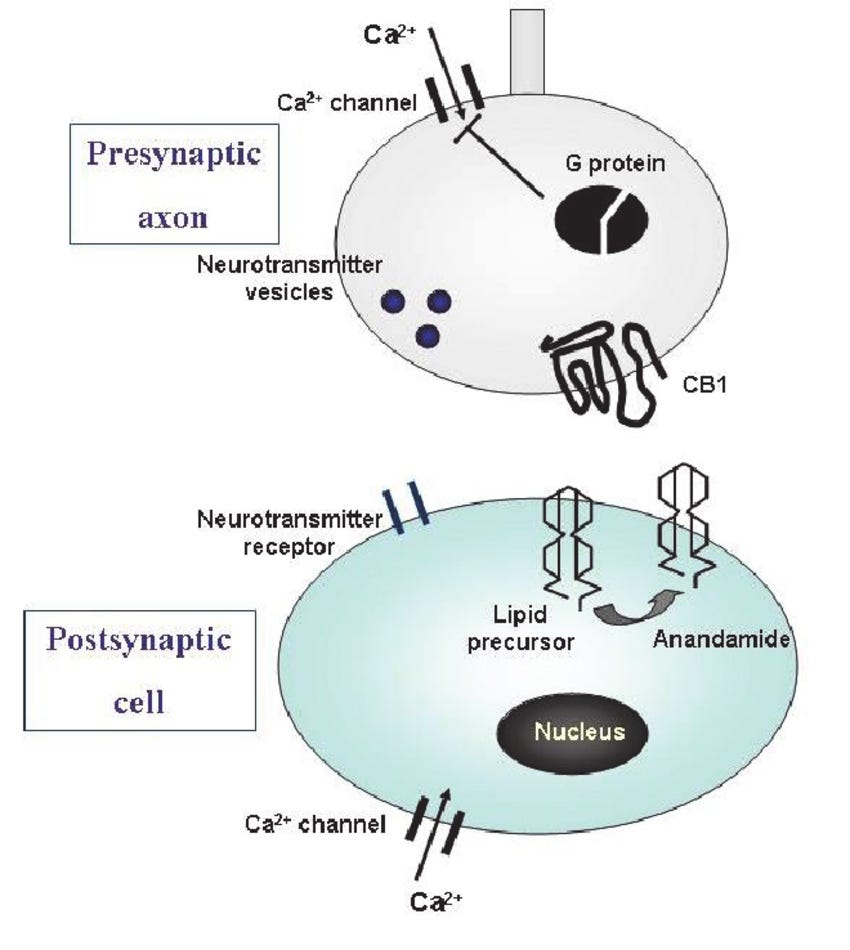
The mechanism of action of anandamide
2-Arachidonoylglycerol: The Abundant Workhorse
If anandamide is the body’s subtle messenger, 2-arachidonoylglycerol, often shortened to 2-AG, is its workhorse.
It is far more abundant than anandamide, present at much higher levels in the brain and throughout the body. That difference in concentration reflects a difference in role. Where anandamide fine-tunes and softens, 2-AG steps in when regulation needs to be decisive. It is the primary endocannabinoid the body relies on during moments of heightened activity, stress, or demand.
2-AG is produced from the cell membrane, like anandamide, and synthesized only when needed. What sets it apart is what triggers its release. 2-AG rises quickly in response to cellular activity, especially when neurons are firing rapidly or when physiological systems are under strain. Its production is fast, and its effects are immediate.
Rather than maintaining background tone, 2-AG responds to intensity.
Once released, 2-AG acts strongly but briefly. Its levels spike in response to a stimulus and then fall as that stimulus resolves. This timing allows the body to apply firm regulation without remaining locked in a heightened state.
Response, Regulation, and Adaptation
In the brain, 2-AG plays a central role in feedback. When neurons become highly active, 2-AG helps signal backward to regulate incoming input, preventing overstimulation and allowing circuits to recalibrate in real time. This process supports learning, emotional flexibility, and adaptation. It allows the nervous system to respond fully, then settle again.
Beyond the brain, 2-AG is deeply involved in immune regulation. During inflammation, levels rise in affected tissues, where 2-AG helps temper immune activity and support resolution. This allows the body to respond to injury or infection without tipping into prolonged or excessive inflammation.
2-AG also participates in metabolic signaling. In tissues involved in energy storage and glucose balance, higher circulating levels are associated with insulin resistance and increased fat accumulation, particularly in men. These patterns highlight how endocannabinoid signaling links energy availability with storage, stress physiology, and long-term metabolic health.
Sex-specific differences add nuance here. In men, elevated 2-AG tends to correlate with visceral fat and metabolic risk. In women, anandamide appears more closely tied to fat distribution and metabolic signaling. These differences suggest that endocannabinoids interact with sex hormones and contribute to distinct physiological patterns.
Movement offers another window into how 2-AG works. Levels often rise following higher-intensity exercise, contributing to pain reduction and shifts in mood. With long-term endurance training, baseline levels may decrease, reflecting adaptation of the endocannabinoid system to repeated demand rather than dysfunction.
2-AG does not whisper. It responds when systems are active, stressed, or inflamed. Where anandamide shapes background tone, 2-AG governs response strength.
It is this contrast that gives the endocannabinoid system its range:
the ability to respond fully, then return to balance.
Why Two? A Complementary System
The presence of two primary endocannabinoids raises a simple question: why does the body need both?
Anandamide and 2-AG are not redundant. They serve different roles within the same regulatory system, giving the body flexibility in how it responds to changing conditions.
Anandamide supports baseline balance. It helps shape emotional tone, stress buffering, and sensory processing on an ongoing basis. Its lower concentration and gentler signaling make it well suited for subtle adjustments rather than dramatic shifts. It modulates without overwhelming.
2-AG, by contrast, is built for response. It rises quickly during periods of heightened demand and falls once the need has passed. Its greater abundance and stronger signaling allow it to drive rapid feedback, support learning and adaptation, and coordinate immune and metabolic responses in real time. Where anandamide maintains tone, 2-AG governs intensity.
Keeping these signals distinct gives the system precision. Some moments call for quiet stabilization. Others require decisive action. Because anandamide and 2-AG are produced and cleared through different pathways, the body can adjust one without automatically engaging the other. This allows regulation to remain responsive rather than blunt.
Over time, these patterns help shape how stress, emotion, and threat are experienced. The endocannabinoid system does not only respond to the present moment. It participates in building the nervous system’s expectations, influencing whether it settles easily or stays on edge.
Through anandamide and 2-AG, regulation becomes both steady and responsive, able to meet experience without losing its center.
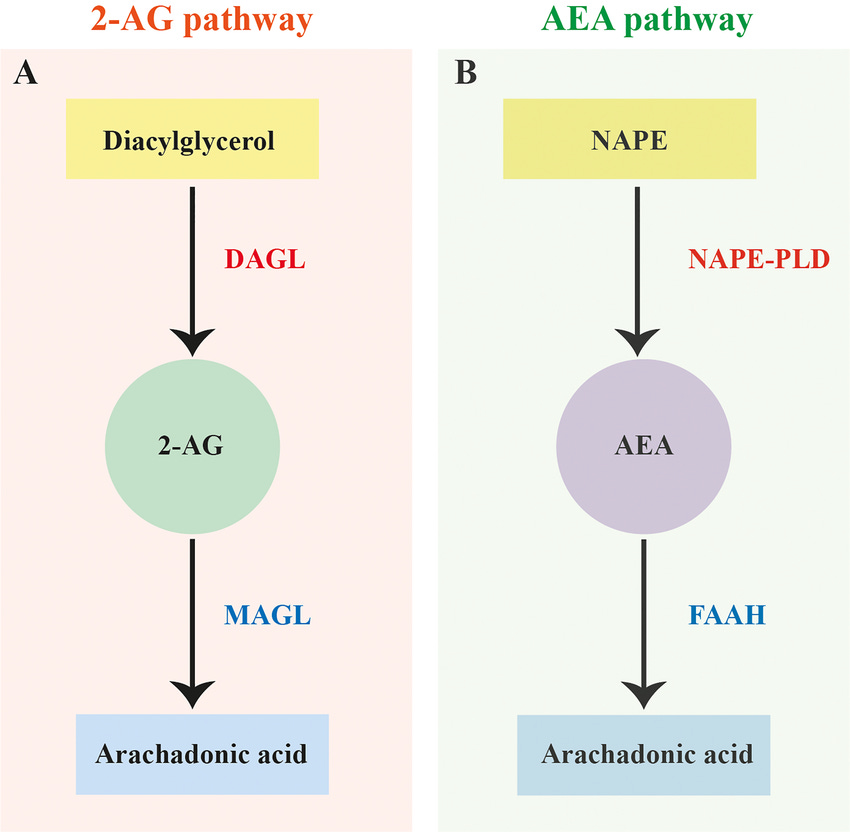
Canonical 2-arachidonoylglycerol and anandamide biosynthesis and degradation pathways.
And they are not working alone.
The body also produces other lipid messengers that support this system more quietly, refining inflammatory tone and metabolic signaling without acting directly at cannabinoid receptors. We turn next to these quieter collaborators: palmitoylethanolamide and oleoylethanolamide.
The rest of this article is for paid subscribers.
In the sections that follow, we move beyond the primary endocannabinoids and into the quieter architecture that supports this system as a whole. We’ll explore palmitoylethanolamide (PEA) and oleoylethanolamide (OEA), two lipid messengers that do not activate cannabinoid receptors directly, but play an important role in shaping inflammatory tone, metabolic signaling, and nervous system regulation.
From there, we’ll look at CBGA, the biochemical starting point for plant cannabinoids, and how its activity fits alongside the body’s own regulatory pathways without mirroring them exactly.
If you’re interested in understanding not just what the endocannabinoid system does, but how regulation is refined, supported, and resolved, this is where the picture deepens.