



You fall asleep fine.
And then, somewhere around 3am, you’re awake. Just... chillin. Not anxious, not in pain. Just inexplicably, maddeningly awake. Staring at the ceiling. Negotiating with your own eyeballs, who are promising — swearing, actually — that they only need five more minutes. Just five. They’ll be so good.
If this is you, you are not alone. Middle-of-the-night waking is one of the most common sleep complaints I hear, and one of the most casually dismissed. You fell asleep, didn’t you? You’re not tossing and turning. You’re not having nightmares. You’re just... awake. Doctors will sometimes shrug at this. Take some melatonin. Try a sleep mask. Have you considered magnesium?
I recently described this exact experience to my own primary care doctor. I fall asleep fine, I told him. But then I’m just awake. Chillin. He nodded. He had heard this before.
What nobody told me then, and what most people never hear, is that this particular flavor of broken sleep is doing something very specific to the brain. Not in a vague, you-need-your-rest kind of way.
In a this-is-a-named-physiological-process-that-is-being-interrupted kind of way.
Here is what is actually happening.
Your brain has a maintenance crew. A literal, physical cleaning system that moves through your brain tissue while you sleep, flushing out the metabolic debris of a full day of thinking. We are talking about waste products. Toxic proteins. The same proteins that accumulate in the brains of people with Alzheimer’s disease. Your brain produces them every single day just by functioning, and every single night, while you sleep, a remarkable system runs through and clears them out.
This system was discovered in 2013. It is called the glymphatic system. And before you ask, no, it was not in your doctor’s textbooks. It was not in mine either, and I went to medical school. It is barely in the newest ones. It is that recent.
The glymphatic system is particular about its working conditions. It does not run while you are awake. It does not do half shifts. It requires you to be in a specific, deep stage of sleep to operate at full capacity.
The research is unambiguous on this point.
When you are sleeping well, really sleeping, this system is doing some of the most important maintenance work in your entire body. When you are not, it isn’t.
Which means that when you are lying there at 3am, wide awake, just chillin, your brain’s cleaning crew is sitting in the break room. Waiting. And the debris they were supposed to clear tonight is just sitting there too.
That is what we are going to talk about today.

The Brain’s Night Shift
So, let’s talk about what is actually happening inside your brain while you sleep.
Your brain is the most metabolically active organ in your body. It never really clocks out. Even when you are doing nothing, your neurons are firing, communicating, processing. All of that activity generates waste. Metabolic byproducts, used proteins, cellular debris. The same way a busy kitchen produces dishes, your brain produces garbage just by doing its job.
Every other organ in your body has a way to deal with this.
Your lymphatic system, a network of vessels running alongside your circulation, collects waste from your tissues and carries it away for processing. Fluid from your blood seeps into tissues, gathers cellular debris, and is pulled into lymphatic capillaries before eventually draining back into the bloodstream. Your liver handles the final breakdown. It is a continuous sanitation system running quietly in the background.
Your brain does not have one of those.
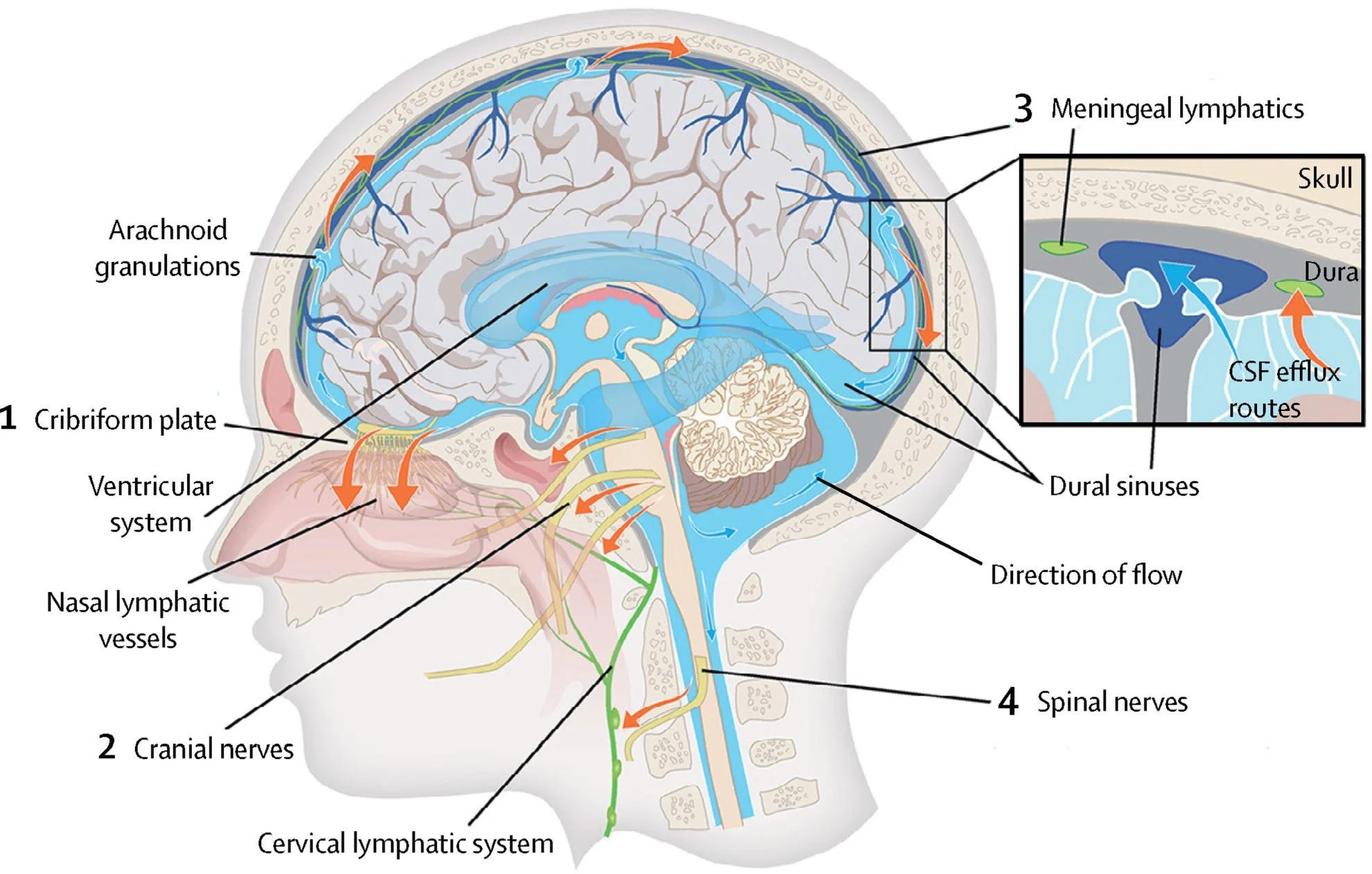
For a long time, this genuinely puzzled researchers. The brain is the most sensitive, most protected organ you have. It sits behind the blood-brain barrier, a selective filter that controls what enters and what leaves. That same barrier, which protects neural tissue so effectively, also restricts the kind of fluid exchange that supports clearance elsewhere in the body. Traditional lymphatic vessels are absent here.
So how was the most metabolically demanding organ in the body taking out its trash?

The Cleaning Crew, Officially Named: Meet the Glymphatic System
In 2013, a neuroscientist named Maiken Nedergaard and her team at the University of Rochester figured it out. What they found was so unexpected that it genuinely took the scientific community time to catch up.
The brain had been running its own private waste clearance system the entire time. It just operated at a fraction of its capacity while you were awake.
Here is how it works.
Your brain is bathed in cerebrospinal fluid, which we will call CSF from here on out because life is short. This fluid is not just sitting there passively cushioning your brain. It moves. It circulates. The pathway it takes through the brain tissue is where things get interesting.
Running alongside every blood vessel in the brain is a narrow channel known as a perivascular space. You can picture it as a sleeve, with the vessel at the center and a thin fluid-filled corridor surrounding it. These channels follow structured, directional routes shaped to move fluid efficiently. Cerebrospinal fluid enters the brain along the arterial pathways, flowing inward through these spaces.
As it moves through the tissue, it mixes with interstitial fluid, the fluid between neurons that has been collecting metabolic byproducts throughout the day. That mixture, now carrying its cargo of waste, travels outward again along the venous routes.
In. Collect. Out.
The system was named the glymphatic system, a combination of glial cells and lymphatic, because it does for the brain what the lymphatic system does for the rest of the body.
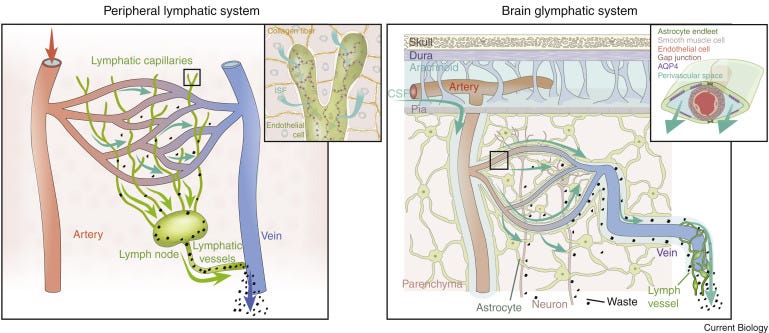
Comparison of peripheral lymphatic and brain glymphatic interstitial fluid movement.
Now, the glial cells in question are called astrocytes. You have probably never heard of them. Most people have not. Neurons get all the attention, but astrocytes are everywhere in the brain and they do an enormous amount of work, and they look like little stars.
One of their jobs is to wrap their cellular extensions, called endfeet, around the walls of blood vessels, essentially lining those perivascular sleeves. Embedded in those endfeet are specialized water channels called aquaporin-4, or AQP4. These channels are what allow CSF to move efficiently from the perivascular spaces into the brain tissue and back out again.
When AQP4 channels are working properly and sitting in exactly the right position on those astrocyte endfeet, glymphatic flow moves the way it should. When those channels get displaced, when the astrocytes become reactive and inflamed, when the precise architecture of the system gets disrupted for any reason, the whole thing slows down. The fluid exchange becomes sluggish. The waste does not clear.
What is the system actually clearing?
Most critically, amyloid-beta and tau. These are the proteins that accumulate in the brains of people with Alzheimer’s disease. They are not foreign invaders. Your brain produces them naturally, every single day, as a byproduct of normal neuronal function. The glymphatic system exists precisely to clear them out. When sleep is disrupted, when the system is impaired, when the machinery breaks down, they accumulate. Over years and decades, that accumulation becomes a disease.
The research on this is unambiguous. This is some of the most important neuroscience published in the last fifteen years.
I did not learn about this in medical school. It had not been discovered yet. It is still barely in the newest textbooks.
The system that may determine whether your brain ages well or does not has only been known to science for twelve years.

Why Sleep Is Not Optional
Let’s go back to 3am.
You are awake. Just chillin. Not in any distress, not watching the clock with particular anxiety. Just inexplicably, frustratingly conscious when you should not be. Now that you understand what the glymphatic system is and what it does, we need to talk about what is actually happening in your brain during those hours.
The glymphatic system does not run on a continuous loop the way your heart does. It is not always on. It is, to a significant degree, a sleep-dependent system.
The original 2013 research from Nedergaard’s lab showed that when mice were asleep, fluid movement through the perivascular spaces increased dramatically compared to when they were awake. The interstitial space, the fluid-filled gaps between brain cells, expanded during sleep.
CSF moved in.
Waste moved out.
The whole operation scaled up in a way that simply did not happen during wakefulness.
That finding has since been extended to humans.
A 2019 study published in Science used MRI imaging to show that during sleep, the brain generates slow electrical waves that drive coordinated changes in blood volume and CSF flow. The brain essentially pulses, and those pulses push CSF through the perivascular spaces. It is a beautifully timed mechanical process. It requires the brain to be in a specific, quiet neurological state to work.
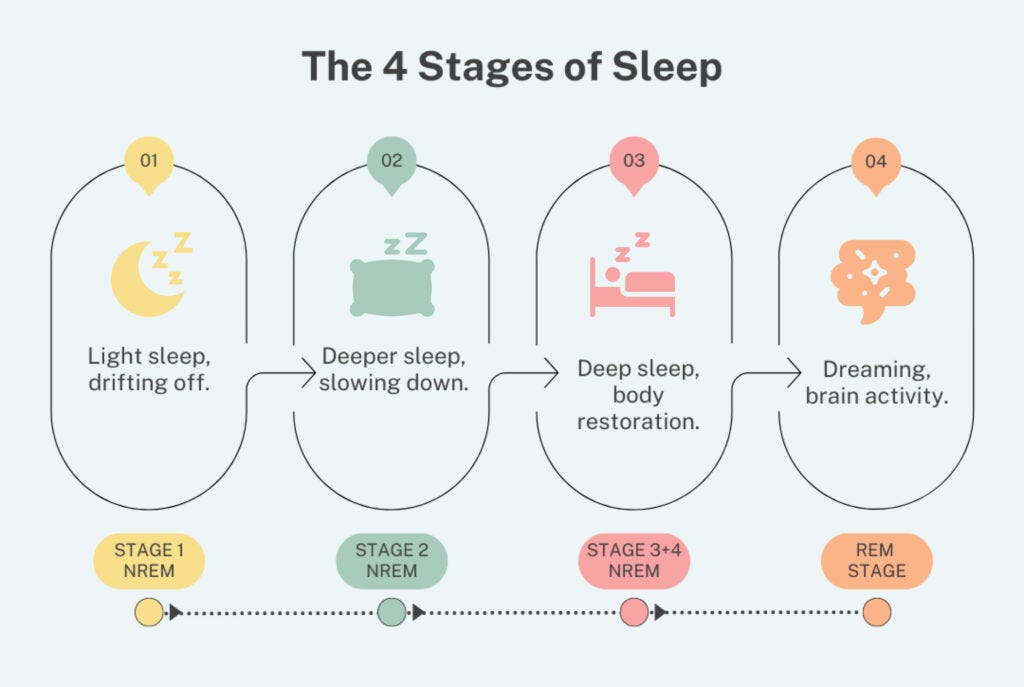
That state is NREM sleep. Specifically, slow-wave sleep, the deepest stage.
Sleep is not one thing. It cycles through stages across the night, moving between lighter NREM stages, deep slow-wave NREM sleep, and REM sleep. Glymphatic activity correlates most strongly with slow-wave NREM, the stage characterized by large, synchronized electrical waves rolling across the cortex at a slow, steady rhythm. During REM sleep, brain activity looks almost awake. During wakefulness, a neurotransmitter called norepinephrine, which promotes alertness, actively suppresses glymphatic flow. The brain cannot efficiently clean itself while it is busy processing the world.
This is why middle-of-the-night waking matters more than most people realize.
Total sleep time matters, and yet sleep architecture matters more. Every time you wake up at 3am and lie there chillin for an hour, you are interrupting the cycling of sleep stages. The architecture of the night gets disrupted. The slow-wave stages that drive glymphatic clearance get compressed or skipped entirely. The maintenance crew punches out early.
A 2018 study from the National Institutes of Health made this concrete in a way that is genuinely difficult to ignore. Researchers used PET imaging to measure amyloid-beta burden in the brains of twenty healthy adults, once after a normal night of sleep and once after a night of sleep deprivation.
One night without sleep produced a measurable increase in amyloid-beta accumulation in the hippocampus and thalamus, two regions that are among the first to show damage in Alzheimer’s disease. One night.
It is worth pausing on that. These were healthy people. Not elderly, not genetically predisposed, not already showing signs of cognitive decline. They lost one night of sleep and their brains showed detectable amyloid accumulation in regions we associate with memory and early neurodegeneration.
The study was small, and the researchers were appropriately cautious about drawing sweeping conclusions. We do not know how quickly those levels normalize with recovery sleep. A single study cannot establish that disrupted sleep causes Alzheimer’s disease. The relationship between sleep quality and amyloid clearance is real though, measurable, and present in the human brain after a single bad night.
That is the stakes.
This is also why the conversation about sleep has to change. We have been framing poor sleep as a lifestyle inconvenience. Something that makes you tired, slows you down, puts you in a bad mood. All of that is true, and it barely scratches the surface. Sleep is when your brain runs its maintenance cycle. It is when the glymphatic system does the work that determines, over years and decades, whether neurotoxic proteins accumulate or get cleared. Every night of fragmented, shallow, or insufficient sleep is a night the maintenance crew worked at reduced capacity.
That is a reason to pay attention.
What Gets in the Way
The glymphatic system is not fragile exactly, but it is particular. It needs specific conditions to do its job. When those conditions are not met, clearance slows. When clearance slows consistently, over months and years, the consequences compound. So, let’s talk about what actually gets in the way.
Sleep fragmentation
We covered this in the last section, but it bears repeating here in a different context. The glymphatic system does not just need sleep. It needs uninterrupted, architecturally intact sleep. The slow-wave NREM stages that drive the majority of glymphatic clearance tend to dominate the earlier part of the night. When sleep is fragmented, when you are waking up at 3am and lying there for an hour, or cycling into lighter stages repeatedly across the night, those early slow-wave periods get compressed or lost entirely. The maintenance crew does not get to finish the job.
Alcohol
This one deserves its own conversation because the cultural story around alcohol and sleep is genuinely backwards.
Alcohol does help people fall asleep faster. It is a central nervous system depressant, so sleep onset often comes more quickly.
What happens after that is the problem.
Research consistently shows that alcohol suppresses REM sleep early in the night and fragments sleep later, increasing wakefulness and lighter sleep stages as it is metabolized. The sedation is real. The restorative sleep is not.
From a glymphatic perspective, this matters enormously. Deep slow-wave NREM sleep depends on a specific, naturally coordinated neurological state. Alcohol-induced sedation may resemble sleep on the surface, but it does not reproduce the same brain wave patterns. A 2025 study from Nedergaard’s lab showed that the norepinephrine oscillations that drive glymphatic flow during NREM sleep follow a tightly timed rhythm. When that rhythm is disrupted, through alcohol or other agents that alter sleep architecture, clearance efficiency declines downstream.
The nightcap, in other words, is working against you.

Neuroinflammation and AQP4 disruption
Remember the AQP4 water channels we talked about earlier, the ones embedded in astrocyte endfeet that allow CSF to move efficiently through the perivascular spaces?
Their precise localization matters enormously.
When astrocytes become reactive, which happens in response to chronic neuroinflammation, injury, or disease, AQP4 channels can become mislocalized. They shift away from the perivascular endfeet where they do their job and redistribute to other parts of the cell where they do not. Glymphatic flow slows as a result.
This is one of the reasons chronic systemic inflammation is increasingly understood as a risk factor for neurodegeneration. The inflammatory cascade extends into the brain, gradually reshaping the astrocytic architecture that glymphatic flow relies on. As that structure shifts, the system’s ability to clear its protein load declines over time.
Aging
Glymphatic function declines with age, and the research on why is sobering. As the brain ages, AQP4 channels gradually lose their polarized distribution at the vascular endfeet. Blood vessels become stiffer and more tortuous, which slows CSF flow through the perivascular spaces.
Slow-wave sleep itself diminishes with age, peaking during puberty and declining steadily from there. Less slow-wave sleep means less glymphatic activity. Less glymphatic activity means more accumulation of amyloid-beta and tau. The system that is supposed to protect the aging brain is the same system that aging degrades.
Whether declining glymphatic function triggers neurodegeneration or accelerates an existing process is still an open question in the research. The relationship is real either way.
A Note on Sleep Position
This one surprises people and it is worth including because it is both well-researched and genuinely actionable.
A 2015 study from Stony Brook University used dynamic contrast MRI to compare glymphatic transport in rodents sleeping in three positions: lateral, supine, and prone.
Glymphatic transport was most efficient in the lateral position.
The researchers proposed that sleeping on your side, the most common sleep position across humans and most animals, may have evolved precisely because it optimizes waste clearance from the brain. The study was conducted in rodents, and the researchers were appropriately cautious about generalizing directly to humans. The directional finding is compelling enough to mention.
If you are already a side sleeper, you may be doing your brain a quiet favor every night without knowing it.

Now that you understand how the glymphatic system works, what it clears, and what gets in its way, the next question is the one I find most exciting.
Where do plants fit into this?
The rest of this article maps the herbal research onto the glymphatic physiology we just covered, intervention point by intervention point. We look at the herbs with the strongest evidence for supporting slow-wave sleep architecture, the herbs that address the neuroinflammatory disruption of AQP4 channels, and the herbs that support the cervical lymphatic drainage the glymphatic system ultimately empties into. We also look at why one herb in particular keeps showing up across multiple mechanisms simultaneously, which is not something you see very often in the research.
Before we get there, I want to mention the supplement I personally use for sleep support and recommend most often in my practice. It covers several of the mechanisms we are about to discuss, and I have linked it here for anyone who wants to look ahead. Everything that follows will explain why.
If you are not yet a paid subscriber, I would love to have you. The paid tier is where the deeper work lives: the full herb breakdowns, the mechanism-first analysis, and the kind of science translation that I hope makes plant medicine feel genuinely rigorous. If this article has been useful to you so far, that is exactly what you will find on the other side.
You can upgrade below. I am so glad you are here.