


A quick note: I’ve gained a LOT of new readers recently, there are now over 11,000 of you, so HI!! Welcome! I’m going to keep this deep-dive free and accessible to everyone for a few days so you can get a peek at how I work and what kind of content you’d be getting if you decided to upgrade.
This article is a prime example of my researched deep dives. I start by explaining the physiology behind the topic, walk you through the actual research papers (and no, as you’ll see, I don’t cherry-pick studies to strengthen a claim. If I have questions about a paper, I’m going to show you exactly why. This publication isn’t here to sell you on herbs. It’s here to show you what’s out there, no fluff.), and then we look at what an herb is actually doing according to the evidence. These pieces are long, so please feel free to save this and come back to it whenever you’re ready.

At some point in the last decade, a very specific story about aging started showing up pretty much everywhere.
It usually gets introduced with the exact same analogy: They’re like the plastic caps on the ends of your shoelaces! AND btw the shoelace caps are called AGLETS so this is basically MY topic to write about!
We are told that every time your cells divide, those little caps fray a bit. When they get too short, the cell stops dividing, you age, and everything goes downhill. The marketing pitch that follows is almost entirely predictable: Buy this incredibly expensive extract of Astragalus root, grow your aglets back, and live forever! YAY!
It sounds beautiful, empowering, and incredibly simple. See you in 500 years!
Buuuuut if medical research has a golden rule, it’s that biology is never simple. Those tiny plastic shoelace caps aren’t a design flaw the body forgot to fix. They are actually part of a highly coordinated, brilliant defense system.
Today, we are going to look at the physiology: why your cells shorten their fuses on purpose, how stress gets under your skin to burn through them, and what happens when supplement marketing stretches clinical trials past their breaking point.

The Mitotic Clock: Why Your Cells Have Fuses
So, what are telomeres, actually?
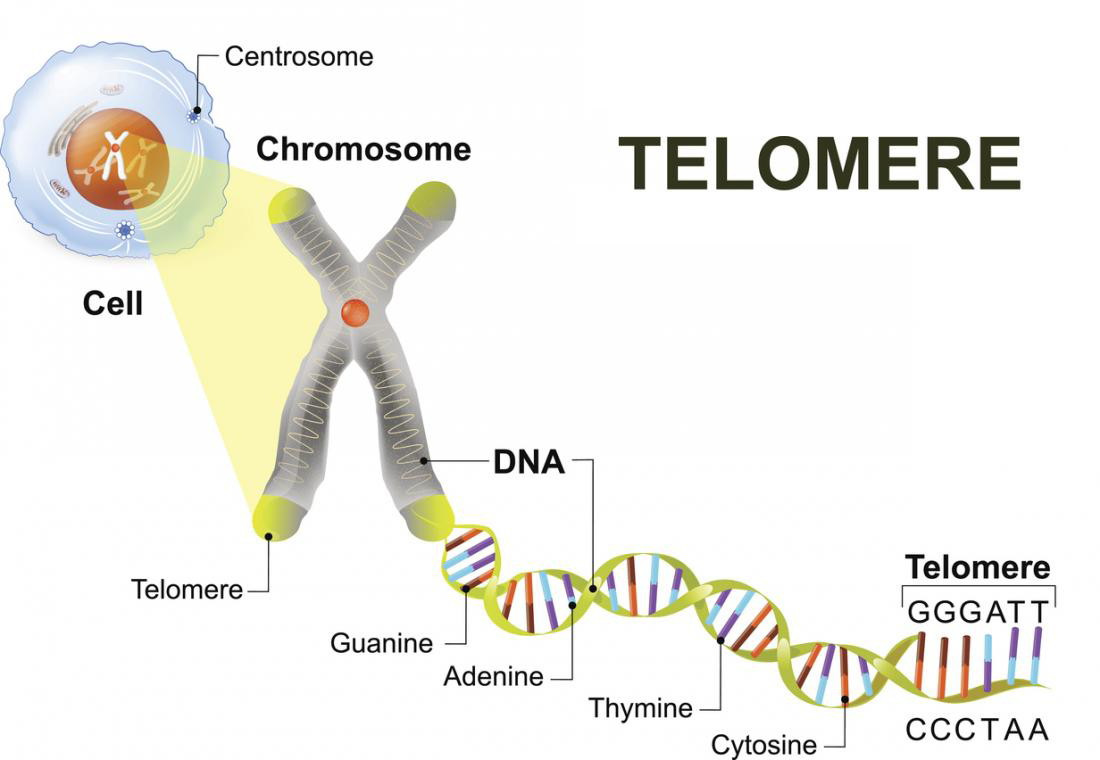
Your DNA is organized into chromosomes, and those chromosomes are linear, meaning they have ends. The problem with having ends is that every time a cell copies its DNA to divide, the enzyme doing the copying can’t quite finish the job. It needs a primer to get started and can only work in one direction, so a small stretch at the very tip of each chromosome gets left behind every single round (Vaziri et al., 1994; López-Otín et al., 2023). This is called the end-replication problem, and your body has been dealing with it since before you were born.
The solution is a buffer zone. Your chromosomes are capped with long repeating stretches of non-coding text, the sequence TTAGGG over and over, thousands of base pairs deep, sitting between your actual genetic code and the edge that keeps getting nibbled (Vaziri et al., 1994). Those buffers are your telomeres. They’re sacrificial by design, because the alternative would be losing functional DNA with every division, and that’s not something you survive for long.
Telomere
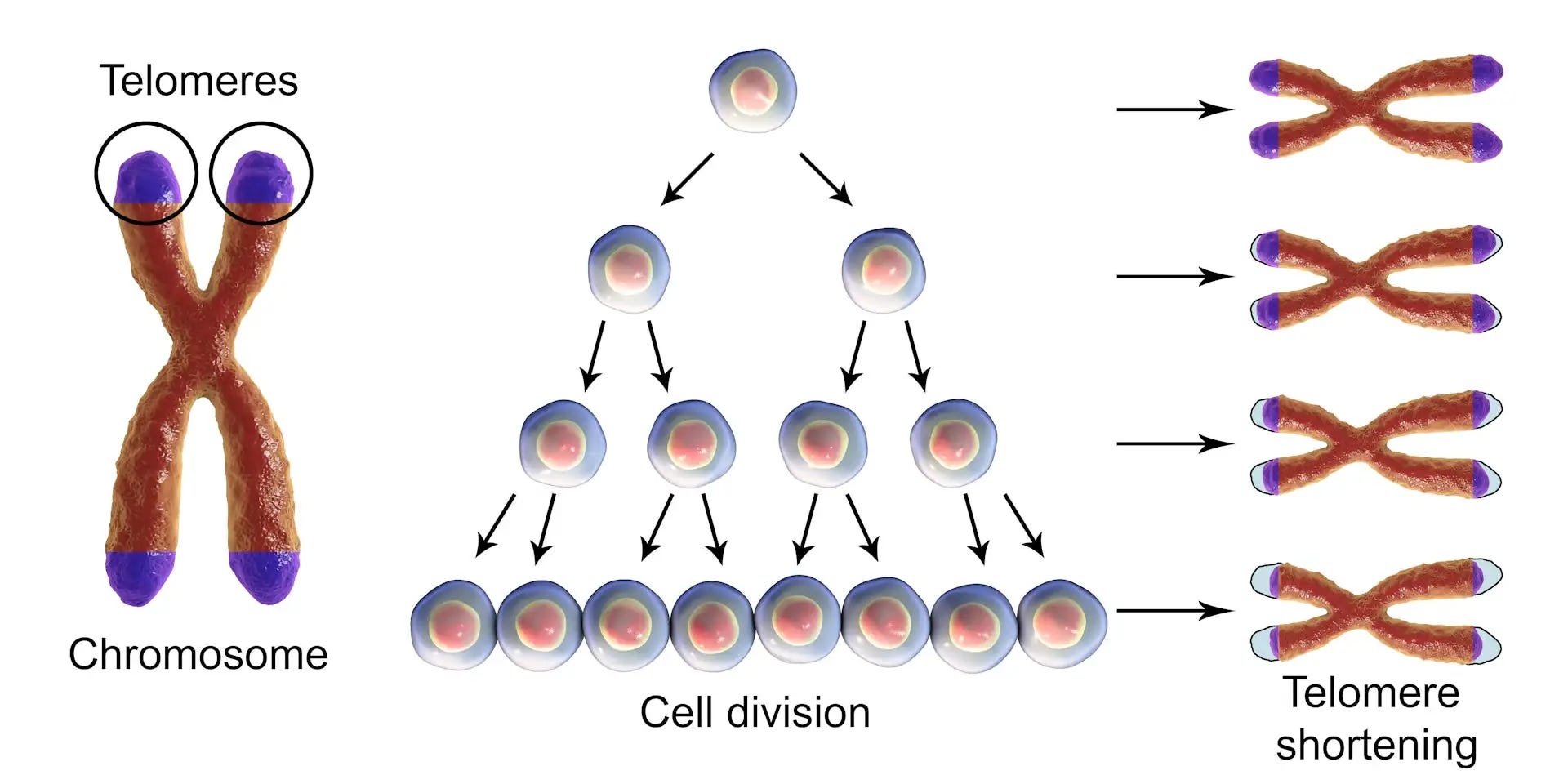
Now think about how much cell division your body is actually running. You’re replacing cells constantly, in your skin, your gut lining, your blood, pretty much anywhere tissue needs to be maintained or repaired. Your bone marrow alone keeps a small population of stem cells on permanent duty, and those cells are responsible for generating your entire supply of red blood cells, white blood cells, and platelets, every single day, for your entire life (Vaziri et al., 1994). That’s an almost unreasonable amount of cellular division, and every single round shaves a little more off the telomere.
Back in 1994, Vaziri et al. (1994) tracked telomere length across human life, from fetal tissue to umbilical cord blood to adult bone marrow from donors ranging from 16 to 58 years old. They found that telomeres shortened by roughly 9 base pairs per year of donor age in vivo, and when those same cells were cultured and asked to divide, they lost about 37 base pairs per population doubling. Every cell in your body is carrying a record of how many times it's divided, written into the length of its own telomeres.
When those telomeres shorten far enough, the chromosome ends uncap, genomic stability falls apart, and the cell is forced into one of two exits: apoptosis, which is programmed self-destruction, or senescence, which is permanent cell cycle arrest (López-Otín et al., 2023). The cell either kills itself or locks up forever. And as we're about to get into, both of those outcomes are the point.
Attrition as Defense
Telomeres act as potent tumor suppressors by limiting proliferation (Barnes et al., 2022).
Your cells are constantly bombarded by chemicals, replication errors, and environmental toxins, all of which threaten genome integrity and stability, meaning your DNA’s ability to stay accurate and intact across every round of copying (López-Otín et al., 2023). If a cell picks up mutations that tell it to multiply uncontrollably, its shrinking telomere is the thing that stops it. The fuse burns down, the cell hits a wall, and the runaway replication ends before it can go anywhere.
Now, your body does have a tool that can rebuild telomeres: an enzyme called telomerase. It’s a specialized reverse transcriptase that uses its own RNA template to add telomeric DNA back onto the chromosome ends (Epel et al., 2004; López-Otín et al., 2023). Pretty elegant, right? But most of your somatic cells don’t express it, and that’s on purpose (López-Otín et al., 2023). Your body would rather let those fuses burn down than risk a cell that can copy itself forever. Because when cells do find a way to bypass that arrest signal and flip telomerase back on, that’s typically what you’re looking at in cancer progression (Vaziri et al., 1994). Telomerase reactivation shows up in more than 80 percent of human tumors (Canale & Andreassi, 2025).
So, when a supplement company tells you their pill is a systemic telomerase activator designed to override this safety mechanism in every cell of your body, I want your first reaction to be a healthy dose of caution, not a visualization of your next thousand years on this earth.
Telomere attrition | Source unknown
How Life Stress Gets Under the Skin
If somatic cells keep telomerase turned off, what causes some people’s fuses to burn down way faster than others? Chronological time is only part of it, because the biological environment matters immensely, and your mind is directly wired to that environment. ,
