


This topic comes to us from a member of The Buffalo Herbalist Community, who asked if I could dive deeper into psoriasis as part of our skin–gut connection series.
Psoriasis is often brushed off as “just a skin thing,” but if you live with it or love someone who does, you know it is so much more than that. It is a lifelong, immune-driven inflammatory condition. In psoriasis, the immune system shifts into overdrive, changing the way skin cells grow and shed.
That is what creates those familiar red, scaly plaques. But what shows up on the surface is only part of the story. Psoriasis can be connected to joint pain in psoriatic arthritis, changes in heart and liver health, and for many, a heavy emotional and psychological load.
In 2014, the World Health Organization officially named psoriasis as a serious, long-term health condition. They did not just acknowledge the physical side, they called attention to the frustration of late diagnoses, treatments that do not go far enough, and the stigma that still surrounds visible skin conditions.
The Global Burden of Disease Study put it into perspective: in 2016, psoriasis accounted for 5.6 million years of life lived with disability worldwide. That is more than three times the burden of inflammatory bowel disease.
Psoriasis does not discriminate. It can show up in both men and women, and often runs in families. For men, it is most common between the ages of 30–39 and 60–69. For women, it often appears about ten years earlier. Globally, around 60 million people are living with psoriasis, though how common it is varies from place to place.
Conventional medicine offers a range of options: topical creams with corticosteroids or vitamin D analogues, light therapy to slow skin cell turnover, and oral or injectable medications like methotrexate, ciclosporin, or targeted biologics that work on the immune system itself.
These treatments can be incredibly helpful for managing symptoms, but they still leave us with the bigger question: what is driving the immune system to react this way in the first place?
That brings us to the heart of this series.
Does herbalism have a place in supporting psoriasis? Can plants help not only the skin, but also the deeper systems that influence it—like the gut and the immune network it communicates with?
Let’s explore what the science says, and what the skin–gut connection can teach us.

What Psoriasis Really Is
Genetics, Immunity, and Triggers
Psoriasis doesn’t come from a single cause. Instead, it develops from a mix of genetics, immune system changes, and environmental influences. Genetics play a strong role, especially in people who develop plaque psoriasis before the age of forty. Studies in twins, families, and large populations suggest that 60 to 90 percent of the risk is inherited. More than sixty regions of the genome have been linked to psoriasis, many connected to the immune system and the way the skin’s barrier functions.
Some of the genes linked to psoriasis help immune cells identify and react to perceived threats. One example is HLA-C, a gene that makes a protein used like an “ID badge” on cells, helping the immune system decide what’s safe and what’s not.
Other genes influence inflammation through a process called NF-kappa B signaling. You can think of NF-kappa B as a master switch for inflammation — when it’s turned on too often or for too long, it keeps the immune system in a heightened state.
Then there’s the type 1 interferon pathway, which is normally part of the body’s antiviral defense system. In psoriasis, this pathway can become overactive, even when there’s no virus to fight, adding more fuel to inflammation.
Finally, certain genes control the IL-23/Th17 axis, a key immune pathway that drives both inflammation and the rapid skin cell growth seen in psoriasis. When this pathway is overactive, skin cells turn over far faster than normal, creating the thick, scaly plaques common to the condition.
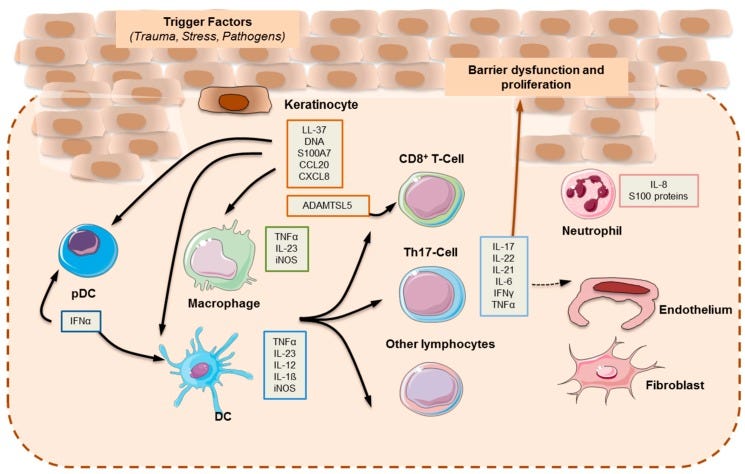
Psoriasis Pathogenesis
At the core, psoriasis is a miscommunication between the immune system and the skin. Immune cells like T cells and dendritic cells, and skin cells called keratinocytes, feed into one another’s activity in a constant inflammatory loop. The IL-23/Th17 pathway is especially active, releasing cytokines that keep the inflammation going and speed up the skin cell cycle. Normally, skin cells take about a month to mature and shed. In psoriasis, this happens in just three to five days, leaving no time for a strong, healthy skin barrier to form.
Even with a genetic tendency, psoriasis often needs a “push” from the environment to appear or worsen. Common triggers include infections (especially strep throat, which is linked to guttate psoriasis), certain medications like beta-blockers or lithium, stress, smoking, alcohol, and injury to the skin. This last one is known as the Koebner phenomenon, where new psoriasis patches form exactly where the skin has been damaged.
How Psoriasis Shows Up
Psoriasis doesn’t look the same for everyone.
The most common form, plaque psoriasis, shows up as well-defined patches of salmon-pink skin with silvery-white scales, often on the elbows, knees, scalp, and trunk. Flexural psoriasis appears in skin folds, often without much scaling. Guttate psoriasis tends to start suddenly, with small, drop-shaped spots that may follow an infection. Pustular psoriasis is marked by white pustules on red skin and can be localized or widespread. Erythrodermic psoriasis is the rarest and most severe form, causing almost total body redness and scaling. This form can be life-threatening if left untreated.
Up to half of people with psoriasis also notice changes in their nails, such as pitting, separation from the nail bed, discoloration, thickening, or crumbling.
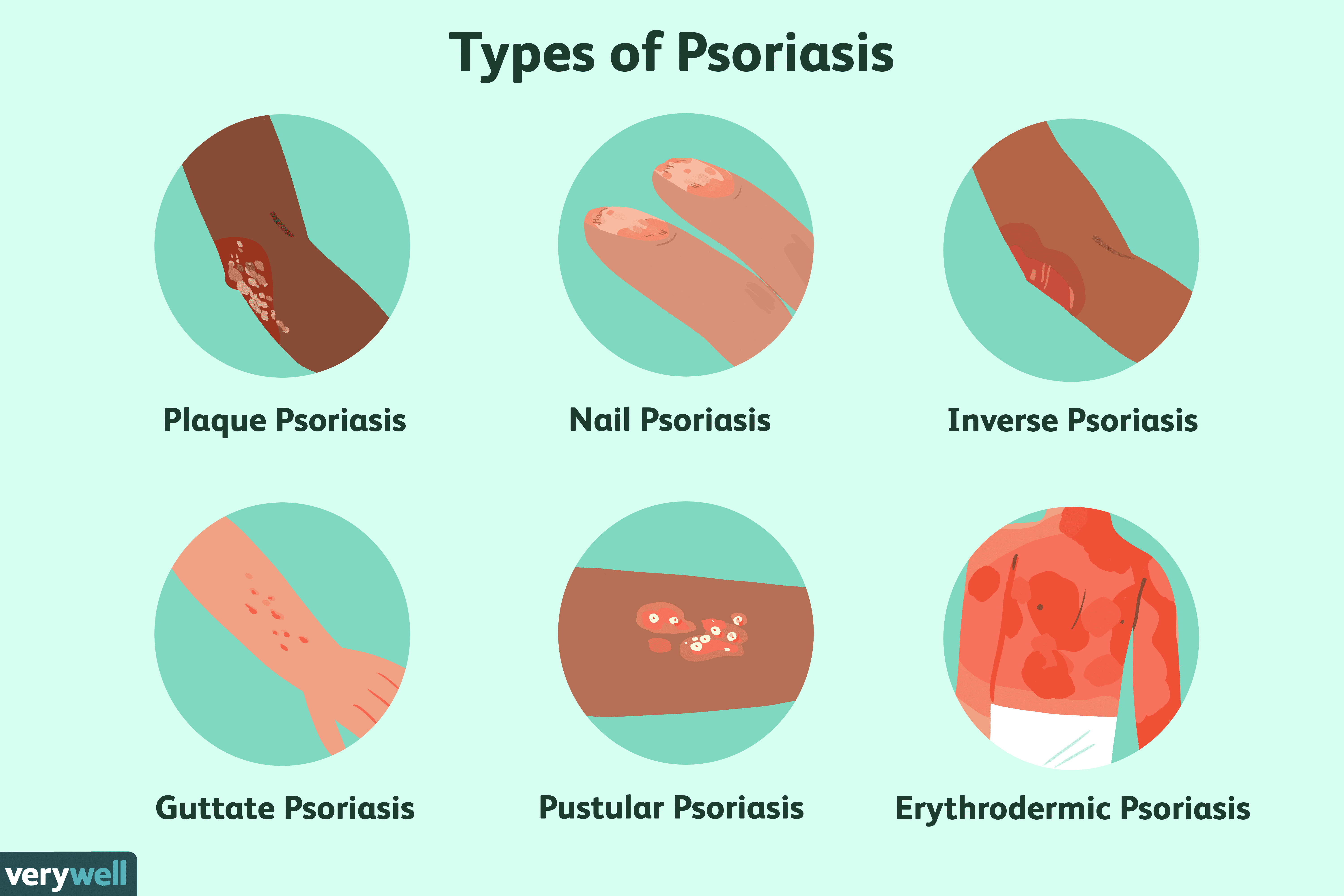
Types of Psoriasis
More Than Skin Deep
For some, psoriasis stays on the surface. For others, it’s linked to conditions like psoriatic arthritis, which affects up to 30 percent of people with psoriasis and can cause joint pain, swelling, and stiffness—often years after the first skin symptoms. Psoriasis is also associated with higher rates of obesity, cardiovascular disease, diabetes, fatty liver disease, and metabolic syndrome. This may be due to shared inflammatory pathways and risk factors, meaning the same immune activity that shows up in the skin may also be affecting the heart, blood vessels, and metabolism.
The emotional and mental health effects are just as important to acknowledge. Anxiety and depression are more common in those with psoriasis, not only because of the physical discomfort, but also because of the stigma and self-consciousness that can come with visible skin changes.
Psoriasis is, in every sense, a whole-body condition that happens to be most visible on the skin. Addressing it fully means going deeper than topical creams or symptom-focused treatments. It requires looking at the immune system, the body’s inflammatory terrain, and the outside influences that keep the condition active.
The Gut Connection
In the last section, we looked at psoriasis as a condition that begins with the immune system and skin cells miscommunicating. But as we explored in this week’s earlier article, the gut has a seat at that table too.
Research shows that the gut microbiome, the community of bacteria, viruses, and fungi living in our intestines, looks different in people with psoriasis compared to those without. This is not just a subtle change. Studies have found shifts in both the diversity of microbes and the relative amounts of certain bacterial groups.
One of the most consistent microbiome patterns in psoriasis is an increase in certain bacterial groups like Firmicutes and Actinobacteria, and a decrease in Bacteroidetes. Within these groups, species such as Faecalibacterium, Megamonas, and Blautia often appear in higher amounts, while Prevotella and some Bacteroides species are found in lower amounts.
On the surface, this can seem counterintuitive. For example, Faecalibacterium prausnitzii is usually considered a “good” bacterium because it produces short-chain fatty acids (SCFAs) like butyrate, which help keep the intestinal lining strong and support an anti-inflammatory environment. So why would more of it be seen in psoriasis?
The answer lies in function versus presence. You can have more of a certain bacterium without it working at full capacity. In some cases, even though F. prausnitzii is present in higher numbers, it may not be producing enough butyrate to offset the inflammation happening elsewhere in the gut. The broader microbial community, immune activity, and environmental factors all influence whether a beneficial species can actually deliver its benefits. In other words, it’s not just about who’s there — it’s about what they’re doing.
Note: This concept confused me, personally, while doing research for this article. I wanted to make sure to clarify this for you.
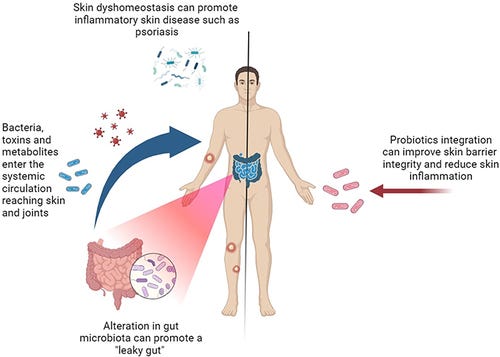
Psoriasis and Gut Microbiome
When the microbial balance shifts, the gut lining can become more permeable, allowing immune-activating molecules, sometimes called PAMPs, to pass into the bloodstream. These signals can prime immune cells throughout the body, including the skin, to remain in a heightened state of alert.
Several studies have linked these microbiome changes to increased inflammatory markers in psoriasis. For example, certain gut bacteria are associated with higher levels of IL-2 receptor and other immune signals that drive chronic inflammation. Lower levels of SCFA-producing bacteria may mean less support for immune-balancing cells like T regulatory cells (Tregs).
Without adequate Treg activity, inflammatory pathways like IL-23 and IL-17—both central in psoriasis—can stay switched on.
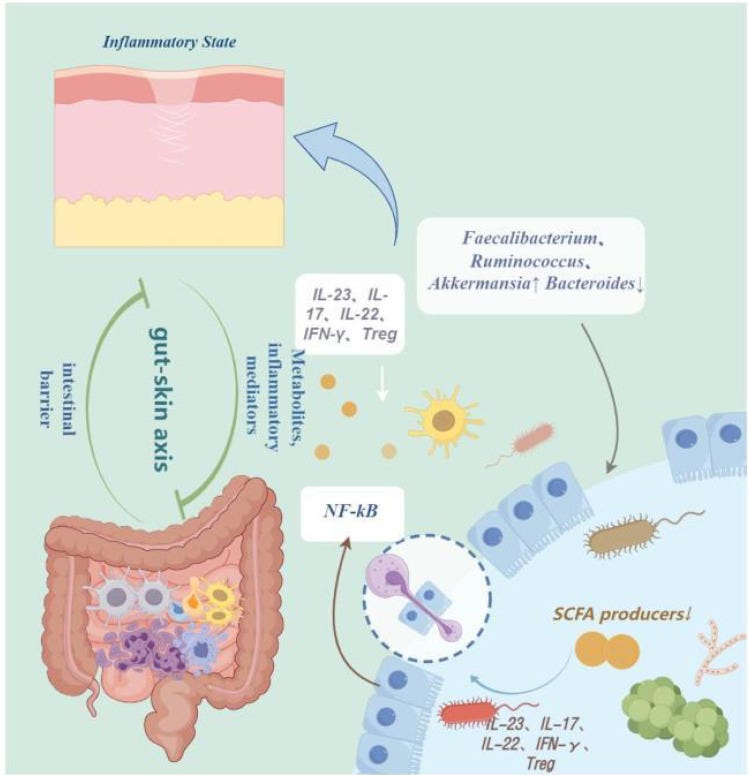
Gut-skin axis
The Gut–Skin Axis in Action
The gut and skin are in constant biochemical conversation through immune signals, metabolites, and even the nervous system. A disturbance in one can echo in the other. In psoriasis, microbiome imbalances may amplify the skin’s inflammatory loop, making it more reactive to triggers.
Animal studies have shown that introducing certain bacteria to the gut can worsen skin inflammation, while restoring microbial balance can ease it. We do not yet know whether gut changes cause psoriasis, result from it, or both. The relationship is likely a two-way street: skin inflammation can alter the gut microbiome, and gut changes can worsen skin inflammation.
Either way, this connection opens an important door. Supporting the gut could be part of a more complete psoriasis care strategy.
The rest of this article is for members of The Buffalo Herbalist Community
In the next section, we will explore herbal strategies for psoriasis, from plants that soothe the skin directly to those that work deeper by calming immune overactivity, supporting liver detoxification pathways, and restoring gut balance. I will share some of my favorite ways to prepare and work with these herbs, along with safety considerations and tips for tailoring them to the individual.
As a member of The Buffalo Herbalist Community, you also get access to:
Exclusive, in-depth articles and guides not available to the public
Downloadable PDFs, monographs, and study resources in The Library
Our private chat space for community questions and discussion
Becoming a member not only gives you access to these resources, it also supports the continued creation of research-based herbal content for our community.
If you have been enjoying the Skin–Gut Connection series so far, becoming a member means you will not miss the herbal applications that bring it all together.