


Terpenoids are everywhere once you start looking. They glimmer on the surface of leaves, hide in the stickiness of resins, color the petals of flowers, and drift into the air as scent. They are the invisible language of plants, carrying messages of attraction, defense, and resilience.
Every plant on earth makes them in some form. Together, they form one of the largest and most expressive families of compounds in nature. What begins as a small five-carbon fragment called isoprene becomes, through endless rearrangements, a world of fragrant oils, protective coatings, pigments, and hormones. Through these molecules, plants respond to everything around them—light, heat, water, soil, and the living beings that share their space.
To understand terpenoids is to glimpse the artistry of the plant kingdom. From something so small, life builds color, scent, protection, and conversation. They remind us that chemistry is not separate from nature; it is nature’s way of dreaming up infinite possibilities.

Terpenoids as Secondary Plant Metabolites
Terpenoids are a vast family of natural compounds built from small five-carbon molecules called isoprene. These repeating units link together in countless ways, forming everything from delicate essential oils to sturdy plant resins and pigments.
They are grouped according to the number of isoprene units they contain, and each group carries its own chemical personality.
Monoterpenes are formed from two isoprene units (C₁₀).
Sesquiterpenes contain three units (C₁₅).
Diterpenes have four (C₂₀).
Triterpenes include six (C₃₀).
Tetraterpenes extend to eight (C₄₀).
Each class plays a distinct role, shaping not only how a plant smells but also how it responds to the world around it. Some are light and volatile, drifting into the air to attract pollinators or repel insects. Others are heavier and more stable, forming resins, pigments, and structural compounds that help the plant adapt to changing conditions.
Although terpenoids are not part of a plant’s core functions of growth or reproduction, they are essential to what botanists call secondary metabolism. This is the creative, adaptive system that allows plants to communicate, defend, and survive. Secondary metabolites protect against herbivores, pathogens, and environmental stress while also attracting pollinators and beneficial microbes.
In this way, terpenoids act as both defense and dialogue. They form a living network of chemical signals that ties the plant to everything around it. From the scent of pine and citrus to the golden resin of conifers and the pigments of autumn leaves, terpenoids are how plants express themselves—the aromatic, protective, and often unseen forces that help sustain life across the green world.
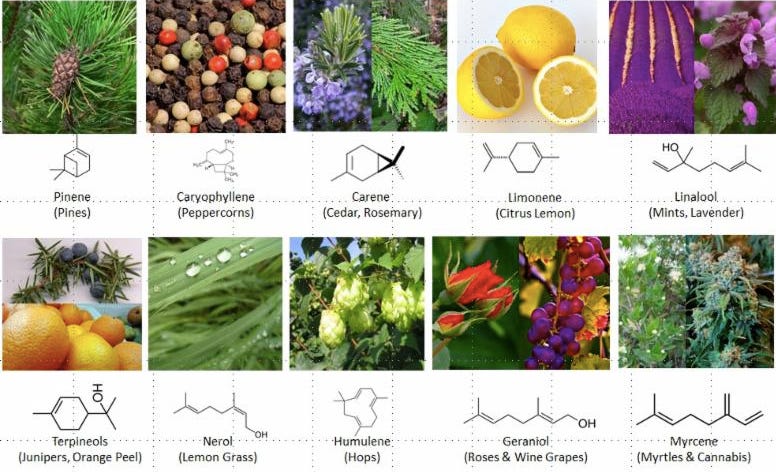
Source Unknown
The Many Roles of Terpenoids in Plants
Terpenoids are extraordinary in their versatility. Their molecular diversity allows them to fulfill many different roles across the plant’s life cycle and environment.
While their functions vary by species, climate, and ecological context, most terpenoids can be understood through four major patterns: defense, attraction, protection, and adaptation.
1. Defense Against Herbivores and Pathogens
Many terpenoids are produced as part of the plant’s defense system. When leaves or stems are damaged, specialized cells release volatile terpenes that deter herbivores or inhibit the growth of microbes. Some act directly as toxins or feeding deterrents, while others operate more subtly by making the plant less palatable.
Terpenoids are also found in resins and essential oils, which create physical and chemical barriers against infection. Conifer trees, for instance, exude sticky resin rich in diterpenes that seal wounds and protect against invading fungi or insects. In other plants, terpenoid compounds can disrupt bacterial cell membranes or interfere with fungal enzymes, preventing colonization before it begins.
These defensive reactions are not random. They are often finely tuned to the type of attack. A single plant can alter the composition of its volatile terpenes depending on whether it is being eaten by an insect, infected by a pathogen, or exposed to drought stress.

2. Attraction and Ecological Signaling
Terpenoids are also responsible for many of the scents that draw pollinators to flowers and seed dispersers to fruit. Their volatility allows them to move easily through the air, creating a chemical signal that can travel far beyond the boundaries of a single plant.
Different terpenoid blends communicate different messages. Sweet floral aromas invite bees and butterflies. Sharp, resinous tones may attract beetles or flies. Even within a single plant, scent composition can shift throughout the day to align with the activity of target pollinators.
Beyond attraction, terpenoids also function in plant-to-plant communication. When one plant is damaged, the volatile compounds it releases can trigger nearby plants to strengthen their own defenses. This airborne signaling helps entire plant communities respond collectively to stress.

3. Environmental and Physical Protection
Some terpenoids are built not for communication but for endurance.
Certain classes form protective coatings on leaves and fruits that reduce water loss and protect tissues from ultraviolet radiation. Others act as antioxidants within plant cells, stabilizing membranes and preventing damage caused by reactive oxygen species that accumulate under heat or drought conditions.
This protective chemistry allows plants to tolerate extremes—arid climates, strong sunlight, and nutrient-poor soils. In many aromatic herbs that thrive in dry regions, such as those in the mint and thyme families, high concentrations of terpenoids play a major role in their ability to survive harsh environments.

4. Regulation and Adaptation Within the Plant
Terpenoids are not limited to outward interactions. They also serve internal functions that regulate plant growth and metabolism. Some terpenoid derivatives act as plant hormones, influencing processes like flowering, fruit ripening, and response to stress.
Others participate in the formation of pigments that capture light energy or protect chlorophyll from degradation.
Because of these regulatory functions, terpenoids are closely tied to the plant’s overall rhythm and adaptation. Their synthesis often increases under stress, helping the plant redirect energy toward survival.

An Invisible but Constant Conversation
Viewed together, these roles show how terpenoids form an invisible network of communication and protection. They are not isolated metabolites, but part of a dynamic ecological conversation. A single molecule might repel an herbivore, attract a pollinator, and protect the plant’s cells from sunlight, all at once.
And when we study these compounds, we begin to see that understanding how they work for the plant gives us a deeper understanding of what they can offer us. Terpenoids were never created for human use; they evolved as part of the plant’s own intelligence and survival. Yet we are fortunate to work in partnership with them, learning to interpret the same chemistry that keeps a plant alive as a form of medicine, aroma, and connection.
From Plant Survival to Human Partnership
Terpenoids remind us that plant chemistry was never made for us. These compounds evolved to help plants survive—to defend, communicate, and adapt within their ecosystems. Yet when we understand how they function for the plant, we begin to see why they resonate with us. What calms the plant’s stress response can soothe our own. What shields its tissues from oxidation or infection can support our healing, too.
This perspective shifts the way we approach herbalism. It reminds us that we are not the center of the story, but participants in it. The chemistry we work with was not created for us, yet it meets us where we are, sharing the plant’s intelligence in a form we can receive.
To study phytochemistry is not just to memorize classes of compounds, but to learn a language of relationship.
Terpenoids invite us to notice the sensory bridge between ecology and physiology, between what keeps a plant alive and what helps us heal. They are a living reminder that medicine begins with connection, and that our role is to listen

Terpenes in Plants and Humans
Keep Reading in The Buffalo Herbalist Community
Just as understanding how these compounds serve the plant helps us understand what they offer to us, the next section explores what happens once terpenoids interact with the body. We’ll look at how they move through membranes, calm inflammation, disrupt microbes, and support repair at the cellular level. You’ll also find a closer look at their antioxidant, anticancer, and anti-allergic activity, and what these patterns reveal about the deep intelligence that lives within plant chemistry.
If you’re a paid subscriber, you can keep reading below.
If you’re not yet a member, consider joining The Buffalo Herbalist Community to continue your study of phytochemistry, explore detailed materia medica entries, and access monthly herbal learning resources created for those who want to understand plants on a deeper, more connected level.
