


Welcome, class!
If you’ve subscribed to my little side quest, The Herbal Academic, you probably knew this one was coming. Today, I want to give you guys an overview of the hypothalamic-pituitary-adrenal axis, better known as the HPA axis.
Physiologically, the HPA axis helps coordinate our stress response, and in the herbal world, it has become pretty intertwined with conversations about adaptogens, cortisol, and “adrenal support.”
We’ll get to the herbs, I pinky promise.
As I started putting this article together, though, I realized there was WAY too much physiology involved to squish everything I wanted to talk about into one piece. So, we’re turning this into a little HPA-axis series!
THE AGENDA:
For Part 1, we’re sticking with the axis itself. We’re going to meet the hypothalamus, pituitary, and adrenal glands, follow the hormonal signals that travel between them, and look at how the HPA axis regulates its own activity through negative feedback.
Then, in Part 2, we can zoom out and look at the meat and potatoes, what HPA-axis activity is doing throughout the body, including its connections with metabolism, cardiovascular function, immune activity, and reproductive function.
Part 3 will finally bring us back to the plants, where we can pull out the research on adaptogens and look at what researchers are measuring when they study their effects on the HPA axis.
My goal is to avoid handing you another textbook-like piece where the voice in your head slowly turns monotonous and dull, and before you’ve even scrolled halfway down, you’ve closed the app or browser and moved on with your day. Pointless!
Sound good?! Okay, please take out your notebooks!

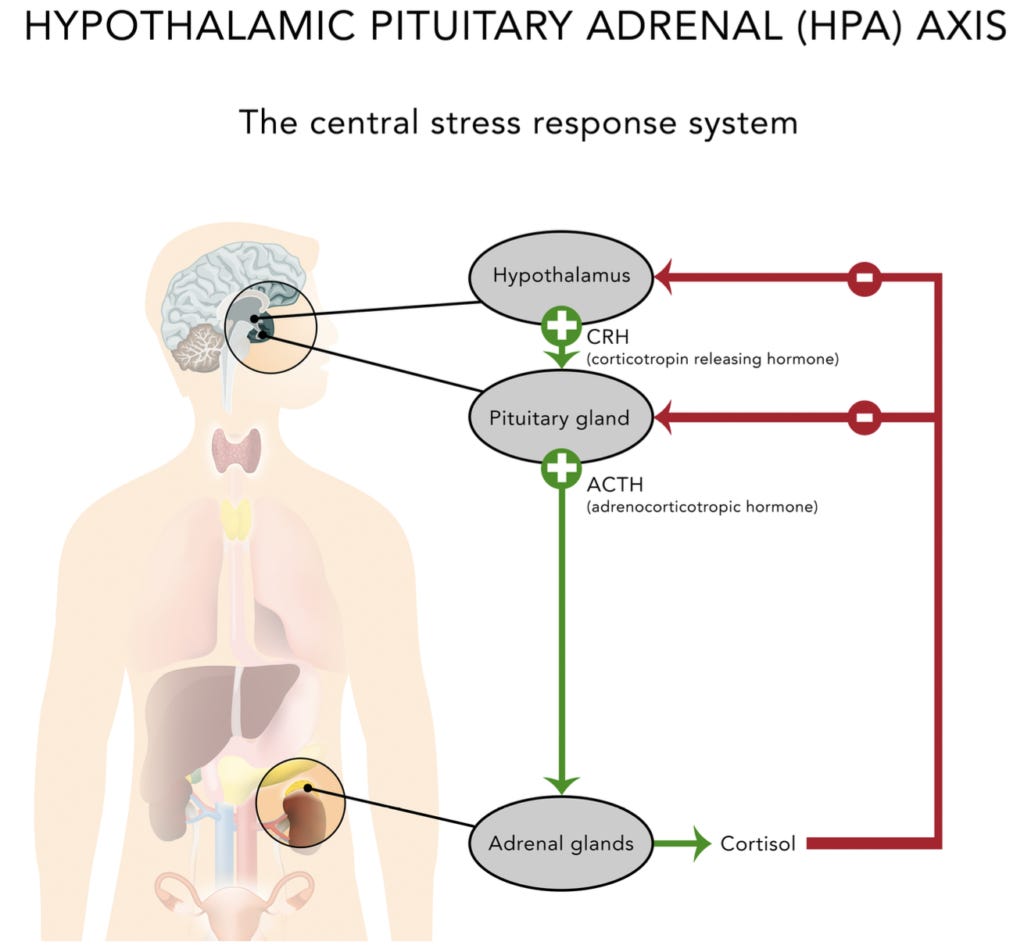
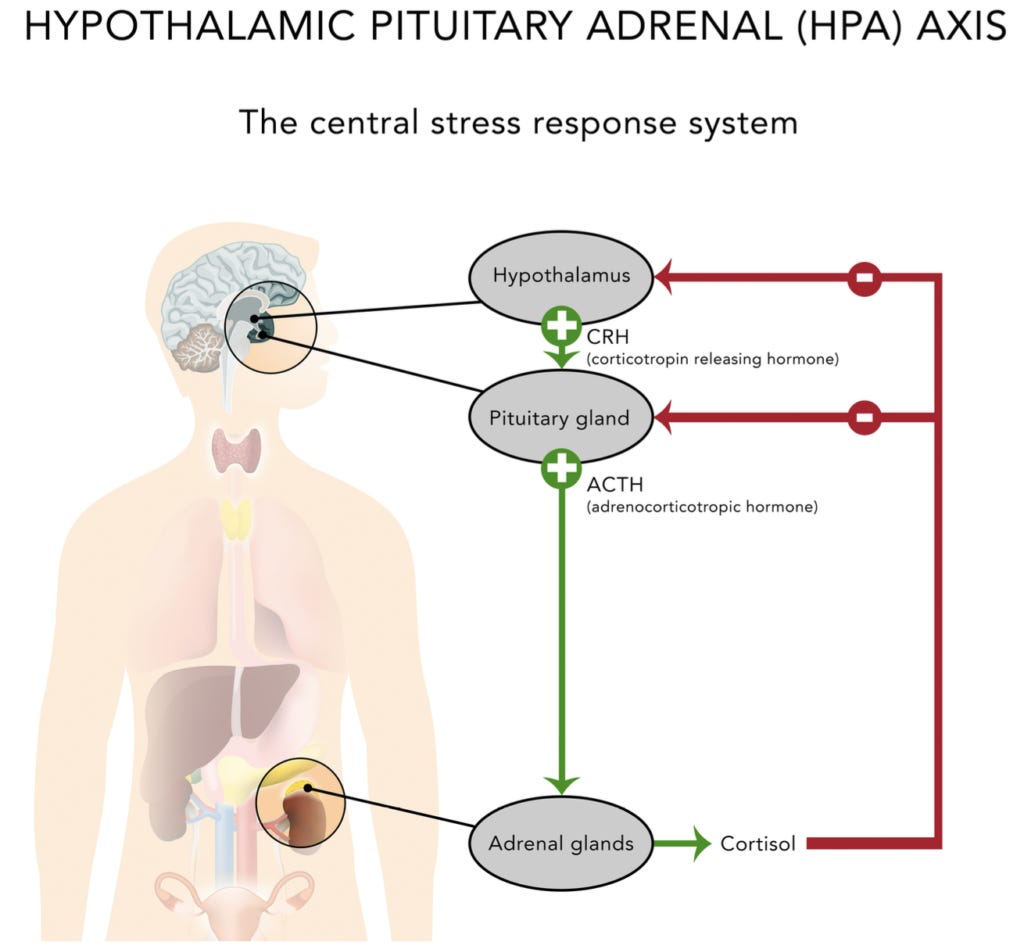
(take a minute to look at this diagram before you dive in! you’ll see it later in the article as well)
Point A: The Hypothalamus
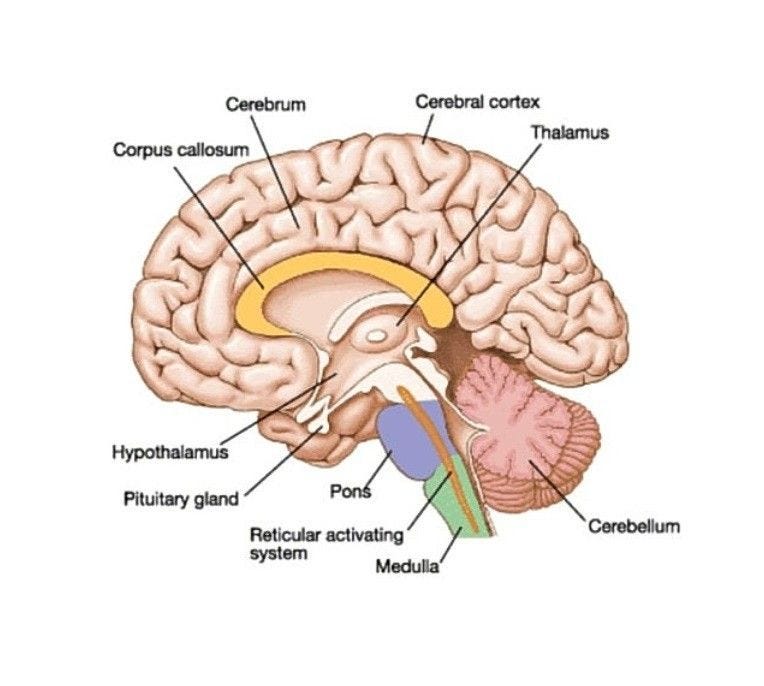
The hypothalamus is a relatively small region of the brain located within the diencephalon, just below the thalamus (Molina, 2023). If you imagine looking at the brain from the side, we’re pretty centrally located, sitting underneath the thalamus and just above the pituitary gland.
That last part is going to be useful for us because the hypothalamus and pituitary work VERY closely together! Work besties!
What Does the Hypothalamus Do?
The hypothalamus is heavily involved in maintaining homeostasis, which is basically our body’s ongoing attempt to keep its internal environment relatively stable. And that’s a MUCH bigger job than it probably sounds like.
To do this, the hypothalamus receives and integrates information from the environment, other areas of the brain, and from within the body. It helps regulate things like body temperature, thirst and fluid balance, food intake and energy expenditure, blood pressure, and our sleep cycle (Molina, 2023). So, yeah. It has its little neuronal hands in A LOT of things!
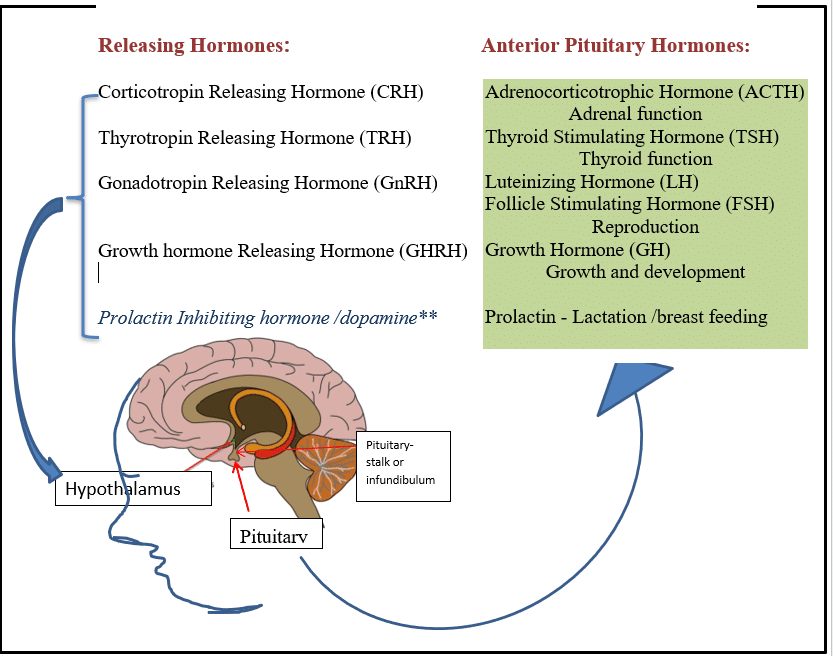
For the HPA axis, the hypothalamic hormone we need to know is corticotropin-releasing hormone (CRH). The hypothalamus produces a number of other hormones, but for the sake of the scope of this article, CRH is the one you need to remember!
When the HPA axis is activated in response to stress, the hypothalamus releases CRH, which travels through a specialized network of blood vessels connecting the hypothalamus and anterior pituitary (Herman et al., 2016). And when we say “stress” here, we’re talking broadly about a real or anticipated demand that requires the body to make physiological adjustments to help maintain homeostasis. (yes, having to make a very normal, everyday phone call unfortunately totally counts as this type of stress)
Point B: Pituitary Gland
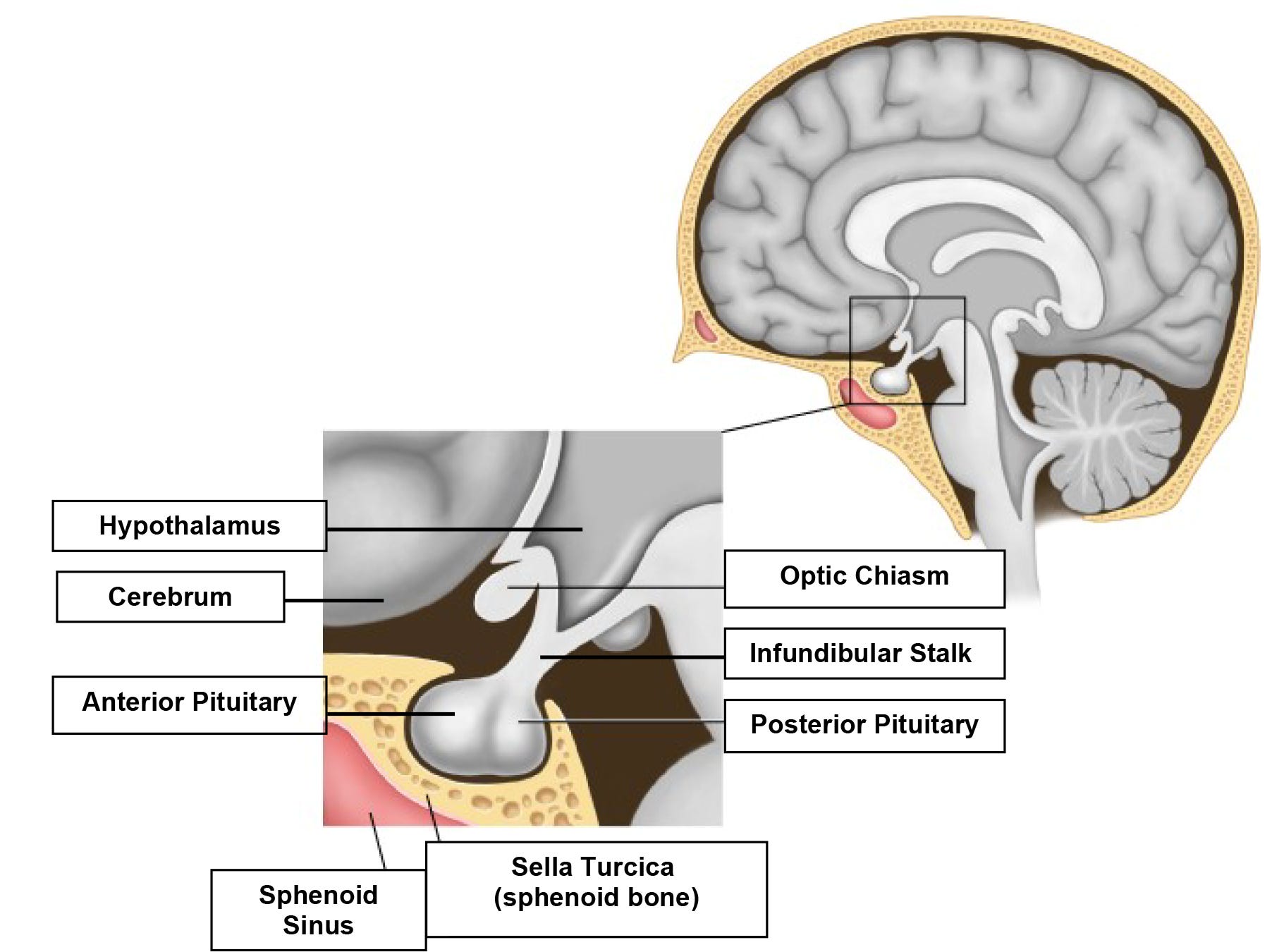
The pituitary gland is a small endocrine gland located at the base of the brain, where it sits inside a little bony pocket called the sella turcica. I don’t know why, but I’ve always found that kind of adorable? The gland basically gets its own little seat inside the skull.
It’s also connected to the hypothalamus by the pituitary stalk, so our first two pieces of the HPA axis are VERY close neighbors.
The pituitary itself is divided into two main parts: the anterior pituitary and the posterior pituitary. These two regions differ in their structure and in how they communicate with the hypothalamus, and there’s a whole lot of physiology hiding in that sentence that we’re going to graciously leave alone today.
For the HPA axis, we only need the anterior pituitary.
CRH and ACTH
Once CRH reaches the anterior pituitary, it stimulates specialized cells called corticotrophs to release adrenocorticotropic hormone (ACTH).
ACTH is one of several hormones produced by the anterior pituitary, but it’s the one we care about for the HPA axis. Once released, ACTH enters the bloodstream and travels through the systemic circulation until it reaches its target: the adrenal cortex (Kamel-ElSayed & Schwartz, 2023).
So far, we have:
CRH: from the hypothalamus
ACTH: from the anterior pituitary (which is now on its way to the adrenals! lets goooo)
Point C: Adrenal Cortex
We’ve officially made it to the adrenal glands!
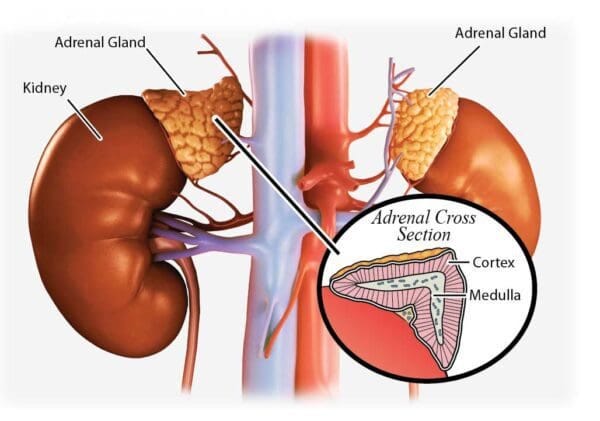
These are two small endocrine glands that sit right on top of the kidneys. If you’ve never seen them before, they kind of look like tiny little hats perched on top of each kidney, which I feel makes them seem much less intimidating than they are in an endocrinology textbook. Cuties :)
Each adrenal gland is divided into two main regions: the outer adrenal cortex and the inner adrenal medulla.
Now, both of these regions are involved in our physiological response to stress, but they do very different things. The adrenal medulla is involved in the sympathetic nervous system response and releases catecholamines like epinephrine and norepinephrine, while the adrenal cortex produces steroid hormones, including the glucocorticoids we’re interested in for the HPA axis. There’s a whole physiology lesson hiding in these two little glands alone, and I could VERY easily get distracted by it. So, I will NOT.
For today, we’re staying in the adrenal cortex.
ACTH and Cortisol
Once ACTH reaches the adrenal glands, it binds to receptors in the adrenal cortex and stimulates the production and release of cortisol, our main glucocorticoid hormone.
Cortisol has gotten a bit of a villain reputation online, which is unfortunate because we very much NEED it. (Do we want a deep dive on cortisol? Physiological/pathophysiological actions?)
During a stress response, cortisol helps make energy available to meet increased physiological demand. It influences glucose metabolism, helps mobilize stored energy, supports cardiovascular function, and temporarily shifts resources away from processes that aren’t as immediately necessary during a stress response (Sheng et al., 2021).
And cortisol’s job extends way beyond stress. It plays a role in metabolism, immune function, cardiovascular regulation, and maintaining normal physiological function throughout the day. (see! not so bad!)
We’re focusing on its role in the HPA axis today, but I don’t want you leaving class thinking cortisol only shows up when something stressful happens!
So now we can add our third hormone:
CRH: from the hypothalamus
ACTH: from the anterior pituitary
Cortisol: from the adrenal cortex
Okay, Let’s Put This All Together
We’ve spent a lot of time following individual hormones around the body, so let’s review really quick:
The HPA axis was activated in response to a stressor, or some kind of real or anticipated demand that required the body to make physiological adjustments.
The hypothalamus responded by releasing CRH, which traveled to the anterior pituitary and stimulated the release of ACTH. ACTH then entered the bloodstream, made its way to the adrenal cortex, and stimulated the production and release of cortisol (Herman et al., 2016; Sheng et al., 2021).
That rise in cortisol helps the body meet the increased physiological demand by mobilizing energy stores, increasing the availability of glucose, supporting cardiovascular function, and temporarily altering processes like immune and reproductive activity (Sheng et al., 2021).
What we’ve been following, then, is a coordinated neuroendocrine response: information about a stressor is translated into a series of hormonal signals that ultimately changes what’s happening throughout the body.
Look at us! We know the HPA axis! Weeee!
The Negative Feedback Loop
Alright, so we’ve released cortisol into circulation. Now we need to make sure we don’t just keep making more and more of it indefinitely. I just want to touch on this really briefly to close because it helps put the WHOLE axis into perspective.
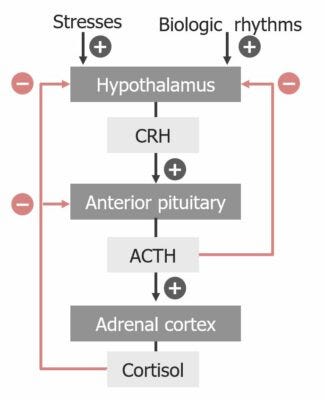
The HPA axis helps regulate its own activity through a negative feedback loop!
As cortisol circulates through the body, some of that signaling makes its way back to the HPA axis through glucocorticoid receptors. We don’t need to get super deep into receptor physiology today, but these receptors give cortisol a way to influence the same pathway that led to its production (DeMorrow, 2018; Herman et al., 2016).
So, as cortisol levels rise, glucocorticoid feedback at the hypothalamus helps reduce CRH activity, while feedback at the anterior pituitary helps decrease ACTH secretion. With less CRH stimulating the pituitary and less ACTH stimulating the adrenal cortex, we’re essentially turning down the signals telling the body to keep producing cortisol (Herman et al., 2016).
Basically, cortisol gets a say in how much more cortisol we make.
And THAT is our negative feedback loop! As the end product of the pathway increases, it feeds back into the system and reduces the signals driving its own production. This helps regulate HPA-axis activity and allows the stress response to move back toward baseline.
Part 2 will pick back up from here!

I think that’s enough endocrinology for one day! Don’t you?
We now have the basic physiology of the HPA axis under our belts, but there’s still A LOT more to talk about. Cortisol travels throughout the body, where glucocorticoids influence a wide range of physiological processes, including metabolism, cardiovascular function, immune activity, and reproductive function (Herman et al., 2016).
If you feel like this left you itching to learn more, don’t fret! This is what’s coming!
In Part 2, we’ll look at how HPA-axis activity connects with other physiological systems throughout the body and what cortisol is doing once it reaches those tissues.
Then, in Part 3, we can finally bring the plants into the conversation. We’ll look at adaptogens, the HPA axis, and what researchers are measuring when they study these herbs. More importantly, we’ll look at what those findings can tell us, and where we need to be careful about saying more than the research does.
Class dismissed!
If you enjoyed this article and would like to support the work that goes into researching and writing pieces like this, you can become a paid subscriber to The Buffalo Herbalist. Paid subscriptions help give me the time to keep digging into the research, asking more questions, and turning what I learn into something we can all explore together.
And if you’re curious about what I’m researching, reading, and working on between these articles, you can also find me over at The Herbal Academic. That’s my new little behind-the-scenes corner where I share more of the academic side of this work, including the papers I’m reading, research questions I’m chasing, and whatever has currently taken over my brain.
Whether you’re a free or paid subscriber, or you’ve decided to follow me down both rabbit holes, I’m very happy you’re here. Thank you for reading and learning alongside me!
Until next time,
— Agy | The Buffalo Herbalist
References:
DeMorrow, S. (2018). Role of the Hypothalamic–Pituitary–Adrenal axis in health and Disease. International Journal of Molecular Sciences, 19(4), 986. https://doi.org/10.3390/ijms19040986
Herman, J. P., McKlveen, J. M., Ghosal, S., Kopp, B., Wulsin, A., Makinson, R., Scheimann, J., & Myers, B. (2016). Regulation of the Hypothalamic‐Pituitary‐Adrenocortical stress response. Comprehensive Physiology, 6(2), 603–621. https://doi.org/10.1002/cphy.c150015
Kamel-ElSayed, S. A., & Schwartz, J. (2023, May 1). Physiology, pituitary gland. StatPearls - NCBI Bookshelf. https://www.ncbi.nlm.nih.gov/books/NBK459247/
Molina, P. E. (2023). Endocrine physiology (6th ed.). McGraw Hill.
Sheng, J. A., Bales, N. J., Myers, S. A., Bautista, A. I., Roueinfar, M., Hale, T. M., & Handa, R. J. (2021). The Hypothalamic-Pituitary-Adrenal axis: development, programming actions of hormones, and Maternal-Fetal interactions. Frontiers in Behavioral Neuroscience, 14, 601939. https://doi.org/10.3389/fnbeh.2020.601939
Thank you, and yes to cortisol deep dive!
What an excellent primer into HPA physiology! Thank you, this is so good that I will start linking to this any time I make the “cortisol isn’t all bad/there’s a whole built-in feedback loop around cortisol in our bodies” point :)