



If you have spent any time on health-focused social media lately, you have probably encountered MCAS. Mast cell activation syndrome. It shows up in the captions of people describing years of unexplained symptoms: flushing after meals, migraines that track with their cycle, skin that reacts to everything, a body that seems to be perpetually on high alert.
The comments fill up with people saying me too. And for a lot of those people, that moment of recognition is the first time their experience has felt seen.
For some, that comment section is the first place their experience made sense. Chronic, distributed, hard-to-explain symptoms are real, and the medical system is not always equipped to take them seriously. The community that has formed around MCAS and histamine intolerance exists because people needed somewhere to bring their experience when their doctors had nothing useful to offer.
But the social media version of this story has also become a symptom checklist that applies to nearly everyone, a diagnosis handed out in comment sections, and a growing fear that histamine is quietly destroying your health and your doctor just has not caught on yet.
I want to offer something different.
I’m a clinical herbalist and doctoral student in integrative health. I also react to smoked foods, and I carry the MTHFR gene variant, which is relevant to histamine metabolism in ways I’ll get into. I haven’t formally worked this up with a physician, and I’m not writing this as someone who has it all figured out.
I’m writing this because people deserve an accurate map of the physiology before they land on a diagnosis, and because understanding what histamine actually does makes it a lot easier to think clearly about what’s happening in your own body.
This article covers the physiology of histamine, what goes wrong and why, the distinction between histamine intolerance and MCAS that the social media conversation keeps blurring, and what the evidence actually supports in terms of integrative approaches. The goal isn’t to talk you into or out of anything. It’s to give you enough to work with.

Let Histamine Reintroduce Itself
Before we talk about what goes wrong, let’s start with what histamine actually is, because most people have only ever met it in the context of allergies and that is not a fair introduction.
Histamine is a biogenic amine, which is a fancy way of saying it’s a small chemical compound built from an amino acid.
Specifically, it’s made from histidine, an amino acid you get from protein in your diet, through the action of an enzyme called histidine decarboxylase.
Once produced, it gets stored primarily in mast cells and basophils, two types of immune cells, and released in response to a wide range of signals: allergens, pathogens, physical injury, hormonal shifts, and certain foods.

Here’s the part that gets lost in the allergy conversation: Histamine is not an aberration. It’s not something your body produces by accident or in error. It’s an essential signaling molecule that your body makes on purpose, every day, because it has a lot of work to do. The problem is never histamine itself. The problem is what happens when it accumulates faster than your body can clear it.
Think of it less like a toxin and more like a text message.
Useful when it gets delivered and processed.
Disruptive when your inbox is full and the messages keep coming.
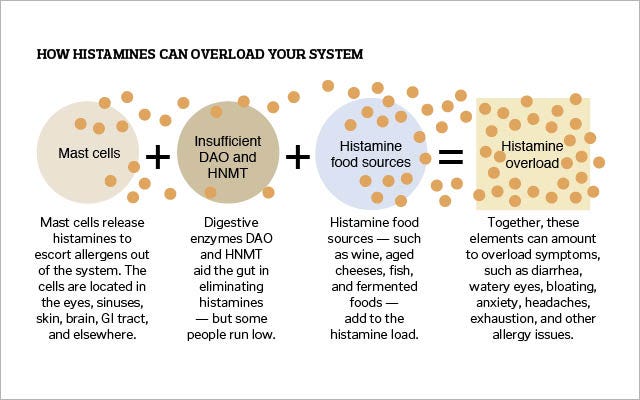
Under healthy conditions, histamine is produced, released, does its job, and gets broken down through two primary enzymatic pathways: diamine oxidase, which works outside the cell, and histamine N-methyltransferase, which works inside it.
When those pathways are functioning well, the whole system hums along without incident.
When they are not, the signal starts to pile up. And because histamine receptors are distributed across virtually every tissue in the body, the effects of that accumulation show up everywhere at once, which is exactly what makes it so hard to trace back to a single source.
One Molecule, Four Jobs
Before we go any further, I want to address something I see constantly in online discussions about this topic. People referring to “histamines,” plural. As in, “my histamines are high” or “I’m reacting to histamines.”
There’s only one histamine molecule.
Not a family of them, not multiple versions.
One.
Think of it like a key. There’s one key, but it fits into four different locks. Each lock is in a different room, and each room does something completely different. When histamine, the key, enters one of those rooms, it triggers whatever that room is designed to do. The room it walks into determines what happens next. That’s what a receptor subtype actually means, and it’s why histamine can simultaneously be involved in your allergies, your digestion, your sleep, and your immune response without being four different things.
So, when we talk about histamine “causing problems,” we need to ask: which door did it open, and what was already going on in that room?
The Four Rooms
H1 is the one antihistamines like Benadryl target, and the one that gave histamine its reputation. When histamine binds here, you get vasodilation, increased vascular permeability, smooth muscle contraction, and that signature itch and sneezing response most people associate with allergies (Bongiorno, 2026). H1 also has a quieter role that gets overlooked: it helps regulate your sleep-wake cycle, food intake, and body temperature (Cleveland Clinic, 2023). The allergy response is just the loudest thing this receptor does.
H2 lives primarily in the stomach lining. Its job is to stimulate gastric acid secretion, meaning histamine is actively involved in your digestion at every single meal (Bongiorno, 2026). This is exactly why H2 blocker medications like famotidine work for acid reflux: they’re targeting histamine’s role in the stomach, not allergies. If you’ve ever wondered why acid reflux medications and allergy medications are both called antihistamines, now you know. Different doors.
H3 is where it gets genuinely fascinating. This receptor lives primarily in the central nervous system, where it acts as a presynaptic regulator of neurotransmitter release, including dopamine, serotonin, norepinephrine, and acetylcholine (Bongiorno, 2026). Basically, histamine through H3 is quietly influencing your sleep quality, your appetite, your focus, and your mood every single day. Researchers are actively studying H3 receptor modulation as a potential target for conditions including narcolepsy, Alzheimer’s disease, and obesity (Thangam et al., 2024). Most people have no idea histamine is part of that conversation at all.
H4 is the most recently identified of the four and still the least fully understood. It’s expressed primarily on immune cells including mast cells, eosinophils, dendritic cells, and T lymphocytes, where it plays a role in directing immune cell movement toward sites of inflammation (Bongiorno, 2026). H4 is an active area of research in chronic inflammatory and autoimmune conditions, and it’s highly relevant to the MCAS conversation we’ll get to in a few sections.
One molecule. Four receptors. Simultaneous roles in digestion, neurotransmission, immunity, and inflammation. The allergy story is the smallest part of what histamine does.
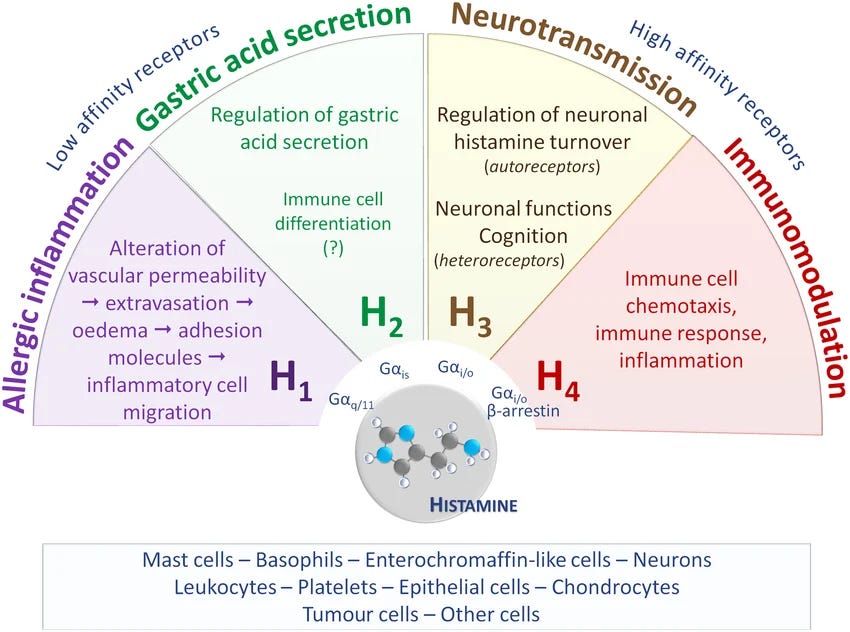
Overview of the main functions of the histamine receptors.
It Starts in the Gut
If there’s one thing I want you to take away from this article, it’s this: histamine intolerance is not primarily a food problem. It’s a gut problem. The gut is where histamine is made, where it’s broken down, and where the decision gets made about how much of it reaches the rest of your body. The food list is downstream of all of that.
Let’s start with where histamine comes from inside the body, because most people don’t realize the gut is actively producing it. Two sources are at work here. The first is your own cells: specialized cells in the stomach lining called enterochromaffin-like cells produce histamine as a normal part of digestion, specifically to trigger gastric acid secretion through those H2 receptors we just covered. The second source is your microbiome. Certain bacterial species in the gut produce histamine directly by converting histidine using the same enzyme your own cells use, histidine decarboxylase (Reese et al., 2017). We’ll come back to why the bacterial piece matters when we get to accumulation.
Now for the other side of the equation: clearance. The gut breaks histamine down through two enzymes working in parallel, and understanding both of them is key to understanding why things go wrong.
Histamine Clearance
The first is diamine oxidase, or DAO. This is the primary extracellular histamine-clearing enzyme, synthesized by the cells lining the intestinal villi and released into the gut space to break down histamine before it gets absorbed into circulation (Maintz & Novak, 2007).
Here’s where the gut-as-root-cause argument really lands: DAO levels directly reflect the integrity and maturation of the small intestinal mucosa (Chen et al., 2022). Your DAO output is only as good as the health of the tissue producing it. A damaged or inflamed gut lining means less DAO activity, and less DAO activity means more histamine slipping through into systemic circulation. This is why gut health is the conversation, not the food list.
The second enzyme is histamine N-methyltransferase, or HNMT. Where DAO works in the space outside the cells, HNMT works inside them. It clears histamine through a process called methylation, attaching a methyl group to the molecule to render it inactive, using a compound called S-adenosyl-L-methionine, or SAM, as the methyl donor (Maintz & Novak, 2007). Because DAO is not expressed in the central nervous system, HNMT is the primary pathway for clearing histamine in the brain, giving it a reach well beyond the gut (Premont et al., 2001).
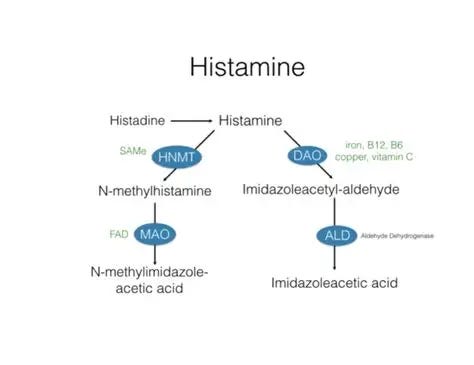
This is also where the MTHFR piece becomes personally relevant for me. MTHFR gene variants reduce the efficiency of the methylation cycle, which can limit SAM availability, which in turn can reduce HNMT’s capacity to clear histamine intracellularly. I haven’t formally worked this up with a physician, but it’s a mechanistically plausible connection worth understanding if you also carry the variant.
DAO and HNMT form the gut’s histamine management system. When both pathways are functioning well and the gut lining is intact, histamine gets produced, does its job, and gets cleared before it causes problems. When either pathway is compromised, whether through gut damage, dysbiosis, genetic variation, or a combination of all three, the load starts to build. And the downstream effects of that buildup don’t stay local. They travel.
The Difference Between Histamine Intolerance and MCAS
This is the section I most wanted to write, because the conflation of these two conditions is at the heart of a lot of the confusion circulating online right now. Histamine intolerance and MCAS are related, they can overlap, and they share a number of symptoms. But they are not the same diagnosis and treating them as interchangeable does a disservice to people who have either one.
If this is landing for you so far, the rest of this article goes deeper.
Paid subscribers get the full breakdown of how histamine accumulation actually happens, including the three converging pathways that push the system past its clearance capacity, and why the food list is rarely the whole story.
We get into the clinical distinction between histamine intolerance and MCAS that the social media conversation keeps blurring, the estrogen-histamine feedback loop and what it means for anyone whose symptoms track with their cycle, and a full system-by-system look at what excess histamine load actually looks like in the body.
The second half covers what to do about it: how to restore clearance capacity rather than just manage symptoms, the DAO cofactors that most protocols overlook, two herbs with solid mechanistic evidence for mast cell stabilization, how to think about quercetin through both food and supplemental forms, microbiome rebalancing and why probiotic strain selection matters more than most people realize, and the methylation piece for anyone carrying the MTHFR variant.
I’ve also included a list of my favorite gut repair supplements, the ones covered in this article, so everything is in one place when you’re ready to take action.
The goal of this article has always been to give you a framework sturdy enough to actually use. The second half is where that framework becomes actionable.