


You're scrolling, maybe in bed, maybe on the couch, maybe waiting for coffee to brew. An influencer holds up a jar of chia pudding and tells you it has fourteen grams of fiber. A friend sends you a screenshot of her breakfast bowl, captioned with a small flex about hitting forty grams before lunch. Someone stitches a video about their fibermaxxing routine and lists every bar, powder, and psyllium scoop that made it into the blender. .
And somewhere in all that scrolling, a small question lands in the back of your head: when was the last time I thought about fiber? Have I EVER, really?

Source Unknown
What the Trend Gets Right
If that question caught you off guard, you’re in good company. Fiber has spent most of its cultural life as the least interesting thing on the nutrition label, a word most of us have skimmed past for years without ever really stopping to think about. Now it’s having a wellness moment, with its own vocabulary and influencers stacking grams like points in a video game.
National consumption data shows that only about 5% of Americans actually meet fiber recommendations, and inadequate intake has been flagged as a public health concern (Quagliani & Felt-Gunderson, 2017). And the research backing why we should care is substantial. Veronese et al. (2025) recently pulled together meta-analyses across more than 17 million individuals and confirmed protective associations between higher fiber intake and reduced risk of cardiovascular disease, type 2 diabetes, colorectal cancer, and all-cause mortality. Reynolds et al. (2019) walked through the same picture in a Lancet meta-analysis drawing on nearly 250 prospective studies and clinical trials. So the data isn’t hiding from us. It’s been here for a while.
What Fiber Actually Does Inside the Body
Let me show you what fiber actually does inside the body, because I think this is the part the wellness feed has been skipping over. In the small intestine, viscous and gel-forming fibers slow gastric emptying and blunt the post-meal blood glucose spike, and that mechanism is part of why higher fiber intake is so consistently associated with improved insulin sensitivity and lower type 2 diabetes risk (Lambeau & McRorie, 2017; Ioniță-Mîndrican et al., 2022). Those same gel-forming fibers bind cholesterol-rich bile acids before they can be reabsorbed, which is one of the cleanest explanations we have for why fiber lowers LDL cholesterol and protects against cardiovascular disease (Lambeau & McRorie, 2017). Soluble fiber also slows down how quickly your body absorbs macronutrients in general, which means a more gradual rise in blood sugar, a longer-lasting sense of fullness after a meal, and better appetite regulation across the day.
In the colon, the picture shifts. Fermentable fibers feed the bacterial communities that produce short-chain fatty acids like butyrate, propionate, and acetate. These are the molecules that nourish the cells lining your gut, calm down inflammation, and help maintain the integrity of the gut barrier itself (Ioniță-Mîndrican et al., 2022). A well-fed microbiome is also a more diverse and more stable one, and a diverse microbiome is better at producing the immune-modulating signals that help your body tell the difference between real threats and harmless dietary input. Adequate fiber intake has been linked to lower rates of colorectal cancer, reduced systemic inflammation, and better outcomes in inflammatory bowel disease, and all of those trace back, at least in part, to what’s happening at the level of the colon and its bacterial residents (Ioniță-Mîndrican et al., 2022).
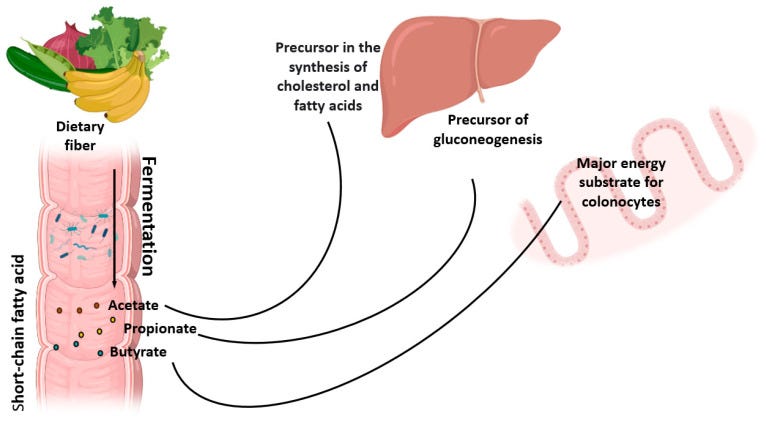
Fiber fermentation and its utilization pathways. Created with BioRender.com.(Ioniță-Mîndrican et al., 2022)
If we look at how fiber works in both the small and large intestine, it's pretty clear that it's carrying the team here. Working on glycemic control, cardiovascular health, inflammation, AND the microbiome, it's not hard to see why this trend is here in the first place.
There’s a wrinkle in the literature I want to flag before we go any further, though. Lambeau and McRorie (2017) put together a clinical review specifically on fiber supplementation and found that most isolated fiber supplements on the market don’t actually reproduce the clinically proven benefits seen with dietary fiber from whole foods. The bars and powders and scoops that fibermaxxing leans on aren’t always the same thing the studies were measuring, and that’s a thread we’ll come back to in Part 2, because plants are going to be your biggest ally here. :)
Where The Trend Loses the Plot
That same 2022 review is titled, carefully, Therapeutic Benefits AND Dietary Restrictions of Fiber Intake, and the second half of that title is one to keep an eye on. The medical literature itself acknowledges that fiber is not universally tolerated, that certain conditions actually require fiber restriction rather than expansion, and that the response to increased intake varies considerably from one gut to another. The trend has held onto the first half of that sentence and lost the second.
This is the part of wellness culture that gets under my skin. Every few months a new trend lands in the feed with the same premise: here’s a single variable, here are the grams or the minutes or the milligrams, stack them, reap the result. It flattens human physiology into a checklist. And what gets lost in that flattening is the part that actually MATTERS, which is that we may all be humans (I think👀), but our bodies are running very different programs underneath.
What helps one person can absolutely make another person worse, and fiber is one of the clearest examples of that anywhere in nutrition.

When I posted about fibermaxxing a little while ago, I wasn’t ready for how many of you had stories to share. You’d tried it, adding the chia and the psyllium and the inulin-heavy bars and the beans at every meal, and your guts hadn’t thanked you for any of it. There was bloating that stuck around for hours, gas that didn’t make sense, discomfort you’d been told was a sign of “healing” and had slowly realized was something else entirely. A handful of you named the conditions you were already navigating, with gastroparesis coming up the most, alongside IBS, SIBO, and the long aftermath of antibiotics. Most of you just felt confused, because a thing that was supposed to help had left you feeling WORSE, and nobody in the feed was explaining why.
That’s what I want to get into today. What fermentable fiber actually asks of the gut, why some bodies handle that ask well and others don’t, and where the plants fit into all of this, because the herbal tradition has been working with inulin-rich roots for a very long time in ways that look almost nothing like the supplement aisle.
The rest of this article is for paid subscribers.
Behind the paywall, we get into the four physiological variables that determine whether fermentable fiber lands as fuel or as friction in your particular gut:
Motility: what gastroparesis and slow-transit patterns actually do to fiber tolerance, why the clinical standard for gastroparesis involves fiber restriction, and what to consider if you suspect motility is part of your picture.
Location: the geography of fermentation in the gut, why SIBO turns fiber into a problem instead of a benefit, and what’s happening at the level of bacteria, the small intestine, and the colon.
Population: how your microbiome adapts (slowly) to changes in fiber intake, and what happens when you outpace it.
Barrier and Sensitivity: why some guts experience normal fermentation as pain, and what post-infectious or post-antibiotic sensitivity means for fiber tolerance.
I also walk through what fiber actually does inside the body, why most fiber supplements don’t reproduce the benefits seen with whole-food fiber, and what to take with you if you’ve tried fiber and didn’t feel your best afterward.
Part 2 drops next Friday and picks up where Part 1 leaves off. We’ll get into the herbal tradition’s relationship with fermentable fiber, the chemistry of inulin and fructans, and the plants that have been doing this work thoughtfully for centuries: chicory, dandelion, burdock, and plantain. We’ll get into clinical reasoning, dose, preparation, and how to actually work with these plants in a way that respects what your gut is telling you.
If you’ve been on the fence about upgrading, this is a good week to do it. Two paid pieces in one week, with a Field Notes in between, all on the same theme. Your subscription supports independent, science-forward herbal writing that doesn’t lean on hype, fear, or oversimplification, and it gives you access to the full archive of clinical reviews, materia medica deep dives, and Field Notes essays.