


While trudging along and working on assignments this week, this topic sort of fell into my lap, and I ended up finding the literature behind it really interesting.
We know that phytoestrogens aren’t actually estrogens. They aren’t steroid hormones, but some of them share enough structural similarity with estrogen that they can interact with estrogen receptors in the body. I’ll get much more into what that means, do not worry. Knowing that, though, opens up an interesting question: if phytoestrogens can interact with some of the same receptors as estrogen, can any of estrogen’s specific physiological effects also be seen with phytoestrogens?
There is obviously a LOT of nuance packed into that question. Estrogen has effects throughout the body, phytoestrogens are a pretty broad group of compounds, and sharing a receptor doesn’t automatically mean two substances are going to produce the same biological response. There are a lot of different pathways we could wander down here, so I want to narrow our investigation to one that caught my attention while I was reading: neuroprotection.
Research has proposed several different mechanisms through which estrogen may be neuroprotective. That made me curious about what we know about phytoestrogens along those same pathways:
Can they influence some of the same processes involved in neuronal damage, and if so, are they doing it through the same mechanisms?
That’s what we’re sorting through today!
So here are the questions I’m looking to answer:
What does “neuroprotective” mean?
So, how is estrogen neuroprotective?
Where do phytoestrogens enter the picture?
What does the research on genistein show?
Does the gut microbiome change the answer?
Are we seeing the same neuroprotection as estrogen?
Photo by Katya Azimova on Unsplash

What Does “Neuroprotective” Mean?
Neuroprotection is exactly what it sounds like: protecting neurons and other components of the nervous system from injury or damage.
We can be talking about an acute injury, like the damage that occurs during a stroke, or damage that develops alongside neurodegenerative diseases like Alzheimer’s and Parkinson’s disease (Khushi et al., 2026).
What does “protecting” a neuron look like on a physiological level? Well, it helps to look at what can damage one. If we can identify the processes that contribute to neuronal damage, we can also start to see where something might step in and interfere with that process. Those points become potential targets for neuroprotection.
The ones I want us to focus on today are oxidative stress, inflammation, apoptosis, and excitotoxicity (Khushi et al., 2026).
Oxidative stress: This happens when the production of reactive oxygen species, or ROS, overwhelms the systems available to manage them. Those reactive molecules can damage cellular components, which makes antioxidant activity one potential avenue for neuroprotection.
Neuroinflammation: Microglia are the resident immune cells of the central nervous system. When activated, they can release pro-inflammatory cytokines, making microglial activation and inflammatory signaling another target in neuroprotection research.
Apoptosis: This is programmed cell death, and it involves its own collection of signaling pathways, including caspases and changes in mitochondrial function. We’ll be meeting some of the proteins involved in this process again when we get to genistein!
Excitotoxicity: Neurons communicate using neurotransmitters, and glutamate is the major excitatory neurotransmitter in the central nervous system. Excessive glutamate activity can lead to too much calcium entering neurons, kicking off a cascade that can ultimately damage or kill the cell (Khushi et al., 2026).
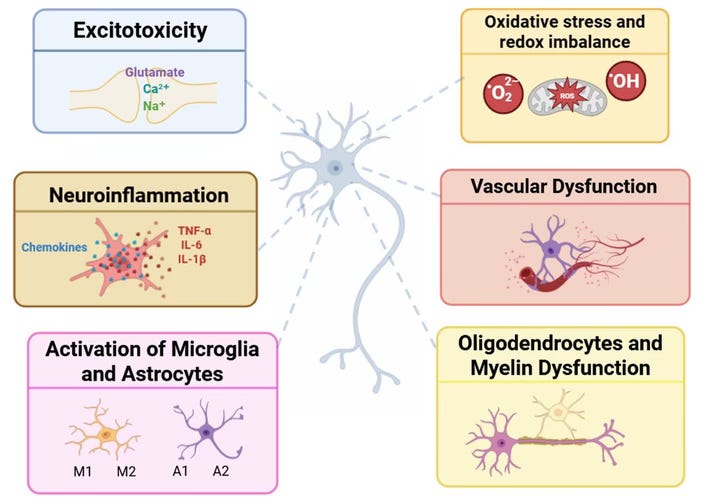
Overview of the mechanisms involved in neuronal damage associated with neurodegenerative diseases.
So, How Is Estrogen Neuroprotective?
When we hear estrogen, most of us probably associate it with the reproductive system. But estrogen is doing quite a bit outside of reproduction too, and there are estrogen receptors throughout the brain! Estrogen signaling has been associated with synaptic plasticity, cholinergic signaling, neuroinflammation, and neuronal survival (Brann et al., 2007; Manasa et al., 2026).
And that connection to neuronal survival is what we’re interested in today :)
Estrogen appears to interact with several of the same processes we just learned can contribute to neuronal damage. It has demonstrated antioxidant activity, for example, which may help limit cellular damage associated with reactive oxygen species. It has also been shown to attenuate activation of NMDA receptors, giving us a potential connection to the excitotoxicity we just talked about (Simpkins et al., 2012).
Our microglia have returned too! Estrogen has been shown to suppress microglial activation and reduce inflammatory responses in experimental models of cerebral ischemia (Brann et al., 2007). So now we have another one of our neuroprotective targets showing up: neuroinflammation.
Then there’s apoptosis. Estrogen can influence cellular signaling involved in whether a neuron survives or progresses toward programmed cell death. ERK and PI3K/Akt are two pathways that show up in this research, and both are associated with promoting cell survival and inhibiting apoptosis (Simpkins et al., 2012). I’m going to leave the signaling alphabet soup there for now, thank you.
The piece I want us to take with us is that estrogen appears capable of influencing some of the cellular machinery involved in keeping a neuron alive.
Can Estrogen Protect the Blood-Brain Barrier Too?
The blood-brain barrier is a really cool piece of anatomy. It creates a highly selective barrier between our circulating blood and the tissue of the central nervous system, tightly controlling what is able to move into and out of the brain. And estrogen may have a role in maintaining it!
The blood-brain barrier is lined by endothelial cells that are connected by tight junctions, which help restrict movement between those cells and maintain the barrier. Claudin-5 is the name of one of the proteins that helps form these tight junctions. Research has shown that estrogen can increase claudin-5 expression as well as endothelial resistance. Pretty cool! Lower estrogen levels have also been associated with increased permeability of the BBB (Manasa et al., 2026). I’d be interested to know whether that relationship is directly connected to changes in claudin-5 expression.
There are also matrix metalloproteinases, or MMPs. These are enzymes capable of breaking down components of the extracellular matrix, and increased MMP activity can contribute to disruption of the BBB. Estrogen has been shown to inhibit MMP activity, giving us another proposed mechanism for how estrogen may help protect the integrity of the blood-brain barrier (Manasa et al., 2026).
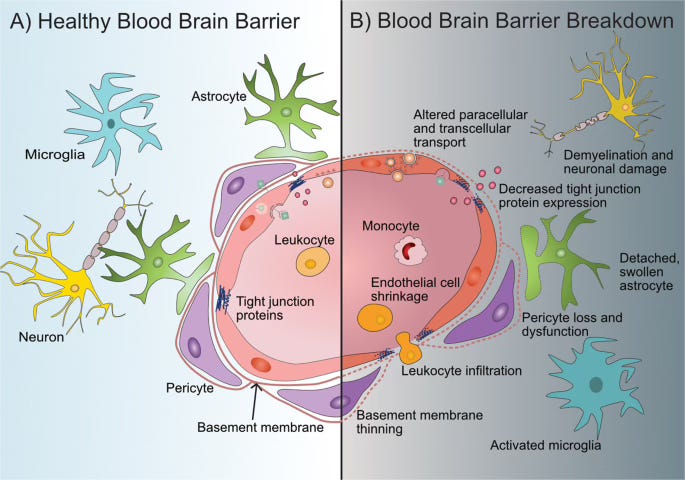
The blood-brain barrier (BBB) in a healthy state compared with BBB breakdown.
Do We See Evidence of Less Neuronal Damage?
Cerebral ischemia is a good example of several of these mechanisms happening at once.
When blood flow to an area of the brain is interrupted, neurons are suddenly deprived of oxygen and glucose, and that can set off oxidative stress, inflammation, excitotoxicity, and eventually cell death. So what happens if estrogen is present? In animal models of cerebral ischemia, estrogen administration has been shown to reduce infarct volume. In other words, researchers found a smaller area of damaged brain tissue following the ischemic injury (Brann et al., 2007).
Most of the evidence we’ve looked at so far is preclinical, though, so we do need to keep that limitation in mind!
Where Do Phytoestrogens Enter the Picture?
Okay, now we can finally add the plants into this!!
Phytoestrogens are naturally occurring, non-steroidal compounds found in plants, and some share structural similarities with 17β-estradiol. That similarity allows certain phytoestrogens to bind to estrogen receptors and influence estrogen signaling in the body (Gorzkiewicz et al., 2021). Phytoestrogen is also a pretty broad term, though. There are several different groups of these compounds, with much of the research into their potential neurological effects focusing on soy isoflavones like genistein and daidzein (Gorzkiewicz et al., 2021).
