


Welcome to the June 2026 AMA answers! (…yes, it’s September and I’m still working through JUNE!? I’m behind, y’all, I’m behind!)
The AMA is not, and never will be, a replacement for a consultation. I cannot and will not answer personal or individualized health questions. Where a question is specific to one person, I’ll answer the general version of it instead.

Question 4: How long can dandelion root and yellow dock root be used regularly, particularly for chronic constipation?
Okay! I’ve been sitting on this question for a bit because I really wanted to dig into the research before answering it.
The original question was about the regular use of dandelion root (Taraxacum officinale) and yellow dock root (Rumex crispus) for chronic constipation, with the reader mentioning that she had heard dandelion wasn’t a “forever herb.”
Which immediately made me wonder...what exactly is a forever herb?
Because really, how long can we take an herb? We talk about some plants as being better suited for short-term use and others as being appropriate for longer periods, but I wanted to know what we actually have to support those recommendations for these two plants.

Okay, Let’s Start With Dandelion
Dandelion (Taraxacum officinale) has a pretty long history of use for digestive complaints, including constipation, dyspepsia, flatulence, and loss of appetite (Martinez et al., 2015). So, its appearance here isn’t strange at all. People have absolutely been using this plant for digestive purposes for a very long time.
When I started looking specifically for evidence supporting its use for constipation, though, things got thin pretty quickly.
A 2015 review of Taraxacum found plenty of traditional use, but the authors couldn’t find clinical studies establishing efficacy or dose-response relationships. They also noted that information on dosage, duration of use, and use in specific populations was unavailable (Martinez et al., 2015).
There is some newer research! A 2025 study found that T. officinale increased gastrointestinal motility and fecal output in rats, which sounds pretty relevant to our question (Ali et al., 2025).
Except...they weren’t studying dandelion root.
The researchers used the aerial parts of the plant, extracted with 70% methanol, and administered that extract to rats at doses of 10, 100, and 500 mg/kg (Ali et al., 2025). That gives us some interesting evidence that T. officinale can influence gastrointestinal motility, but we can’t take a methanolic extract of the aerial parts given to rats and use it as evidence for what happens when someone regularly drinks a decoction of dandelion root.
Different plant part. Different preparation. Different population.
So, while dandelion has a long history of digestive use, including for constipation, the research doesn’t give us a nice answer to our original question of how long dandelion root can be taken regularly. And that’s kind of the problem!
So, How Long Can We Take It?
The European Medicines Agency (EMA) has a monograph specifically for dandelion root, recognizing its traditional use for mild digestive complaints, temporary loss of appetite, and increasing urine output. Interestingly, constipation isn’t among the listed indications (EMA, 2022).
When it comes to duration, the EMA recommends consulting a doctor or qualified healthcare practitioner if symptoms persist for longer than two weeks while using dandelion root (EMA, 2022). I’ll admit, when I saw “two weeks,” my little research brain perked right up! Maybe this was where the idea that dandelion shouldn’t be used indefinitely came from?
Buuut monograph doesn’t establish two weeks as the maximum duration of use. The recommendation is about how long someone should continue self-treatment when their symptoms are persisting.
Also, the original AMA question involved a five-year-old, so of course I wanted to know what the monograph had to say about children:
The EMA states that dandelion root isn’t recommended for children under 12 because its use in this age group hasn’t been established due to a lack of adequate data (EMA, 2022).
So...where does that leave us?
We have a LONG history of traditional digestive use, some interesting preclinical research suggesting that T. officinale can influence gastrointestinal motility, and an EMA monograph giving us some guidance around duration of self-treatment. What I couldn’t find was good long-term data giving us a defined duration for regular use of dandelion root.
There’s another problem I have with the statement that “dandelion isn’t a forever herb.”
Which part of the dandelion are we talking about?
Because that isn’t specified. And if I had to make an herbalist/medically trained guess about what someone meant by that statement, my first thought would be the leaves and their action as a diuretic.
Dandelion leaf contains a relatively high amount of potassium, which often comes up when discussing its diuretic action. But I have questions!
How much potassium are we getting from the amount of dandelion leaf someone would realistically consume?
How much makes it into the preparation?
Is that amount enough to compensate for what may be lost through increased urination?
So, my best guess is that the “not a forever herb” thing may have originated from concerns about using dandelion leaf as a diuretic over a long period of time, specifically because of the potential for ongoing fluid loss.
That’s my interpretation, though! And this brings us right back to why plant part matters so much! SO MUCH!
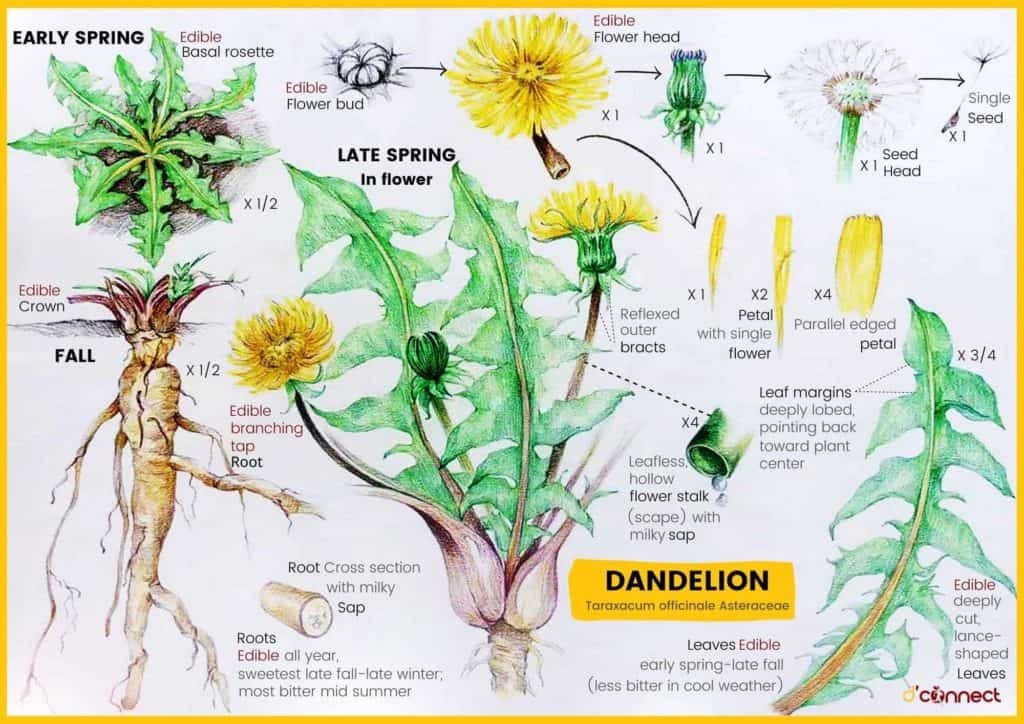
I do not have a direct source for this image, but I wish I did! It’s wonderful!
What About Yellow Dock?
Yellow dock (Rumex crispus) has a long history of traditional use as a laxative, among several other uses (Qian et al., 2024). And unlike dandelion, we have something in its phytochemistry that gives us a little more to work with when we’re trying to understand that use: anthraquinones!
Researchers have identified several anthraquinones in yellow dock root, including emodin, chrysophanol, physcion, rhein, and aloe-emodin (Eom et al., 2020). You may recognize that group of compounds from some of our much more familiar stimulant laxative herbs, which makes their presence in a traditionally laxative plant pretty interesting.
There’s a catch, though. (Why is there always a catch?) How much of those anthraquinones researchers found depended quite a bit on the preparation method. Let me walk you through how:
In one study, researchers first extracted dried yellow dock root with ethanol. They then suspended that extract in water and separated it using n-hexane, dichloromethane, ethyl acetate, n-butanol, and finally water (Eom et al., 2020). Those became the different “fractions” they analyzed.
Basically, they were taking one big extract and separating its compounds into smaller groups based on their chemical properties and which solvents they were more likely to dissolve into.
This let the researchers see that the anthraquinones weren’t distributed evenly across all of those fractions.
And they REALLY weren’t, like really were NOT.
The dichloromethane fraction had the highest total anthraquinone content, followed by the n-hexane fraction, the original ethanol extract, ethyl acetate, and n-butanol. None of the five anthraquinones the researchers measured were detected in the aqueous fraction, though (Eom et al., 2020).
And since our original question was specifically about roots being boiled in water...THIS study doesn’t tell us what would end up in that decoction. Their aqueous fraction was the water-soluble portion left after starting with an ethanol extract and separating it with several other solvents.
They didn’t take yellow dock root, boil it in water the way someone would at home, and analyze the resulting tea.
Truthfully, I really couldn’t find a study that did. I’m not sure the research on a traditional yellow dock root decoction for constipation is out there yet. (If I’m wrong, please please please correct me and drop the study in the comments!) Science likes to make things a bit more complicated, unfortunatelyyyy.
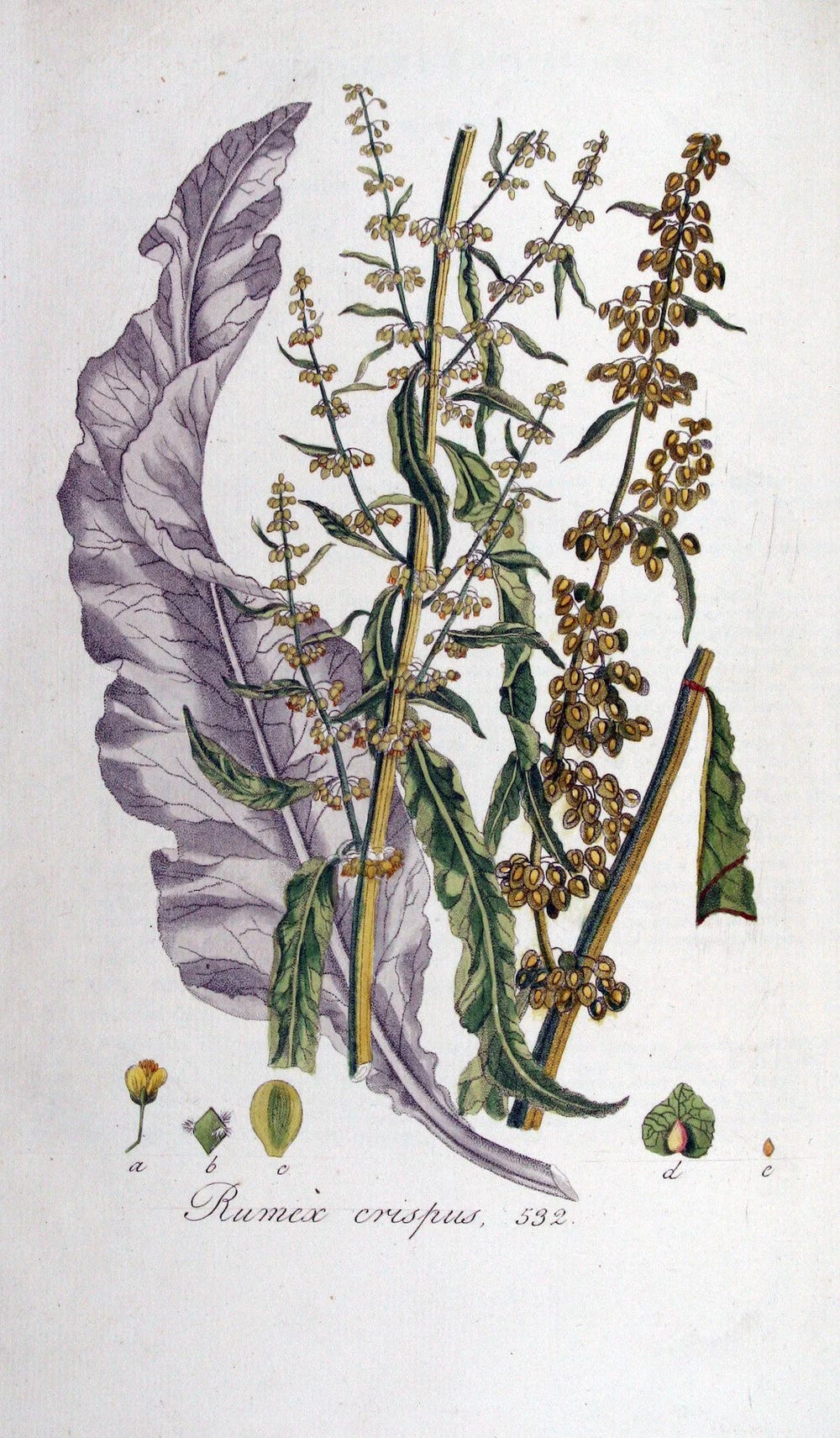
Rumex crispus
But How Long Can You Use Yellow Dock?
This is one place where I did find a much more specific recommendation. YAY!
Ethnobotanist James A. Duke, a longtime USDA researcher and author of the Handbook of Medicinal Herbs, recommends using yellow dock for no longer than 8–10 days (Duke, 2002).
(A little honesty: before researching this article, I hadn’t come across Duke’s work before, but I’m glad I did!)
Duke describes the anthraquinones in yellow dock as laxative compounds that can irritate the gastrointestinal tract. He warns that overuse may cause abdominal cramping and diarrhea, while prolonged use may contribute to hypokalemia and electrolyte imbalance (Duke, 2002).
But I couldn’t find clinical research establishing that 8–10 day limit for yellow dock root. A recent review of R. crispus also calls for more research into its acute, subchronic, and chronic toxicity (Qian et al., 2024).
So, I’d treat 8–10 days as a short-term-use recommendation, rather than a safety cutoff that has been established in clinical research.
But What About the Constipation?
After ALL OF THAT, I personally wouldn’t choose either of these herbs as something to take every day indefinitely for chronic constipation.
With dandelion root, I couldn’t find evidence giving us a clear maximum duration of use. With yellow dock, we have an 8–10 day recommendation from Duke, but we’re missing the clinical research that would establish that as a specific safety cutoff.
For me, though, there’s a bigger issue with using either one as a daily strategy: the constipation is still chronic.
If someone needs an herb every day in order to have a bowel movement, I’d want to start paying attention to what might be contributing. I’d gently introduce more fiber, promote daily movement if they’re able, and start monitoring hydration because, plain and simple, half of us probably aren’t drinking enough water.
I’d definitely pay attention to diet, too! If you want to and you’re able, keeping a food journal for a little while can be really helpful. But you absolutely don’t need a spreadsheet documenting every bite of food you’ve ever eaten. If you can notice how you feel after certain foods, what seems to make constipation better or worse, or any patterns that keep popping up, that’s useful information too. I say that because I personally have an aversion to food journals, like, just let me eat?
And then I’d start asking some bigger questions:
Could a medication be contributing?
Is gut motility impaired?
Is there an underlying digestive issue?
Is something else going on that needs to be addressed?
I might also bring in a mucilage-containing herb supportively, just to make things a little more slippery in there and help things along while working on the larger picture. I wouldn’t expect that herb to fix the underlying cause either.
So, for chronic constipation, I’d be much more interested in figuring out why it keeps happening and supporting the things that can help bowel function along the way. The herbs can absolutely be part of that conversation, but I’d want to look at the whole picture, too.
And I guess this is also a small invitation into the kind of thinking I hope to encourage with this publication. It’s really easy to learn herbalism as a series of pairings: this symptom = this herb. Constipation? Find the constipation herbs. Trouble sleeping? Find the sleep herbs. Headache? Find the headache herbs.
Sometimes that can be useful! But I think we can dig deeper than that.
What is happening physiologically? What could be contributing to the symptom? What patterns are showing up around it? What can we support with food, movement, hydration, lifestyle, or other changes? And then, with that bigger picture in front of us, where might an herb fit?
That’s the kind of herbalism I want to teach here. I want us to zoom out, ask more questions, and understand what we’re trying to support before reaching for a plant.
Until next time,
— Agy | The Buffalo Herbalist
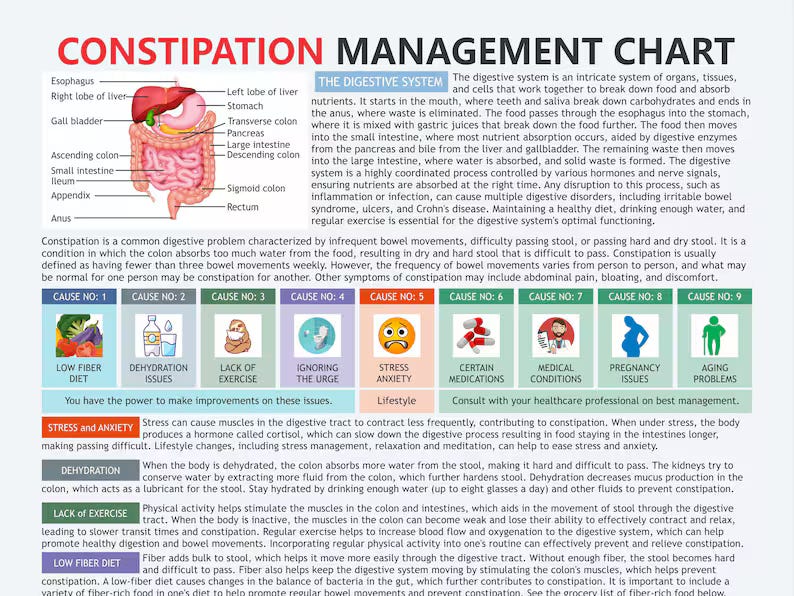
can we see a higher quallity image of that last image please/
and what about dandelion and Long Covid?