It starts as a flicker, light bending at strange angles, a shimmer at the edge of vision.
Then comes the pressure. The nausea. The sound of your own heartbeat thudding louder than the world.
For those who live with migraines, time becomes unpredictable. Plans fracture. Light hurts. Even words, once so easy, can feel distant or lost. Days slip through your fingers, replaced by darkness, silence, and the ache of needing to explain, again, that this isn’t just a headache.
Pharmaceutical treatments help many people, although responses and tolerability vary considerably. Herbal medicine has also been investigated for migraine prevention and treatment, including two plants with long histories of use:
Petasites hybridus, commonly known as butterbur
Tanacetum parthenium, better known as feverfew
Both have made their way from traditional herbal medicine into clinical migraine research. Butterbur root extracts have been studied for migraine prevention in adults as well as children and adolescents (Lipton et al., 2004; Pothmann & Danesch, 2005). Feverfew has also been investigated in several preparations, including dried leaf, standardized CO₂ extracts, and a sublingual feverfew-ginger combination (Cady et al., 2011; Diener et al., 2005; Murphy et al., 1988).
Their pharmacology is interesting, too. Research involving butterbur and feverfew has explored inflammatory signaling, serotonin, vascular activity, and ion channels involved in nociception and neurogenic inflammation (Benemei et al., 2017; Diener et al., 2005).
The clinical evidence isn’t identical between the two plants, and neither is the chemistry behind them. That gives us quite a bit to talk about.

A Brief Look at the Science of Migraine
Before we talk herbs, we have to talk about what’s happening in the body during a migraine, especially one that begins with an aura.
Migraine with aura isn’t just a headache with a light show. It involves neurological symptoms that can include visual disturbances, tingling or other sensory changes, and difficulties with speech or language. Aura is thought to correspond with something called cortical spreading depression: a slowly propagating wave of neuronal and glial depolarization across the cortex, followed by a temporary period of reduced cortical activity (Dodick, 2018).
Basically, there’s a wave of altered electrical activity moving across the cortex, and researchers think this process corresponds with the progression of aura symptoms (Dodick, 2018).
That’s when the migraine physiology keeps moving.
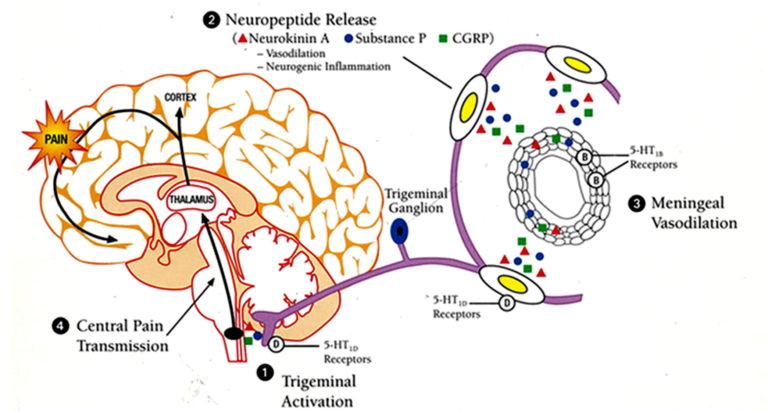
The headache phase involves activation of the trigeminovascular system, which carries pain-related information from the meninges toward the central nervous system. Activation of these pathways can lead to the release of neuropeptides, including CGRP (calcitonin gene-related peptide), which plays an important role in nociceptive signaling and migraine pain (Dodick, 2018).
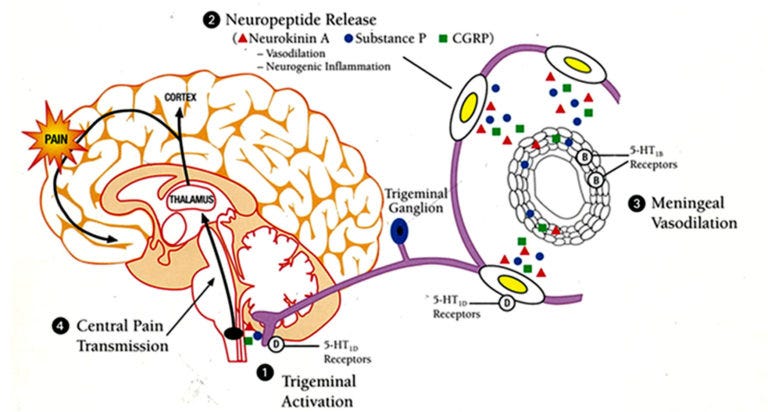
Migraine Pathogenesis
Genetics can influence susceptibility to migraine, although the genetic picture is complex (Dodick, 2018).
You may have heard of genes like CACNA1A and ATP1A2, which affect ion transport and neuronal signaling. These particular genes are associated with familial hemiplegic migraine, a rare inherited form of migraine, so we can’t apply them to everyone who experiences migraine. Broader genetic studies have identified numerous other loci associated with migraine susceptibility (Dodick, 2018).
Everyday factors can also trigger attacks in susceptible people, with commonly reported triggers including changes in sleep, stress, hormonal changes, and sensory stimuli. A trigger doesn’t necessarily explain why someone has migraine, but it can influence when an attack occurs.
So, when we talk about herbs, we’re not talking about vague “relaxation” or “natural” solutions.
We’re talking about plants whose constituents have been investigated for effects involving:
Inflammatory signaling
Serotonin signaling
Vascular activity
Nociceptive signaling
Ion channels involved in sensory neurons
That’s part of what makes the research on butterbur and feverfew so interesting. Researchers have investigated constituents from these plants in relation to several of these pathways (Benemei et al., 2017; Diener et al., 2005).

The rest of this article takes a closer look at butterbur and feverfew, two herbs with long histories of traditional use that have also made their way into modern migraine research.
We’ll look at:
What researchers think each herb may be doing physiologically
What the clinical trials have found
The constituents and biological targets researchers have investigated
Safety, including why the preparation and sourcing of butterbur REALLY matters
And something I was surprised to find: there’s very little research looking at butterbur and feverfew together
The rest of the article is available to paid subscribers of The Buffalo Herbalist. If you enjoy digging into the research with me and want access to the full article, you can upgrade your subscription below.
Paid subscriptions help support the time I spend reading studies, pulling apart mechanisms, and turning all of that into herbal education that doesn’t require a pharmacology textbook sitting beside you. :)
If another subscription isn’t in the cards right now but you’d still like to support my work, you can also “buy me a coffee.” Nothing is expected, and everything is deeply appreciated.