


Before I knew what boneset was, I feared it.
It was one of the first plants I tried to identify as a baby herbalist, growing tall along the wild margin of woods across from my house. The clusters of white flowers looked, to my very untrained eye, like umbels, and my brain immediately went to poison hemlock. (Which, as it turns out, does grow on my property, and I now know the difference, thank you very much.)
Eventually I learned that the mysterious plant across the street was Eupatorium perfoliatum, or boneset. It was one of my earliest lessons in how easily plants can blur together when you don’t yet know which characteristics to pay attention to.
And then I learned its name had its own entire story.
OKAY, WHO’S READY FOR A HISTORY LESSON? :)
Eupatorium has been linked to Mithridates VI Eupator, King of Pontus, through an old medicinal plant name recorded by Pliny. Dioscorides also described a plant called eupatoria in Materia Medica, although that plant was later identified as Agrimonia eupatoria. There’s even some uncertainty over whether eupatoria originally came from hepatoria, referring to the liver (A.Vogel, n.d.).
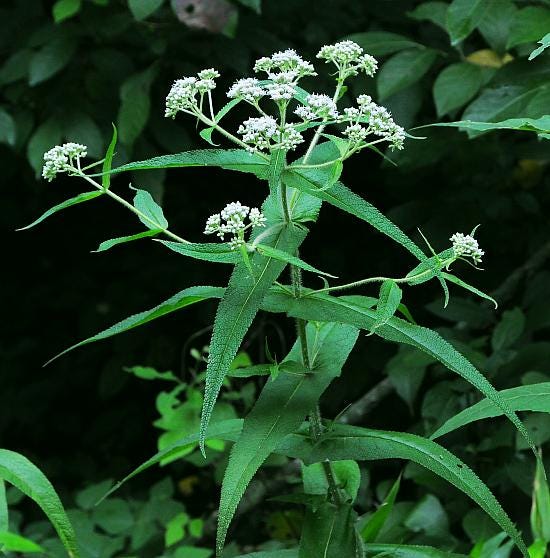
The species name is MUCH easier. Perfoliatum comes from Latin roots meaning “through” and “leafy,” referring to the way the opposite leaves join around the stem and make it look like the stem is growing straight through them (A.Vogel, n.d.). Once you’ve seen it, you get the name immediately.
Boneset also has a long history of medicinal use in North America. Indigenous peoples used the leaves and flowering tops for feverish illnesses, including influenza, colds, and malaria, and as a diaphoretic to encourage sweating (Maas et al., 2011). European settlers later adopted the herb for some of these uses and also used it for inflammatory conditions including rheumatism and arthritis (Maas et al., 2011). Its use became widespread enough that E. perfoliatum appeared in the United States Pharmacopeia from 1820 to 1900 and the National Formulary from 1910 to 1945 (Maas et al., 2011).
And then there’s the name “boneset.”
Historical accounts connect the plant with feverish illnesses accompanied by intense aches and pains. By the late nineteenth century, boneset had become popular enough in North America that it was even described as an “indigenous substitute for quinine” in the treatment of malaria (Maas et al., 2011). The familiar explanation for its common name connects it to “breakbone fever,” particularly dengue, where severe muscle, joint, and bone pain can be a major feature.
So no, the ominous, white-flowered plant across from my house wasn’t poison hemlock.
It was somehow a history lesson waiting for me. :)
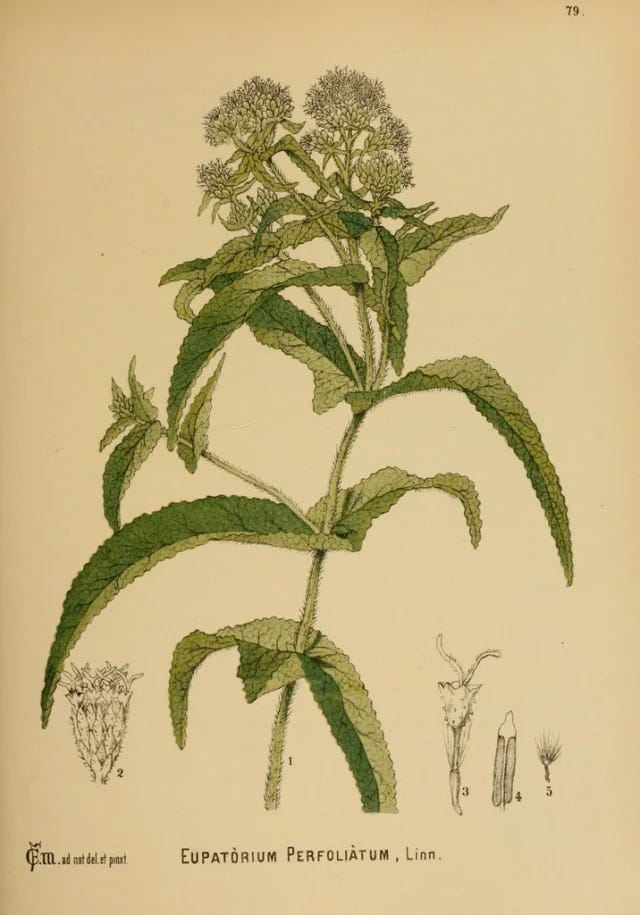
The Shape of the Plant
Boneset (Eupatorium perfoliatum) is a perennial native to eastern North America, where it tends to grow in moist areas like wet meadows, marshes, streambanks, and the edges of ponds and other bodies of water (A.Vogel, n.d.).
The leaves are probably my favorite identification feature because once you see them, they’re HARD to miss. They grow opposite one another and join around the stem, creating that wonderful illusion that the stem has punched straight through a single leaf. The leaves themselves are long and narrow, with toothed edges and a prominent central vein (A.Vogel, n.d.).
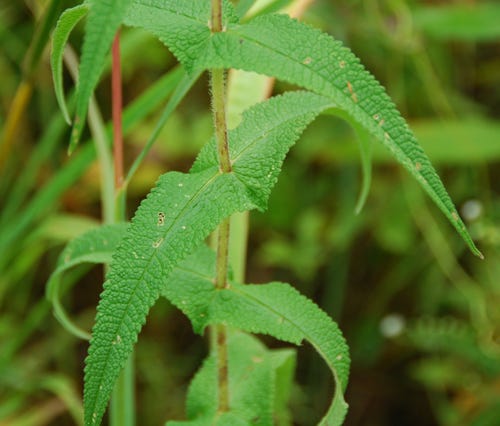
Eupatorium leaves
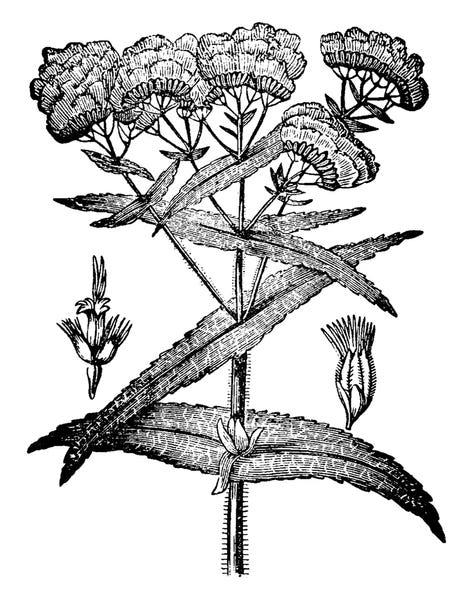
Boneset is a member of the Asteraceae family, although you’re not getting the classic daisy-looking flower you might immediately picture. Its small white tubular flowers gather in dense clusters at the tops of the stems and usually appear in late summer. After flowering, the plant produces small fruits with bristly pappus hairs that help carry the seeds on the wind (A.Vogel, n.d.).
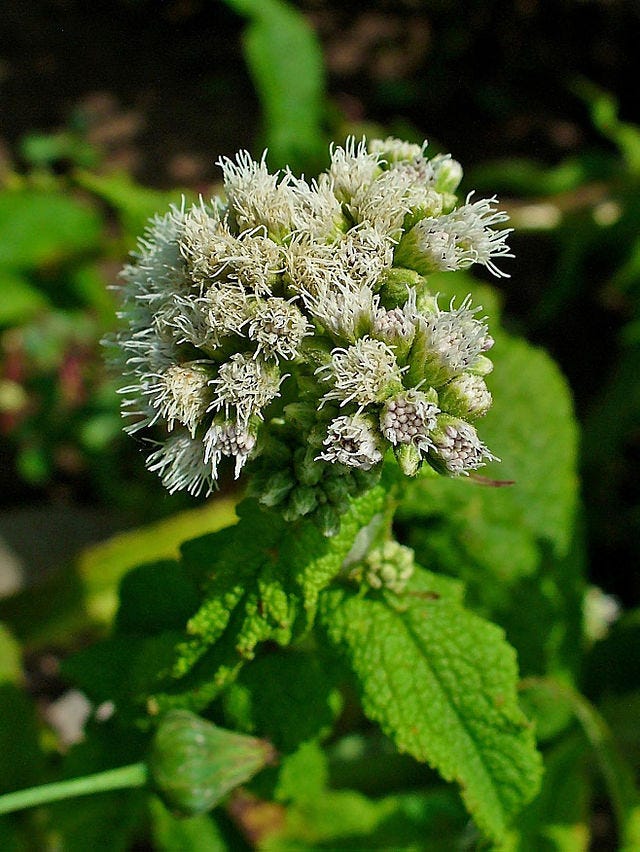
Eupatorium perfoliatum flower
Between those fused leaves and the fuzzy-looking clusters of white flowers, boneset has become a plant I can recognize from VERY far away.
Which is nice considering where this article started. :)
The Way the Plant Works
If we’re talking about boneset from a traditional herbal perspective, this is a bitter herb with a strong association with feverish illnesses.
Herbalist David Hoffmann describes Eupatorium perfoliatum as diaphoretic, bitter, laxative, tonic, antispasmodic, carminative, and astringent (Hoffmann, 2003). That is...quite the résumé. :)
Diaphoretic
Bitter
Laxative
Tonic
Antispasmodic
Carminative
Astringent
The diaphoretic action is probably the one most closely tied to boneset’s historical reputation. Diaphoretic herbs are traditionally used to promote sweating, and historical records describe boneset specifically as a diaphoretic during feverish illnesses (Maas et al., 2011). Pain was also part of its traditional use, including the intense aches associated with febrile illness as well as rheumatism and arthritis (Maas et al., 2011).
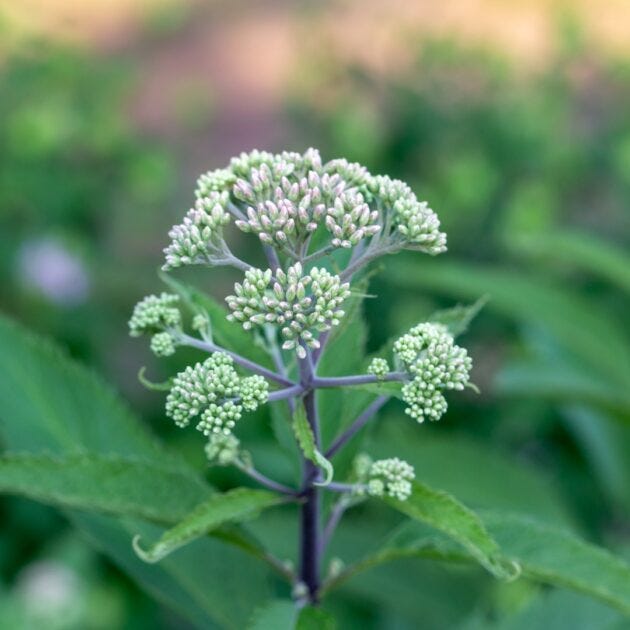
Eupatorium perfoliatum
What Lives Inside the Plant
Okay, let’s crack boneset open. Metaphorically. metaphorically. :)
Eupatorium perfoliatum contains several classes of phytochemicals, including:
Sesquiterpene lactones
Flavonoids and flavonoid glycosides
Caffeic acid derivatives
Triterpenes and phytosterols
Polysaccharides
Volatile oils
Fatty acids and fatty alcohols (Derksen et al., 2016; Maas et al., 2011)
Let’s hang out with the flavonoids for a quick sec.
Flavonoids are polyphenolic compounds produced by plants, and boneset contains several of them. One is eupafolin, which Maas et al. (2011) isolated and tested for anti-inflammatory activity. To do that, the researchers used macrophages, immune cells that participate in the inflammatory response, and exposed them to lipopolysaccharide (LPS). LPS is a component of the outer membrane of certain bacteria and is commonly used in laboratory experiments to provoke an inflammatory response in immune cells. Basically, annoy the macrophages on purpose and then see what happens when you introduce eupafolin.
The stimulated macrophages produced nitric oxide as part of that inflammatory response. When the researchers treated the cells with eupafolin, nitric oxide production decreased. Eupafolin also downregulated several cytokines and chemokines involved in inflammatory signaling (Maas et al., 2011).
So, eupafolin showed anti-inflammatory activity in this experiment. Keep in mind, though, these were macrophages in a dish, not macrophages in a human. We do not reside in dishes. :) We can’t assume the same effect would occur after someone drinks a cup of boneset tea or takes dropper of a tincture.
Eupatorium perfoliatum
Boneset vs. Comfrey: Clearing Up the Name
Despite its name, boneset isn’t a plant used to set broken bones. The name has historically been associated with its use for the intense, deep aching that can accompany febrile illnesses. One explanation links the name specifically to “breakbone fever,” an old name for dengue, although historical herbal texts also describe boneset for the limb and back pain associated with influenza, colds, and rheumatism (Hoffmann, 2003). It’s easy to see how the name could cause some confusion, especially since comfrey (Symphytum officinale) has its own long history of use around bones and connective tissue.
Herbalist David Hoffmann, referencing King’s American Dispensatory, offers some helpful context:
“In influenza it relieves pain in the limbs and back. Its popular name ‘boneset’ is derived from its well-known property of relieving the deep-seated pains in the limbs which accompany this disorder, and colds and rheumatism. Often this pain is periosteal, and if neuralgic in character, or due to a febrile condition, Eupatorium will relieve it. But it is not a remedy for periosteal pain due to inflammation or to organic changes in the periosteum.”
Periosteal pain refers to pain involving the periosteum, the thin layer of connective tissue surrounding the outer surface of bone. So that gives a little more context to the wonderfully dramatic name “boneset.” Its historical use centered around the deep, bone-aching kind of pain associated with illness, not repairing the bone itself (Hoffmann, 2003).

Periosteum
Comfrey is where the bone-healing conversation takes a different turn. Sakakura et al. (2008) studied a homeopathic preparation of Symphytum officinale 6CH in 48 rats. Each rat received a titanium micro-implant in its tibia, and the researchers used digital radiographs to evaluate bone density and bone formation around the implants. At 14 days, the comfrey-treated group had significantly higher radiographic bone-density measurements than the control group, and a significant difference in the area corresponding to bone gain was observed at seven days (Sakakura et al., 2008).

Now, that is a VERY specific experimental setup. We have rats, titanium implants, and homeopathic comfrey 6CH, so we cannot take those results and declare that comfrey regenerates broken bones in humans. That would be asking a rat with a tiny titanium implant to answer a much bigger question than anyone asked it! I do think, however, it’s an interesting study to place alongside comfrey’s much older association with bones and connective tissue, though.
Boneset and comfrey may have names and traditional uses that bring bones into the conversation, but they got there by very different routes.
A Closer Look at the Research
This is by nooo means a comprehensive review of the research on Eupatorium perfoliatum. These are simply a couple of studies I came across that made me go, “wait...what?” So, obviously, I want to talk about them. :):)
Eupatorium and COVID-Related Inflammation
One recent study looked at how an ultradiluted preparation of Eupatorium perfoliatum affected inflammation caused by the SARS-CoV-2 spike protein. Researchers used both cultured cells and mice to explore how exposure to recombinant spike protein, even without the virus itself, could trigger inflammatory and oxidative changes (Roy et al., 2025). There was no active SARS-CoV-2 infection in this experiment! Okay? They were specifically studying what happened in response to the spike protein itself.
The spike protein activated an inflammatory pathway involving NF-κB, which is one of those abbreviations you see ALL over inflammation research. NF-κB is a transcription factor, meaning it helps control which genes a cell turns on and off. When activated during an inflammatory response, it can increase the expression of genes involved in inflammatory signaling (Roy et al., 2025).
In this study, the researchers found increased IL-1β and IL-18, two inflammatory cytokines, along with caspase-1, an enzyme involved in activating them (Roy et al., 2025). They also found increased reactive oxygen species (ROS), inflammatory cells infiltrating the lungs of the mice, and evidence of mitochondrial damage (Roy et al., 2025). So, the spike protein was doing exactly what the researchers brought it there to do: causing problems.
Okay, so what happened when they fianlly added the Eupatorium preparation? The researchers observed several changes (Roy et al., 2025):
NF-κB signaling decreased
IL-1β, IL-18, and caspase-1 decreased
There was less inflammatory cell infiltration into the lungs
Reactive oxygen species and oxidative stress were reduced
Mitochondrial integrity was better preserved
This means that, several parts of the inflammatory and oxidative response triggered by the spike protein were reduced after treatment with the Eupatorium preparation (Roy et al., 2025). I’m especially interested in the mitochondrial finding because ROS and mitochondria are closely connected!
Mitochondria generate ROS during normal cellular metabolism, while excessive ROS can also damage mitochondrial membranes, proteins, and other cellular components. In this experiment, the researchers reported both reduced oxidative stress and better preservation of mitochondrial integrity after treatment (Roy et al., 2025). Very cool. I have questions. Obviously.
Now, we do have a couple of giant asterisks floating around this study. Remember how I mentioned that this was an ultradiluted preparation made through serial dilution in ethanol according to the Pharmacopoeia of India, not a typical boneset tea, tincture, or herbal extract (Roy et al., 2025)? And also, keep in mind, we also have cells and mice, not humans, and there was no active SARS-CoV-2 infection.
So no, this study does not tell us that boneset treats COVID-19. It tells us that this particular preparation reduced several inflammatory and oxidative responses in these experimental models after exposure to recombinant SARS-CoV-2 spike protein.
But regardless, I think this is still pretty cool.
Eupatorium and the Lymphatic System: A New Possibility
In a recent study, Kim et al. (2022) explored the effects of Eupatorium perfoliatum on the lymphatic system. The lymphatic system plays a vital role in immune surveillance and maintaining fluid balance within tissues. When lymphatic function is impaired, it can contribute to conditions including lymphedema, chronic inflammation, and impaired wound healing (Kim et al., 2022). Supporting lymphatic flow is also a long-standing concept in herbalism, which makes this study especially interesting to me.
Scientists screened a library of more than 1,900 plant extracts and found that a petroleum ether extract from the aerial parts of Eupatorium perfoliatum had a notable effect on human lymphatic endothelial cells, which are the cells that form the inner lining of lymphatic vessels (Kim et al., 2022). The extract stimulated the cells to sprout and form new lymphatic “tubes,” a process known as lymphangiogenesis (Kim et al., 2022). Using HPLC activity profiling, the researchers identified pheophorbide a, a compound derived from chlorophyll, as the constituent associated with this activity. Both the full plant extract and pheophorbide a promoted sprouting and tube formation, while pheophorbide a also increased the proliferation of the lymphatic endothelial cells. Interestingly, the full extract did not increase proliferation, so the isolated compound and the whole extract weren’t behaving identically (Kim et al., 2022).
The researchers also wanted to know what might be happening on a signaling level. When they added a MEK1/2 inhibitor, which blocks part of a cellular signaling pathway involved in processes like cell growth and proliferation, the sprouting response decreased (Kim et al., 2022). This suggests MEK1/2 signaling may have been involved in the lymphangiogenic activity they were seeing. So, what are we looking at here? In cultured human lymphatic endothelial cells, a boneset extract and one of its identified constituents promoted behaviors involved in the formation of lymphatic vessels (Kim et al., 2022). That is VERY cool. It also happened in cells in a lab using a petroleum ether extract, so we’re not watching someone drink boneset tea and suddenly grow themselves a shiny new lymphatic vessel.
For herbalists, I think this is an especially fun study to stumble across given boneset’s traditional associations with lymphatic movement, stagnation, and swelling. I do want to keep that traditional herbal use separate from what Kim et al. (2022) demonstrated experimentally, though. They investigated lymphatic endothelial cells, not whether boneset improves lymphatic flow or treats swelling in humans. Their experiment gives us a fascinating little piece of the puzzle without answering those much larger clinical questions.
I knew very little about boneset before I started learning about it. I didn’t even know its name when I first spotted those fuzzy white flowers from across the field and confidently decided I was looking at poison hemlock. So, we’ve come a long way here.
And what a fun plant to get to know. Boneset has this long history of use for feverish illnesses and those deep, miserable body aches, and then you start poking around in the research and suddenly we have eupafolin affecting inflammatory signaling in macrophages, an ultradiluted preparation being studied in a model of spike protein-induced inflammation, and pheophorbide a making lymphatic endothelial cells sprout in a dish. I did not see that last one coming.
I think boneset is also a really good example of why we can’t rely on a common name to tell us what a plant is or what it has been used for. If I handed you the name “boneset” with absolutely no context, I don’t think “deep body aches during febrile illness” would be your first guess. You might reasonably assume we’re talking about a plant traditionally used to heal bones, which sends us straight over to comfrey territory. The name only starts to make sense once we learn the history behind it.Every medicinal plant comes with its own context: its botanical identity, the people who used it, how they prepared it, what they used it for, and eventually, the questions researchers decided to ask about it.
Honoring a plant means taking the time to learn those things instead of reducing it to a common name and a list of supposed “benefits.” That requires diligent study, and frankly, I think it makes herbalism WAY more interesting.
Until next time, friends!
—- Agy | The Buffalo Herbalist
Bibliography
Eupatorium perfoliatum L. | Boneset | Plant Encyclopaedia | A.Vogel. (n.d.). https://www.avogel.ch/en/plant-encyclopaedia/eupatorium_perfoliatum.php
Derksen, A., Kühn, J., Hafezi, W., Sendker, J., Ehrhardt, C., Ludwig, S., & Hensel, A. (2016). Antiviral activity of hydroalcoholic extract from Eupatorium perfoliatum L. against the attachment of influenza A virus. Journal of Ethnopharmacology, 188, 144–152. https://doi.org/10.1016/j.jep.2016.05.016
Eupatorium perfoliatum (boneset thoroughwort): Go Botany. (n.d.). https://gobotany.nativeplanttrust.org/species/eupatorium/perfoliatum/
Kim, J., Gousopoulos, E., Faleschini, T. M., Hamburger, M., Potterat, O., & Detmar, M. (2022). Pheophorbide a identified in an Eupatorium perfoliatum extract is a novel lymphatic vascular activator. Biomedicine & Pharmacotherapy, 147, 112664. https://doi.org/10.1016/j.biopha.2022.112664
Roy, A., Sarkar, A., Roy, A. K., Ghorai, T., Nayak, D., Kaushik, S., & Das, S. (2025). Ultradiluted Eupatorium perfoliatum Prevents and Alleviates SARS-CoV-2 Spike Protein-Induced Lung Pathogenesis by Regulating Inflammatory Response and Apoptosis. Diseases, 13(2), 36. https://doi.org/10.3390/diseases13020036
Sakakura, C. E., Neto, R. S., Bellucci, M., Wenzel, A., Scaf, G., & Marcantonio, E. (2008). Influence of homeopathic treatment with comfrey on bone density around titanium implants. A digital subtraction radiography study in rats. Clinical Oral Implants Research, 19(6), 624–628. https://doi.org/10.1111/j.1600-0501.2007.01514.x
Maas, M., Deters, A. M., & Hensel, A. (2011). Anti-inflammatory activity of Eupatorium perfoliatum L. extracts, eupafolin, and dimeric guaianolide via iNOS inhibitory activity and modulation of inflammation-related cytokines and chemokines. Journal of Ethnopharmacology, 137(1), 371–381. https://doi.org/10.1016/j.jep.2011.05.040
Hoffmann, D. (2003). Medical Herbalism: The science and practice of herbal medicine. https://openlibrary.org/books/OL8233157M/Medical_Herbalism
Not for bones per se but for Dengue Fever, otherwise known as Breakbone in a nod to pain severe pain it causes! Fun post!