


The most important structure in your gut isn’t a cell.
It isn’t a membrane.
It isn’t even a microbe.
It’s a biofilm. You’ve been told to destroy it.
Right now, as you read this, the lining of your colon is covered in a biofilm.
So is your mouth. So is your vaginal tract, if you have one. So is your skin.
This is normal. This is healthy. Your body built these structures on purpose, and it maintains them with the same seriousness it brings to immune surveillance or wound repair.
The wellness internet has spent the last several years telling you that biofilms are the hidden enemy. That they shield pathogens. That they explain why your gut protocol didn’t work. That you need enzymes and antimicrobials and rotating “biofilm busters” to crack them open and flush them out.
Some of that contains a grain of truth. Most of it skips the physiology entirely.
Biofilms are one of the oldest and most successful survival strategies in the microbial world. They exist on nearly every surface on Earth, biological and otherwise. They predate multicellular life. They predate us by billions of years. When bacteria decided that cooperation was more effective than solitude, biofilms were what they built.
Your body evolved to use them.
This article is the full story. The physiology of what biofilms are and why they form. The ecology of where they protect you and where they cause harm. The phytochemistry of what specific plant compounds can do at the molecular level when something has actually gone wrong.
Body first. Plants second.

What Biofilms Actually Are
A biofilm is a community.
Picture a city. Individual bacterial cells are the residents. They arrive at a surface, test it, and if the conditions are favorable, they commit.
They anchor themselves. They begin secreting a shared extracellular matrix, a scaffolding made of polysaccharides, secreted proteins, and extracellular DNA that holds the community together and gives it structure.
This matrix is the infrastructure of the city. The roads, the walls, the communication networks. Without it, the community would be a loose scattering of individual cells with no way to function collectively.
The technical name for this scaffolding is extracellular polymeric substance, or EPS. It makes up roughly 90% of a biofilm’s total biomass. The bacterial cells themselves account for the remaining 10%. This is important to understand, because when we talk about disrupting biofilms later, we are often talking about targeting the matrix rather than the cells inside it.
How a Biofilm Forms
Biofilm formation follows a predictable sequence.
It begins with reversible attachment. Individual planktonic (free-floating) bacterial cells encounter a surface and loosely adhere to it. At this stage, they can still detach and drift away.
If conditions are right, the attachment becomes irreversible. The cells begin producing EPS (the “scaffolding”). They recruit neighbors. They form microcolonies, small clusters that grow and merge into a structured, three-dimensional community.
As the biofilm matures, it develops water channels that function like a circulatory system, delivering nutrients to cells deep within the structure and carrying waste products out. Eventually, portions of the biofilm disperse, releasing planktonic cells that travel to new surfaces and begin the cycle again.
It’s actually quite remarkable if you think about it.
Every stage of this process is coordinated. The coordination system is called quorum sensing.
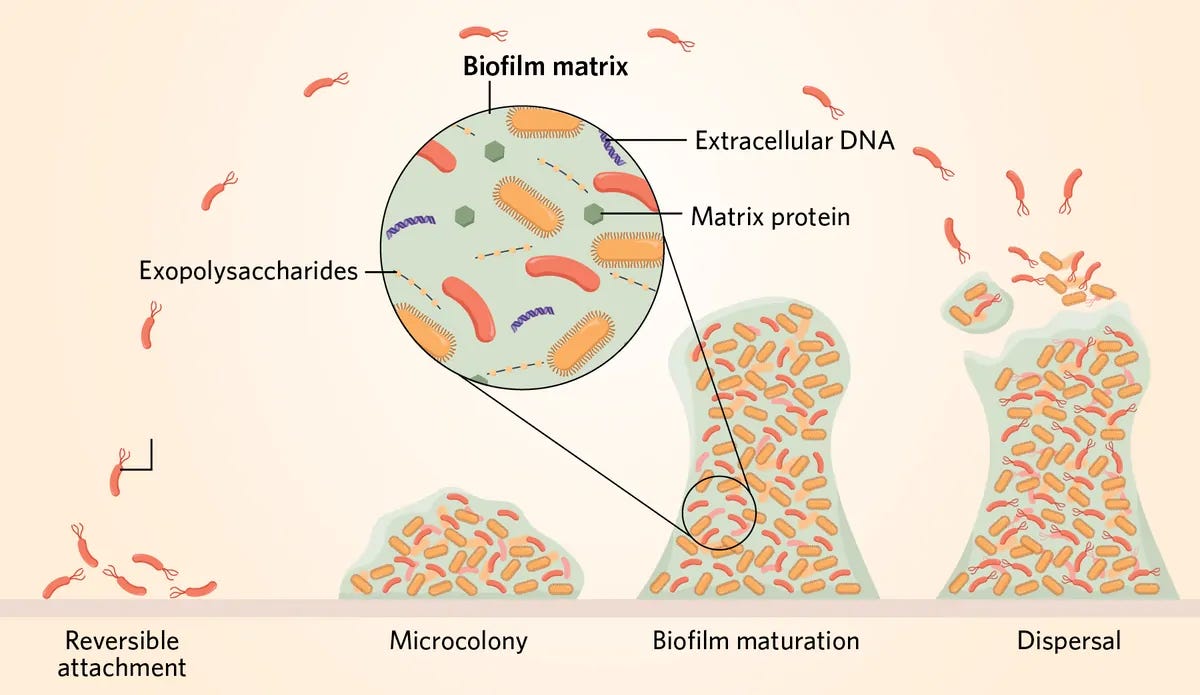
Stages of Biofilm
How They Communicate
Quorum sensing is bacterial communication.
Bacteria release signaling molecules into their environment, and as the population grows, the concentration of those molecules rises. When it hits a certain threshold, it flips a switch. Gene expression changes across the entire community at once. The biofilm collectively ramps up matrix production, activates virulence factors, shifts motility, or coordinates dispersal.
Different bacteria use different signaling currencies.
Gram-negative species primarily use acyl-homoserine lactones (AHLs).
Gram-positive species use autoinducer peptides.
Some signals, like autoinducer-2, cross species boundaries entirely, meaning different bacterial species within the same biofilm can coordinate with each other.
This becomes important later when we talk about how certain plant compounds interfere with these signaling systems.
The takeaway here is that a biofilm is a decision-making system. It grows. It also responds, adapts, and communicates.
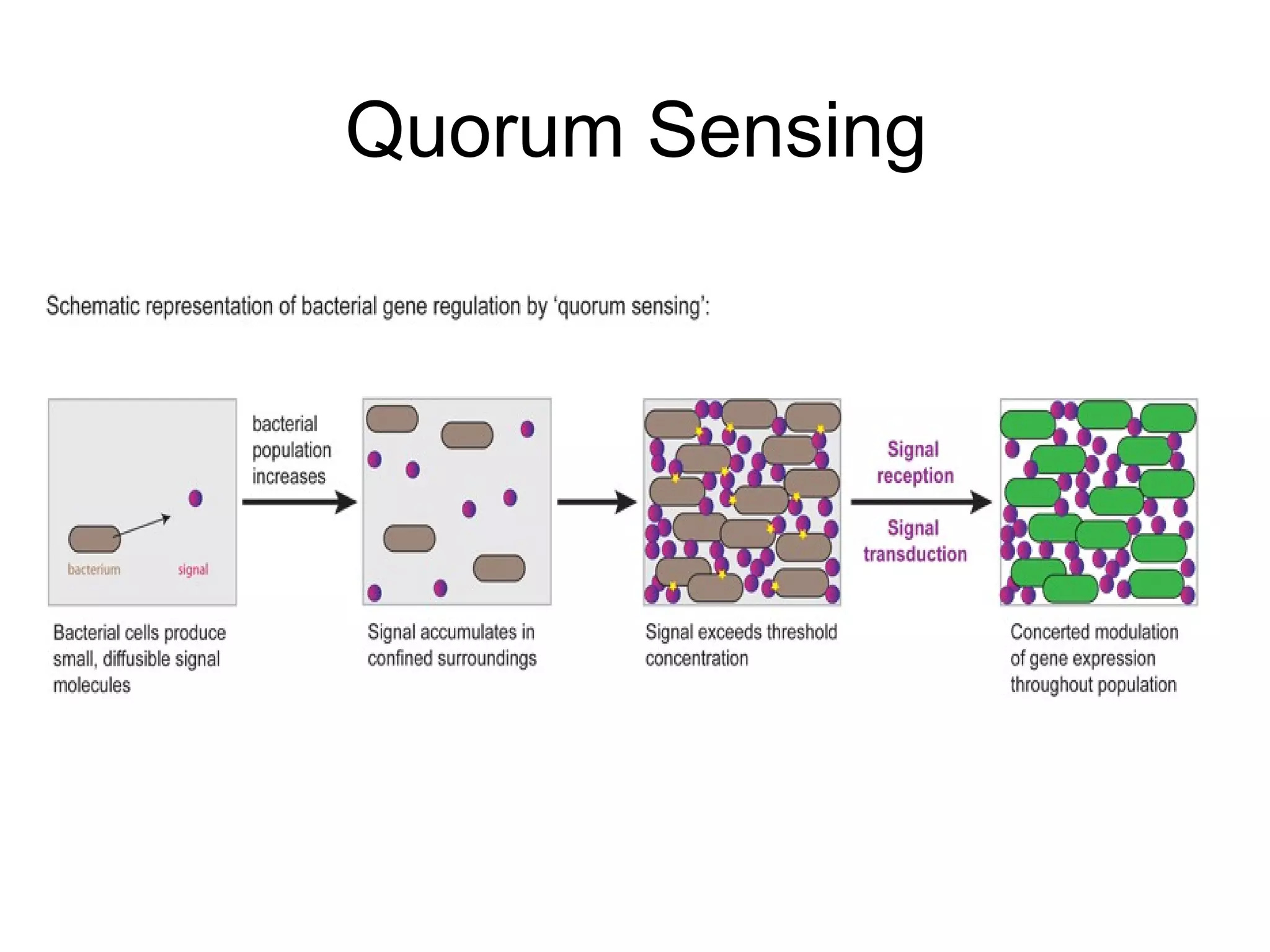
Built to Survive
This is also why biofilms are so difficult to deal with when they become pathogenic.
A bacterium living inside a biofilm is a fundamentally different organism than the same species floating freely in planktonic form. The EPS matrix physically blocks antimicrobial penetration. Resistance genes spread laterally between neighbors through horizontal gene transfer.
In the deepest layers of the biofilm, some cells enter a state of metabolic dormancy, slowing their biological machinery to a crawl. These are called persister cells, and they survive antibiotic exposure simply by being too metabolically quiet to be affected by it. (crazy, right!?)
The commonly cited figure: biofilm-embedded bacteria can tolerate antimicrobial concentrations up to 1,000 times higher than what would kill the same species in planktonic form (Ceri et al., 1999). Clusters as small as 150 cells can already show reduced antibiotic susceptibility (Connell et al., 2010).
This is the organism you are dealing with. Ancient, cooperative, adaptive, and structurally resilient.
In most contexts, working in your favor.

Biofilms as Infrastructure
Your Colon, Right Now
The gut is the clearest example.
Your colon is lined with a mucus layer. Goblet cells secrete it. These are the specialized mucus-producing cells embedded in your intestinal lining, and the layer they create sits like a gel barrier between the microbial ecosystem of the lumen and the single-cell-thick epithelium underneath.
Within that mucus, commensal bacteria organize themselves into biofilms. In a healthy gut, these mucosal biofilms are structurally continuous, draped over the intestinal surface like a living carpet.
This layer is doing three things at once (Turroni et al., 2021; de Vos, 2015).
It creates a physical and biochemical barrier that pathogenic bacteria struggle to get through.
It facilitates the metabolic cross-talk between your microbiota and your tissue, the kind that produces short-chain fatty acids, vitamins, and signaling molecules your body relies on.
It occupies the ecological real estate that invading species would need to claim in order to establish themselves.
The biofilm phenotype matters here. Phenotype refers to how an organism actually behaves and expresses itself in a given environment, and bacteria behave differently depending on whether they are floating freely as planktonic cells or living as part of a biofilm community. The same species, different behavior.
So, the same species of bacteria behaves differently depending on whether it is floating freely as a planktonic cell or living as part of a biofilm community.
Bacteroides thetaiotaomicron and Bacteroides fragilis, two of the most abundant species in the human colon, form surface-associated biofilms and share metabolites with each other. B. thetaiotaomicron breaks down complex polysaccharides and passes the byproducts to B. fragilis, which cannot access those substrates on its own. Fluid flow in the gut shapes how these communities organize spatially, distributing shared metabolites and influencing which species end up where (Donaldson et al., 2023).
This is cooperative, architectural, and intentional at the microbial level.
The Oxygen Problem
Then there is Faecalibacterium prausnitzii.
This is one of the most studied mucosal biofilm species in the human gut, and it shouldn’t technically survive where it lives. F. prausnitzii is an obligate anaerobe, extremely oxygen-sensitive. The mucosal surface of the colon, though, is not fully anaerobic. Oxygen leaks from epithelial cells and creates a steep gradient moving outward from the tissue. So how does an organism that cannot tolerate oxygen persist in a partially oxygenated environment?
It uses an exogenous flavin-thiol electron shuttle, essentially an external redox workaround that lets it manage oxidative stress right there at the mucosal surface (Khan et al., 2012). This is a biofilm-adapted survival strategy. The biofilm provides the microenvironment F. prausnitzii needs to pull it off.
Why should you care? Because F. prausnitzii depletion tracks with active inflammatory bowel disease, infectious colitis, quiescent ileal Crohn’s disease, and colorectal adenomas (Sokol et al., 2008; Lopez-Siles et al., 2016).
When the mucosal biofilm loses integrity, F. prausnitzii loses its habitat, and the anti-inflammatory protection it provides goes with it.
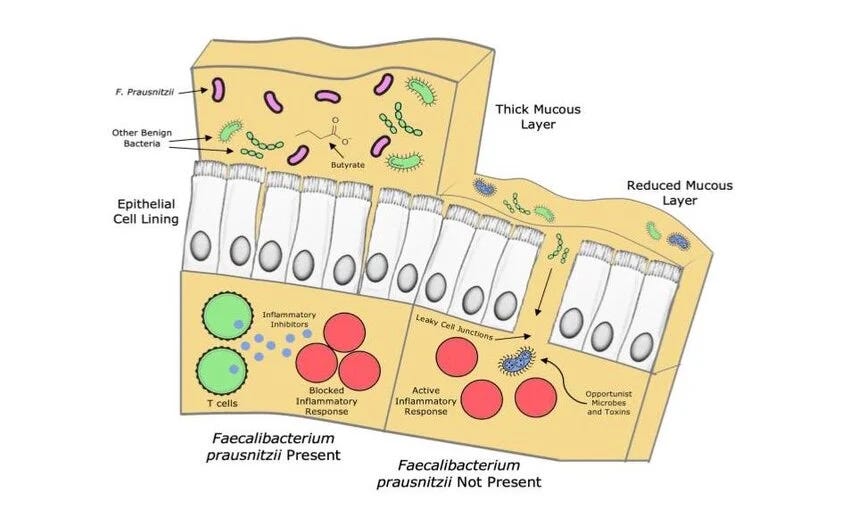
The presence of bacteria F. Prausnitzii in the gut maintains the integrity of the epithelial gut lining and inhibits the T cell inflammatory response. The absence of this materia creates leaky cell junctions in the gut lining, which allow for opportunistic microbes and toxins to enter and activate the inflammatory response.
Iron adds another layer to this story.
Recent research in inflammatory bowel disease models has shown that pathobiont formation (the process by which commensal bacteria turn pathogenic under environmental pressure) requires free environmental iron.
A healthy mucosal biofilm helps keep that iron balance in check. When the biofilm fragments, iron availability shifts, and conditions for pathobiont emergence improve (Motta et al., 2018). If you have read my previous writing on iron and absorption, this should feel familiar. The gut does not manage any single variable in isolation. Iron, biofilm architecture, microbial composition, mucosal immunity. They are all part of the same system.
Iron Masterclass: Why Your Supplement Isn't Working

The body does not simply accept iron. It decides whether to let it in.
Biofilms Beyond the Gut
The gut gets most of the research attention, but biofilms serve protective roles elsewhere too.
In the oral cavity, commensal biofilms (yes, dental plaque is a biofilm) maintain an ecology that deters colonization by cariogenic species like Streptococcus mutans. The composition of the oral biofilm determines whether it protects or damages tooth surfaces. A balanced community is a defense system. A compositionally shifted one is the beginning of dental caries.
In the vaginal tract, Lactobacillus-dominant biofilms maintain an acidic pH that resists colonization by pathogenic bacteria and fungi. Disruption of this biofilm ecology is one of the central mechanisms behind bacterial vaginosis.
The pattern repeats across tissues.
Biofilms are the structural format that commensal microbes use to establish, maintain, and defend their ecological niches in the human body. They are infrastructure. Disrupting them without understanding what they hold in place is the physiological equivalent of demolishing load-bearing walls because you found mold in the basement.
So, here is the sentence this whole section has been building toward: biofilm disruption, not biofilm presence, is what drives pathology.
The early framing of “good bacteria versus bad bacteria” was always too simple. “Good biofilms versus bad biofilms” gets closer but is still incomplete.
What the research increasingly points to is that the same commensal microbes can become pathogenic when they escape the biofilm phenotype. When environmental pressure, infection, inflammation, or dietary shifts destabilize the mucosal biofilm and release planktonic organisms into tissue they were never meant to touch (Buret & Allain, 2023).
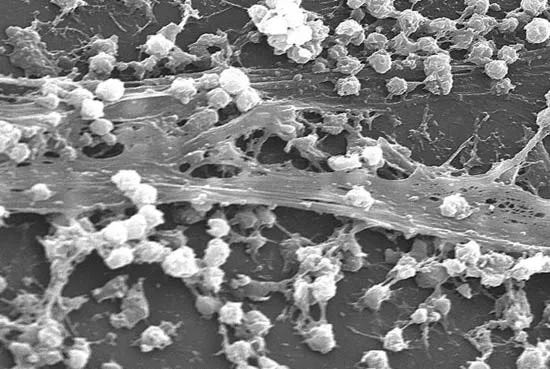
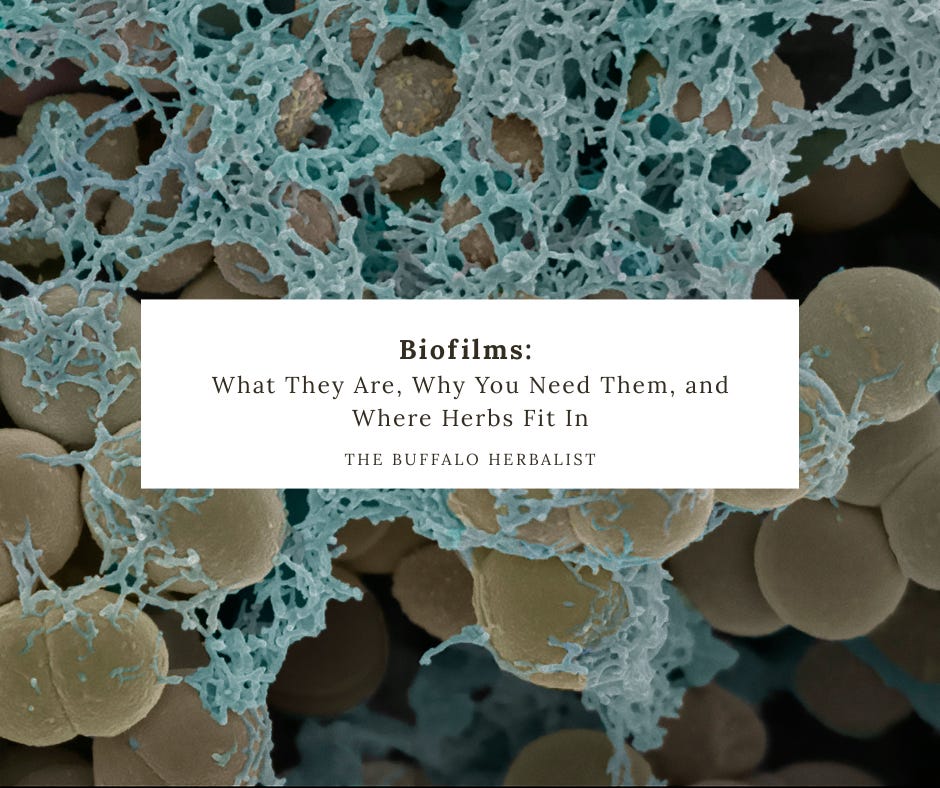
Electron micrograph of Staphylococcus aureus bacteria (light gray spheres) interwoven with a polysaccharide biofilm.
When Biofilms Go Wrong
If the last section made you protective of your beneficial biofilms, good. That was the point. Now we need to talk about what happens when the system breaks down, because it absolutely does.
Biofilm-associated pathology is real, well-documented, and clinically significant. The question is never whether biofilms can cause harm. The question is what kind of biofilm, where, and under what circumstances.
The Gut Data
Let’s start with the gut, since that is where most of you will be applying this information.
A 2021 clinical study published in Gastroenterology examined endoscopically visible mucosal biofilms in nearly 1,500 patients across two cohorts in Austria and Germany. Mucosal biofilms were detected in 57% of patients with irritable bowel syndrome, 34% of those with ulcerative colitis, and 22% of those with Crohn’s disease. In healthy controls, the number was 6% (Baumgartner et al., 2021).
That 6% matters. It tells you that visible, endoscopically detectable mucosal biofilms are unusual in healthy tissue.
The commensal biofilms we discussed in the previous section exist within the mucus layer, organized and contained. Pathological biofilms breach that organization. They adhere directly to the epithelial surface. They shift the local microbial ecology. In the patients with biofilm-positive IBS and UC, researchers found decreased abundance of short-chain fatty acid producers like Faecalibacterium, Coprococcus, Subdoligranulum, and Blautia. These are the species that maintain anti-inflammatory tone in the gut. When the biofilm shifts, they are among the first to decline.
The highest density of gut biofilms in these patients was found in the cecum, terminal ileum, and ascending colon. This distribution is worth noting if you work with clients or patients dealing with right-sided GI symptoms or post-infectious IBS patterns.
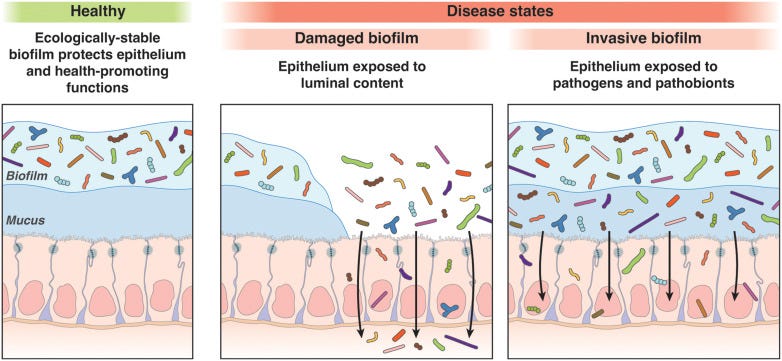
Gut Goo: Physiology, Diet, and Therapy of Intestinal Mucus and Biofilms in Gastrointestinal Health and Disease
Devices, Wounds, and Lungs
Beyond the gut, biofilm-associated pathology shows up across a wide range of clinical settings.
Medical devices are one of the most well-studied contexts. Catheters, prosthetic joints, stents, pacemakers, and dental implants all provide surfaces that bacteria can colonize. Staphylococcus epidermidis, Staphylococcus aureus, and Pseudomonas aeruginosa are the most common biofilm formers in these settings.
Once established on a device surface, these biofilms are extremely difficult to clear. The EPS matrix protects them from both immune responses and antibiotic therapy. In many cases, the only definitive treatment is removing the device entirely.
Chronic wounds are another major site. Biofilm-embedded bacteria in wound tissue evade immune clearance and resist standard topical and systemic antimicrobials. The biofilm creates a persistent inflammatory state that delays healing. The wound stays open. The infection stays low-grade but unresolved. This is one of the clearest clinical examples of biofilm-mediated treatment resistance.
Then there are the lungs. In cystic fibrosis, Pseudomonas aeruginosa forms dense biofilms that persist for years and resist aggressive antibiotic regimens. Biofilm involvement has also been documented in chronic bronchitis, bronchiectasis, ventilator-associated pneumonia, and chronic rhinosinusitis.
The common thread across all of these scenarios is the same. The biofilm creates a protected microenvironment. Antimicrobials cannot penetrate effectively. The immune system can see the infection but cannot resolve it. The infection persists, often at a level subclinical enough to evade standard diagnostics. Conventional culture methods may produce false-negative results because the bacteria are embedded in matrix rather than floating freely in fluid.
Which Biofilms Are You Disrupting?
This is the clinical reality that makes the “biofilm buster” conversation so appealing. People are dealing with chronic, recurrent, treatment-resistant conditions. Someone telling them there is a hidden structure protecting the pathogen feels like it finally explains why nothing has worked.
The explanation is partially correct.
But it often skips a critical question: which biofilms are you trying to disrupt?
The pathogenic ones adhering to damaged epithelium?
Or the commensal ones lining your mucosa and keeping pathobionts in check?
A broad-spectrum biofilm disruption protocol that does not make this distinction is working without a map. It may clear pathogenic biofilm in one location while destabilizing protective biofilm in another.
The physiology demands precision.
The wellness market often delivers a sledgehammer.
This is where herbs enter the conversation. Specific plant compounds have demonstrated the ability to interfere with biofilm formation, disrupt mature biofilms, and jam quorum sensing communication, and some of them do so with a selectivity that broad-spectrum antimicrobials lack. The next section walks through the phytochemistry of how they do it.
Where Plants Fit In
Before we get into individual herbs, a few things need to be said up front.
The vast majority of anti-biofilm herbal research is in vitro. Petri dish studies. Lab conditions. That research is valuable because it tells us which compounds interact with biofilm biology and through what mechanisms, but it stops at the petri dish. What happens inside a living human gut with its oxygen gradients, immune surveillance, fluid dynamics, and resident microbial ecology is a different question. Translating in vitro results directly into clinical protocols without acknowledging that gap is how bad recommendations get made.
This section presents mechanisms and evidence, not protocols.
The other thing worth naming is that the goal here is precision, not sterilization. If you have read the first half of this article, you already understand why. We are looking at which plant compounds can interfere with pathogenic biofilm formation, which can help disrupt mature pathogenic biofilms when clinically indicated, and which may support the broader ecology that keeps commensal biofilms intact.
Five major classes of plant-derived compounds show anti-biofilm activity in the literature: phenolics (including tannins, flavonoids, and phenolic acids), essential oil constituents, terpenoids, alkaloids, and polypeptides. They work through a handful of overlapping mechanisms: disrupting bacterial membranes, interfering with quorum sensing signaling, blocking adhesion to surfaces, degrading or destabilizing the EPS matrix, and depriving biofilm bacteria of substrates they need.
The herbs below are the ones with the strongest mechanistic data. For each one, I am walking through what the compound is, where it comes from, how it interacts with biofilm biology at the molecular level, and what the current limitations of the evidence are.
The rest of this article is for paid subscribers.
Below the paywall, you will find deep dives into six specific compounds with anti-biofilm activity: berberine, oregano (carvacrol and thymol), garlic (allicin), green tea (EGCG), bearberry (arbutin), and NAC. Each section covers the source plants, the molecular mechanisms, the research, and the honest limitations of the evidence.
Paid subscribers also get access to all of my researched deep dives, the ability to suggest future article topics, and full access to The Library, which includes the Materia Medica Index, the Body Systems Index, and every article I have written organized in one place.
If this article taught you something new in the free section, the paid section is where the plant science lives.
I have put together a Biofilm Supports collection in my Fullscript dispensary with my specific product recommendations for the herbs and compounds discussed in this article, including berberine, oregano oil, garlic, green tea, uva-ursi, and NAC. These are the formulations I trust for quality and sourcing, with options at different price points. You can browse the collection here. As always, work with a qualified practitioner before starting anything new. This article is educational, not prescriptive.
