


Hi! I have a surprise Field Notes for you today! This one exists because after completing my pieces on Long Covid and EBV, I’ve been working on an antiviral guide for The Library and I realized... I don’t think I’ve ever covered viruses as a general topic?! So, this is IT!
It doesn’t make sense for me to tell you, “Hey, X herb was shown to work on the viral envelope!” without explaining what the heck a viral envelope even is. Sounds like a cute piece of stationery... it is not.
And don’t worry! We’re doing this in easy mode!
Alright, in this issue:
What a virus actually is
How a virus gets inside your cells
Viral replication, easy mode
Where we can interrupt that process
Why calling an herb “antiviral” doesn’t actually tell us very much
The Antiviral Herb Guide :)


Okay, So What Is a Virus?
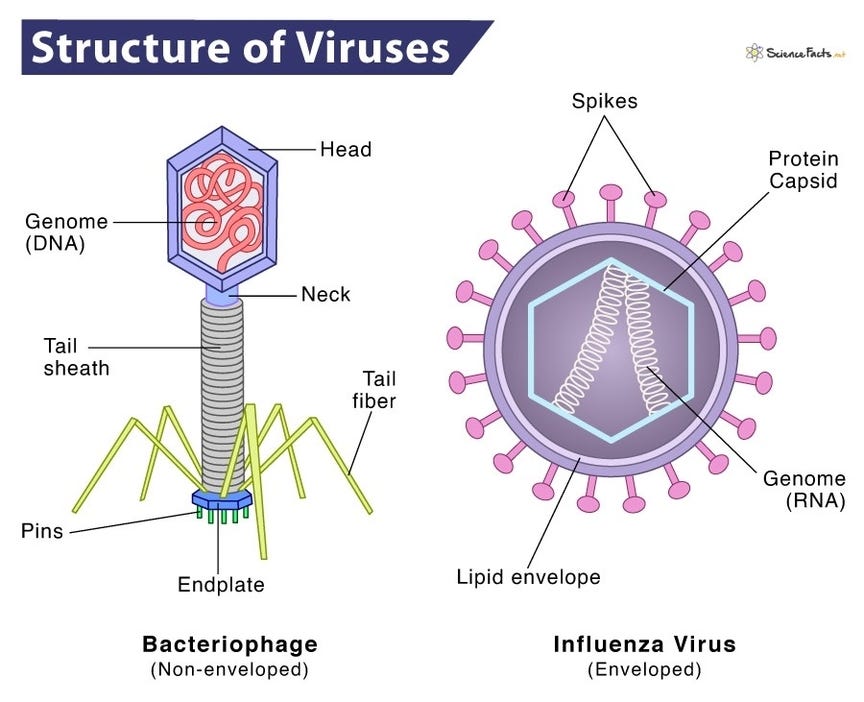
Viruses are strange little things. They aren’t cells, which means they’re built very differently from bacteria, fungi, or the cells that make up our own bodies. At their simplest, viruses carry genetic material, either DNA or RNA, tucked inside a protein shell called a capsid. Some have one more layer on the outside: the viral envelope (Kausar et al., 2021).
This is our cute little piece of stationery; except it’s actually a lipid membrane surrounding certain viruses!
Much of that membrane originally belonged to us. (which is crazy to think about!) Enveloped viruses pick it up from the host cell as newly formed viral particles leave, taking a portion of the cell membrane with them on the way out. Viral proteins embedded within that membrane can then help the virus recognize or interact with the next cells it encounters (Kausar et al., 2021).
Underneath all of that packaging is a pretty major limitation: a virus doesn’t really have everything it needs to reproduce independently. It needs a living host cell to copy its genetic material, make viral proteins, then assemble new viral particles. That dependence on a host is one of the defining features of viruses (Adeosun & Loots, 2024).
So, for something capable of causing this much trouble, a virus is surprisingly dependent on us, right?! Without a host cell to hijack, it can’t make more of itself.
Getting Into the Cell
Before a virus can use a cell to make more of itself, it has to get inside. That starts with attachment, when proteins on the surface of the virus bind to specific receptors on a host cell. Those receptors matter because viruses can’t necessarily infect every cell they encounter. The virus has to be able to recognize and bind to something on that particular cell first (Kausar et al., 2021).
Which, already, is a lot of work for something that can’t reproduce on its own.
Attachment gets the virus to the cell, but now it has to actually cross the membrane. Exactly how it manages that varies between viruses. Some enveloped viruses can fuse their own envelope with the host cell membrane, allowing their contents to enter the cell. Others use endocytosis, a completely normal cellular process where the membrane folds inward and brings material from outside the cell with it (Kausar et al., 2021). In that case, the virus is essentially taking advantage of something the cell already does.
Once inside, there’s still one more layer to deal with. The viral genetic material is tucked away inside its capsid, so that DNA or RNA needs to be released before it can actually be used. This is called uncoating. The capsid is broken apart or removed, leaving the viral genome accessible inside the host cell (Kausar et al., 2021).
So, our virus has now found a cell it can infect, attached itself, made it across the membrane, ditched its packaging, and deposited its genetic material inside.
All of that just to get through the front door. Jeez Louise.
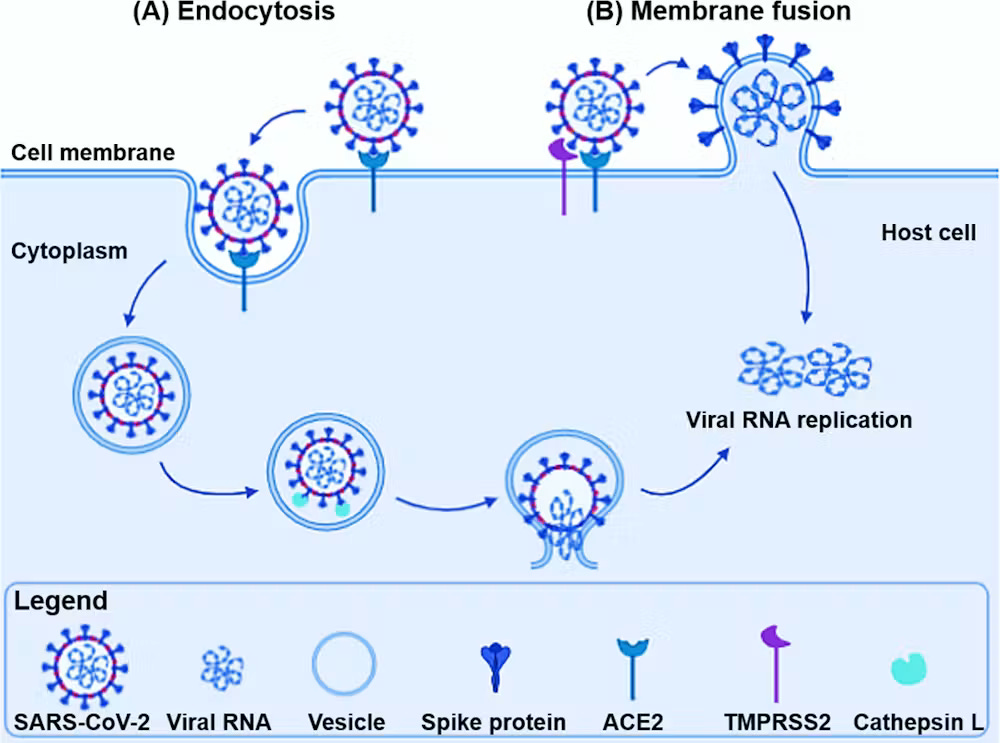
SARS-CoV-2 virus entry into the cell
Viral Replication, Easy Mode
Okay, our virus is inside the cell, its genetic material is unpacked, so now we get to the whole reason it went through the trouble of getting in there in the first place. It needs to make more viruses!!
This can get complicated FAST because viruses don’t all replicate the same way. Some carry DNA, others carry RNA, plus there are different enzymes and strategies involved depending on the virus we’re talking about. We absolutely do not need all of that today, thankfully.
For easy mode, what matters is that the virus now has access to a living cell, along with all the cellular resources it was missing on its own.
The viral genome needs to be copied so every new virus gets its own set of genetic instructions. Viral proteins have to be produced too, since those will eventually become the structural pieces of new viral particles or carry out jobs the virus needs during replication. Viruses rely heavily on the host cell to make this happen, while some also bring or produce specialized enzymes of their own to complete particular steps (Kausar et al., 2021). Your cell, which was minding its own business moments ago, has essentially been recruited into manufacturing viruses, involuntarily. Rude.
Once enough copies of the genome and viral proteins have been made, those pieces can start coming together into new virus particles. Those newly assembled viruses eventually leave the cell, giving them the opportunity to find more susceptible cells and run the whole process again (Kausar et al., 2021).
So, viral replication on very easy mode:
Get inside → unpack → copy the genome → make viral proteins → assemble new viruses → get out.
There’s a tremendous amount of molecular biology stuffed into those six little steps, but that’s enough for what we need today :)
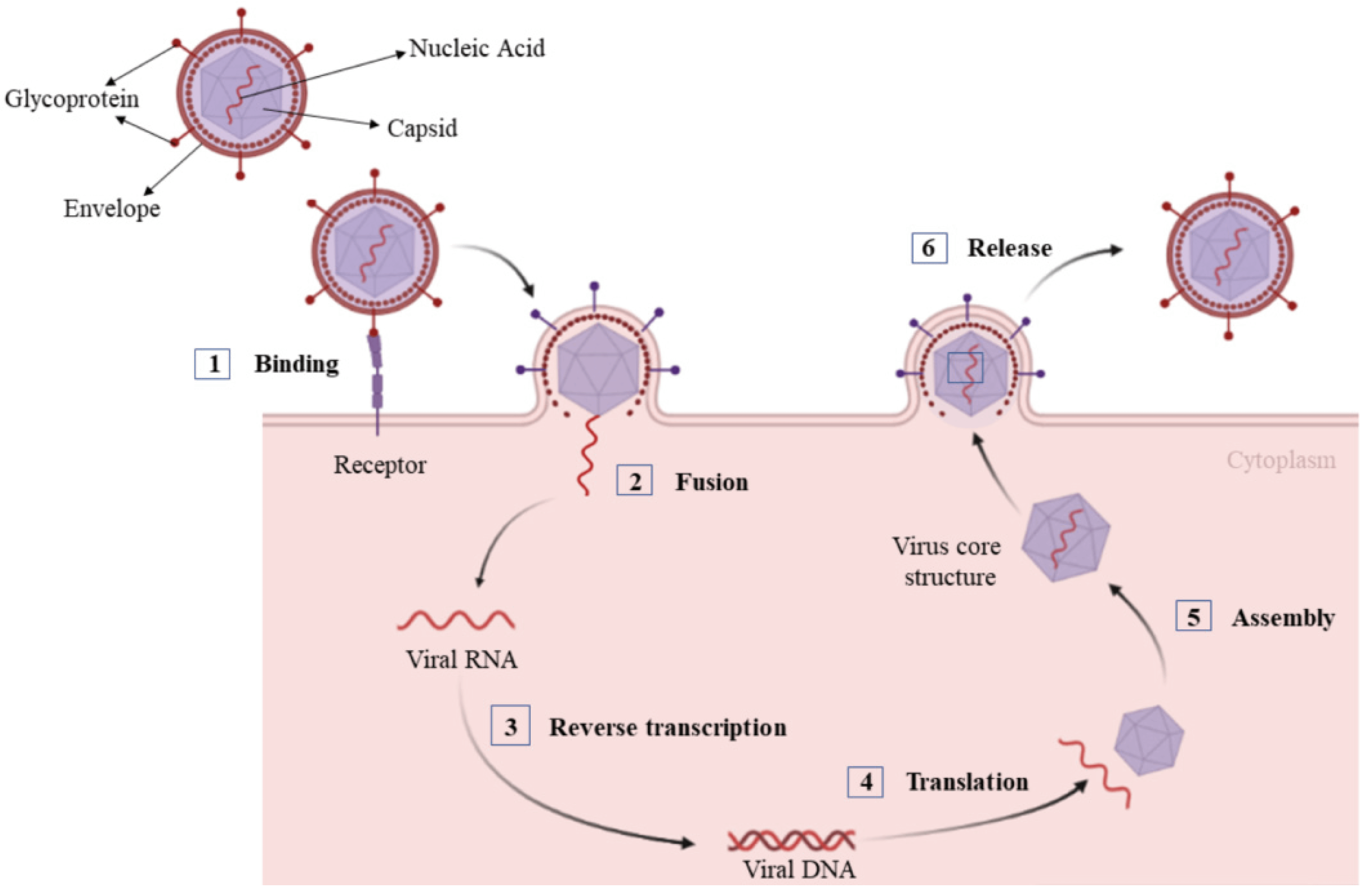
Steps in the viral replication cycle.
So, What Are We Trying to Stop?
Now that we have a virus successfully making copies of itself, we can look back at that whole process and see something useful: there are quite a few places where it could potentially be interrupted.
Depending on the virus, an antiviral might interfere with:
Attachment and entry: The virus has to bind to a susceptible host cell before it can get inside. Interfering with that interaction can stop the infection process before the viral genome ever enters the cell.
Uncoating: Once inside, the virus still has to release its genetic material from its protective capsid. Prevent that from happening and the genome stays packaged away instead of becoming available for replication.
Genome replication: The viral DNA or RNA has to be copied to make new viruses. Some antivirals interfere with this process or with the viral enzymes required to carry it out (Kausar et al., 2021).
Viral protein production and processing: A copied genome isn’t enough. The virus also needs proteins to build new viral particles or perform specific jobs during replication, which gives us another part of the process to interfere with (Kausar et al., 2021).
Assembly and release: All of those newly made pieces still have to be assembled into complete virus particles, then successfully leave the cell. Interrupt either step or you can interfere with the virus spreading to more cells.
The virus itself: Some substances demonstrate direct virucidal activity, meaning they act directly on virus particles. This is different from interfering with something the virus does once it has already entered a host cell (Adeosun & Loots, 2024).
The host response: Not every antiviral effect has to involve attacking the virus directly. Some compounds influence cellular signaling or parts of the immune response involved in antiviral defense (Adeosun & Loots, 2024).
So, when we say something is “antiviral,” I don’t want you to automatically picture “supporting the immune system” or “stimulating immune function.” Those can absolutely be part of the picture, but now we know there are a whole lot of other places where a plant or one of its constituents might interfere with the process.
We can get way more specific than that!
When you’re choosing herbs or explaining their actions to someone else, you can talk about an extract interfering with viral attachment to a host cell. You can point to a constituent that inhibits an enzyme required for viral replication, or explain that an antiviral effect happens directly against the viral particle before it ever enters the cell.
Instead of stopping at, “this herb has antiviral activity,” you can actually say, “This plant has been studied for its ability to interfere with viral replication by inhibiting an enzyme the virus needs for that process.” 😎
Look at you talking mechanisms!
Now We Can Talk About the Plants
Okay! Finally, the herbs!
Plant extracts and their constituents have been studied at several points in the viral life cycle, including attachment and entry, replication, viral protein activity, cellular signaling, plus direct activity against the virus itself (Adeosun & Loots, 2024).
The research gets messy pretty quickly, though, because “plant” can mean a lot of different things in a paper. Sometimes researchers are testing a whole extract, while other studies pull out one constituent and test that on its own. There are cell studies, animal studies, computational models, plus some human research scattered throughout the literature. cue Agy’s head spinning. All of those can tell us something useful, but they aren’t giving us the same kind of evidence.
And when we’re looking at an isolated constituent, we have to be careful about how far we carry that finding. If a compound from a plant inhibits a viral enzyme in a cell study, we can’t automatically give that activity to every preparation of the whole herb. The concentration used in the study matters, the extraction matters, absorption matters, plus we have to account for what happens to that compound after we actually swallow it.
I know, I know. I sound like a broken record about this. Phytochemistry matters!
So I put everything into a guide for you:)
The Antiviral Herb Guide takes the mechanisms we just went through and organizes the plants around them, with the virus studied, what preparation or constituent was actually tested, plus the level of evidence behind it. I wanted something you could pull up when you see “antiviral” attached to an herb and actually figure out what that means.
So again: we’re getting REALLY specific here. This isn’t an exhaustive or complete guide by any means! It was created to give you a head start in understanding what to look for when you’re researching on your own.
Download it here:

If you enjoyed this free Field Notes and have been thinking about upgrading, this is a lovely time to join us. Your subscription gives you access to this guide, the rest of The Library, plus the paid deep dives!
And, of course, it helps fund my ongoing habit of opening a research paper because I had one small question and resurfacing several hours later with an entire PDF and/or article :) Whoops.
Until next time,
— Agy | The Buffalo Herbalist
PS: I’m going to be taking the time to update and revamp The Library this week and next as it’s very clearly been collecting a few cobwebs.


Thank you 🙏
bearing in mind this study Agy could you give me your 'two cents' on the theory of viruses being 'exosomes' - cellular debris? Ta Dx