


Picture this:
You have decided to make your first herbal preparation. You have your herbs, a clean jar, and a quiet Saturday afternoon. You open your laptop to find a recipe and are immediately confronted with a question nobody warned you about.
Does this go in alcohol? Vegetable glycerine? Apple cider vinegar?
What the heck this was supposed to be easy?
You click through four different tutorials, each one contradicting the last, and before long you have seventeen browser tabs open and significantly less confidence than when you started.
Sound familiar?
Here’s what most don’t realize upfront:
The liquid you use to make an herbal preparation is an active participant in the chemistry.
Different solvents pull different compounds out of plant material, which means the same herb extracted in alcohol and extracted in glycerine will produce two genuinely different preparations, with different constituent profiles, different potencies, and different therapeutic applications.
Understanding what each solvent actually does at a molecular level is what turns that choice from a coin flip into something you can make deliberately.
In herbalism, we call this liquid the menstruum. Once you understand what each menstruum does at a molecular level, the choice stops feeling arbitrary and starts feeling like something you can make with confidence.
In this article, we will cover:
What polarity is and why it determines everything about herbal extraction
How alcohol works as a solvent and what it can and cannot extract
How vegetable glycerine works, where it excels, and where it falls short
What an oxymel is and when it makes clinical sense
How to match your menstruum to your herb and the person you are making it for
Let’s get into it.

One quick note before we go further, because it would feel incomplete not to mention it: water is a legitimate menstruum in its own right, and some herbs genuinely do best in it. Marshmallow root is the classic example. Its therapeutic action comes primarily from long-chain mucilaginous polysaccharides that extract beautifully in a cold water infusion and are degraded by both heat and alcohol. Slippery elm, comfrey root, and licorice root are in similar territory. If you’re working with a demulcent herb whose whole clinical point is intact mucilage, a cold-water infusion is often the most appropriate preparation you can make. We won’t go deep on water extractions in this article, but knowing which plants are asking for it is part of learning to read your herbs well.
The Plant Doesn't Give Everything Equally
As I mentioned before, traditional herbalists use the word menstruum for the liquid solvent that pulls medicinal material out of plant tissue, and it’s a word worth knowing because it shifts how you think about the whole process.
Water, vinegar, alcohol, glycerine — these are all menstruums, and the one you choose isn’t a neutral decision. It actively shapes which parts of the plant end up in your bottle, because every phytochemical in that plant has a polarity, and your solvent either matches it, or it doesn’t.
Polarity is the key concept here.
Every molecule carries some distribution of electrical charge, and that charge determines what it's willing to dissolve into.
Water-loving compounds, called polar or hydrophilic, mix readily with water because they share a similar charge distribution.
Fat-loving compounds, called nonpolar or lipophilic, repel water and dissolve more easily into oil-like environments.
The guiding principle is like dissolves like, and it's the reason your salad dressing separates in the jar. Oil and water have different polarities, so they don't mix.
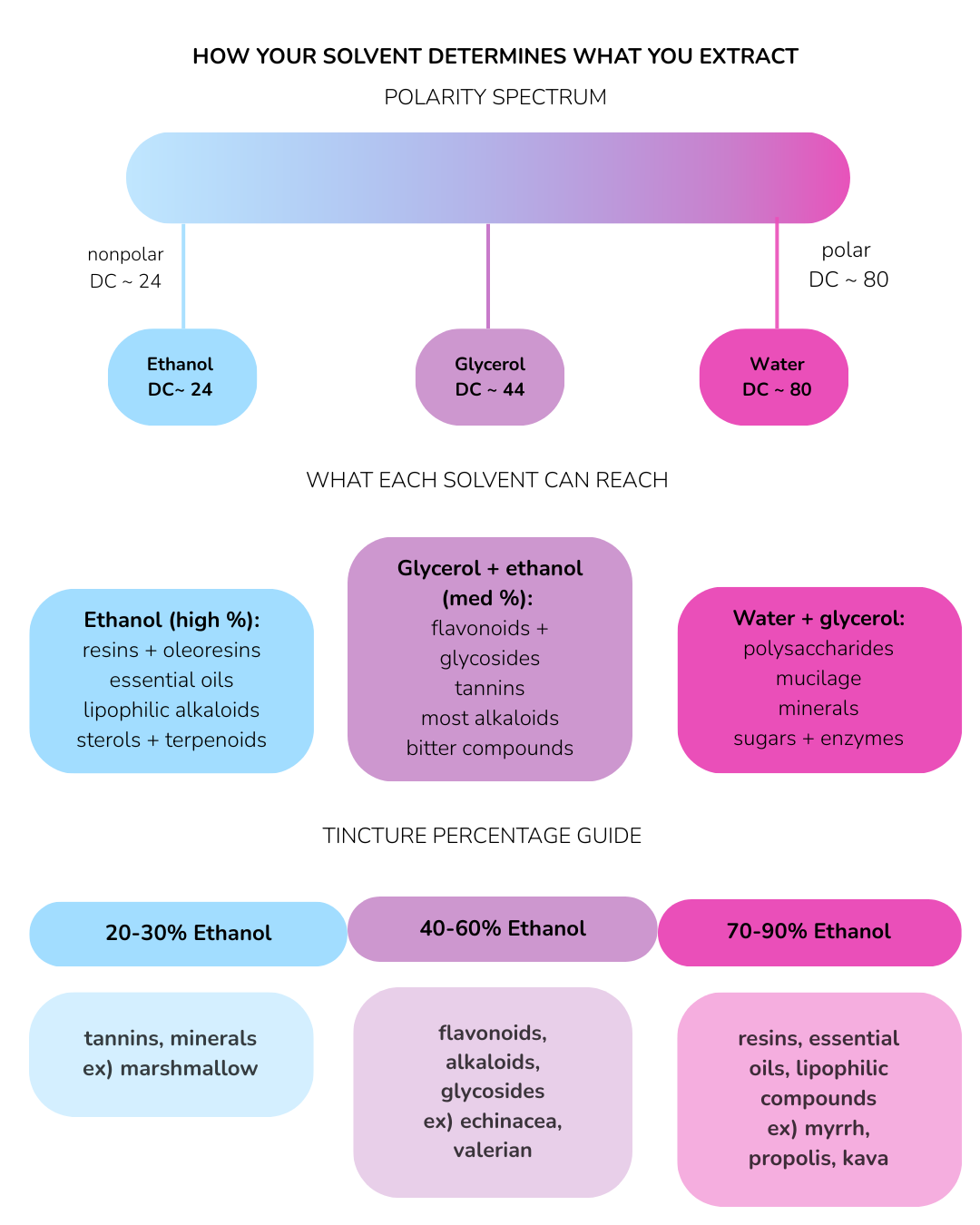
Chemists quantify polarity using the dielectric constant, a number that describes how strongly a liquid interacts with charged molecules. Water scores about 80, the high end of the scale, which is why it pulls polar compounds so effectively. Ethanol scores around 24, lower and less polar, giving it access to a different range of compounds. Glycerol sits at approximately 44, right between the two.
Think of it as a spectrum: the higher the number, the more the solvent favors water-loving compounds; the lower it goes, the more it can reach into fat-loving territory. When you adjust the ratio of alcohol to water in a tincture, you're sliding along that spectrum deliberately, opening the door to different parts of the plant.
made on Canva
How Alcohol Works
Ethanol is amphiphilic. It carries a polar hydroxyl group (–OH) on one end of the molecule that interacts with water-loving compounds, and a short nonpolar carbon chain (–CH₂CH₃) on the other that interacts with fat-like material.
That dual character gives ethanol access to an unusually wide range of phytochemicals: tannins, polyphenols, polyacetylenes, flavonols, terpenoids, sterols, and alkaloids.
Water-soluble constituents including glycosides and certain saponins also transfer, because tinctures are always made with an ethanol-water blend, not pure alcohol. The water fraction handles the hydrophilic compounds. The ethanol fraction pulls the lipophilic ones. Adjusting the ratio between them is how you target a specific constituent class.
A 20 to 30% ethanol blend behaves close to water and pulls polysaccharides, mucilage, tannins, and minerals.
At 40 to 60%, you’re in the broad-spectrum range: flavonoids, glycosides, alkaloids across the polarity spectrum.
At 70 to 90%, the blend behaves close to pure ethanol and is required for resins, essential oils, and lipophilic alkaloid bases. Myrrh, propolis, and frankincense won’t yield their primary bioactives below that threshold.
Marshmallow root, on the other hand, requires low-alcohol or water-only preparation to keep its mucilaginous polysaccharides intact, because high ethanol denatures the long-chain carbohydrates that give the plant its primary action.
(I would personally only extract marshmallow root in a cold-water infusion, but I felt this was the best example to show what a low per cent of alcohol can achieve!)
What the Studies Actually Show
The research backs this up.
A 2013 ScienceDirect study comparing multiple ethanol concentrations found that 100% ethanol produced the highest total phenolic and flavonoid content across all conditions tested, outperforming both water and every intermediate concentration.
A 2025 review in Frontiers in Pharmacology confirmed that solvent polarity is the primary driver of phytochemical composition in plant extracts, with the polar fraction of an ethanol-water blend pulling flavonoids and tannins while the nonpolar ethanol fraction reaches terpenoids, carotenoids, and other lipophilic bioactives.
Alkaloids are a particularly interesting case here. They exist as water-soluble salts under acidic conditions and shift toward lipophilicity at physiological pH, which means a well-calibrated ethanol-water blend is one of the only menstruums capable of capturing both forms in a single preparation.
The preservation question has research behind it too.
A 2020 systematic review published in MicrobiologyOpen analyzed 74 studies on ethanol's antimicrobial activity and confirmed that bactericidal effects are reliable at concentrations between 60 and 85%, with ethanol disrupting cell membranes and inactivating key microbial proteins. A quality control study on botanical tinctures specifically found that 65% ethanol extraction produced the greatest reduction in bacterial colony counts compared to water and lower alcohol concentrations.
That's why a well-made tincture stored in dark glass at room temperature holds its potency for four to six years. The ethanol is doing active preservation work the entire time.
But How Much Alcohol Are You Actually Consuming?
Now, the question that comes up constantly: how much alcohol are you actually consuming?
Less than most people think.
A pharmacovigilance study published in PMC found that typical doses of herbal medicines for children aged 6 to 12 contain 0.07 to 0.18 grams of ethanol per dose, which is the equivalent of 31 to 75 milliliters of apple juice. That dose clears the bloodstream within one to three minutes. For context, a 2016 study in the Journal of Analytical Toxicology measured ethanol in everyday foods and found that orange, apple, and grape juice contain up to 0.77 grams per liter, and that packaged bakery products like burger rolls can exceed 1.2 grams per 100 grams.
Ethanol is a natural byproduct of fermentation, including the fermentation happening in your gut right now. The body is well-equipped to handle small quantities.
That said, there are people for whom even trace amounts of alcohol matter: those in recovery from alcohol use disorder, those with alcohol allergy, people with religious restrictions, certain medication interactions, and some pregnancy contexts.
These are real clinical considerations, and for those individuals, glycerites and oxymels are the appropriate preparation. The point is that those considerations are person-specific, not generalizable to alcohol-based preparations as a category.

How Glycerine Works
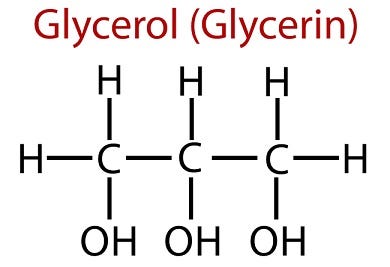
Vegetable glycerine, also called glycerol or glycerin, is a three-carbon molecule with three hydroxyl groups and the chemical formula C₃H₅(OH)₃.
Carl Wilhelm Scheele isolated it in 1783 and described it as the “sweet principle of fat,” a name that still holds up. Glycerol is a natural byproduct of triglyceride hydrolysis: when vegetable oils break down, the fatty acid chains separate from the glycerol backbone, and the glycerol is collected as a co-product.
What you end up with is a clear, odorless, viscous liquid with a noticeably sweet taste and no sugar content at all.
Something that tends to get quietly dropped from the glycerite conversation is this: glycerol is chemically an alcohol. Its three hydroxyl groups are the defining feature of the alcohol functional group in organic chemistry, and for that reason, the FDA does not classify glycerite preparations as alcohol-free in a regulatory sense. This is not a point against glycerites. It is a chemistry fact that matters for anyone choosing a glycerite specifically because they need to avoid alcohol, whether for medical, religious, or personal reasons. You deserve accurate information about what you are taking.
What Glycerol Actually Extracts
With a dielectric constant of 44, glycerol sits right between water and ethanol on the polarity scale. When you mix it with water, it lowers the polarity of the blend, which opens access to a wider range of compounds than water can reach on its own.
A PMC study on glycerol-water extraction of peppermint and common nettle found that glycerol-water systems produced higher flavonoid concentrations than water-only extracts, because the lower polarity of glycerol pulls the blend toward less polar flavonoid forms. A 2024 ACS Omega study comparing five solvents found that a glycerol-ethanol blend produced the highest total phenolic content and antioxidant activity of all five tested. Glycerol does its best work in combination, and that is worth keeping in mind when you are thinking about formulation.
On its own, glycerol extracts tannins, sugars, enzymes, glycosides, and some bitter compounds well.
It also has one real advantage over ethanol for specific herbs: it does not denature proteins.
Ethanol disrupts the hydrogen bonds holding long-chain carbohydrates together, which is why high-alcohol tinctures of demulcent herbs are often a poor clinical choice. A glycerite of marshmallow root or slippery elm keeps those mucilaginous polysaccharides structurally intact, preserving the mechanism that makes those herbs useful in the first place.
Glycerol is also hygroscopic, meaning it actively binds water molecules. This is how it contributes to preservation, through osmotic pressure, drawing water out of microbial cells and slowing their growth.
A 2007 study published in Burns confirmed this directly, finding that glycerol produced no immediate bactericidal effect but a sustained bacteriostatic action that strengthened with concentration. Separate pharmaceutical preservation research published in the International Journal of Pharmacy found that concentrations above 50% are needed to reliably inhibit microbial growth, which is why the working standard for glycerite preservation sits at a minimum of 55% glycerol. With that threshold met, a well-made glycerite typically remains stable for one to two years.
Where Glycerol Falls Short
Resins, essential oils, most alkaloid bases, and fat-soluble compounds do not transfer into a glycerol-water blend through standard cold maceration.
Glycerol can rival ethanol in extractive power, but the research showing that is based on dynamic extraction methods: heat, pressure, agitation.
Cold maceration in a jar on a shelf, which is how most home herbalists and small producers work, does not reach that threshold. A cold-macerated glycerite of valerian or ashwagandha will carry a noticeably narrower constituent profile than a well-made alcohol tincture of the same herb, and for plants whose primary therapeutic compounds are lipophilic, that gap matters clinically.
One formulation trick that does not get nearly enough attention: adding glycerol to an alcohol tincture at around 10% prevents tannins from precipitating out of solution when they contact alkaloids. This is documented in glycerol’s pharmacopeial literature and confirmed in tincture practice.
If you are blending a tannin-rich herb with an alkaloid-rich herb in the same formula, that small glycerol addition stabilizes the preparation in a way pure ethanol cannot manage alone. The two solvents are not simply interchangeable.
Used together, they each bring something the other cannot.

Oxymels: A Third Option
An oxymel is a preparation made from honey and vinegar, and it’s one of the oldest forms of herbal medicine in the Western tradition.
The name comes from Greek: oxy for acid and mel for honey. The preparation appears in texts from Hippocrates forward and was standard in European apothecary practice through the medieval period. It largely fell out of common use when alcohol-based tinctures became more accessible, but it’s seeing a real resurgence, partly for the flavor and partly because it offers a genuinely alcohol-free pathway.
The extraction mechanism here is primarily the acetic acid in the vinegar.
Acetic acid has a pKa of 4.75, which means it creates a mildly acidic environment in the preparation. That acidity matters because alkaloids change their behavior depending on pH: in an acidic environment, they pick up a positive charge and become water-soluble, making them much easier to extract than they would be in plain water.
It’s also effective at chelating minerals from plant material, pulling calcium, magnesium, iron, and other trace minerals out of plant cells and into solution. This makes vinegar-based preparations particularly useful for mineral-dense herbs like nettles, red clover, and horsetail, where the goal is nutritive support rather than pharmacological activity.
Honey contributes its own chemistry.
Raw honey has a pH between 3.2 and 4.5, reinforcing the acidic extraction environment. It contains hydrogen peroxide, low water activity, and in some varieties methylglyoxal, all of which contribute to antimicrobial preservation.
The sugars in honey extract some water-soluble phytochemicals directly, and the combination of honey and vinegar produces a more preserved preparation than either component alone.
The limitations are straightforward:
Oxymels don’t extract resins, essential oils, or nonpolar terpenoids.
Shelf life is substantially shorter than an alcohol tincture, typically three to six months at room temperature and up to a year refrigerated.
The sugar content makes them unsuitable for people managing blood glucose carefully.
The acetic acid can also interact with some constituents in ways that reduce their activity over time.
Where oxymels shine is in respiratory and immune formulations, which is where they’ve historically been concentrated. A thyme, elderberry, and ginger oxymel leverages the mineral and water-soluble phytochemical extraction of the acid, the flavor-softening and preservative properties of the honey, and the antimicrobial activity of both. For someone who needs a genuinely alcohol-free preparation, an oxymel made with the right herbs is a clinically sound choice.

Choosing the Right Menstruum
The herb’s chemistry comes first. Then the person taking it.
Reach for alcohol when you’re working with:
Resinous herbs like myrrh, propolis, and kava. Resins are largely nonpolar and won’t move into a glycerol-water blend through cold maceration. High-proof ethanol is the only standard menstruum that reaches them.
Aromatic herbs rich in volatile essential oils, including thyme, oregano, and rosemary. The terpene-heavy oil fraction needs alcohol to solubilize and stay stable.
Alkaloid-bearing herbs like California poppy and blue cohosh, where the lipophilic alkaloid bases depend on ethanol’s amphiphilic character to move into solution.
Reach for a glycerite when you’re working with:
Demulcent herbs that act through mucilaginous polysaccharides, including marshmallow root, slippery elm, and licorice. Low-alcohol or water-based preparation preserves the polysaccharide structure that makes these herbs work.
Gentle floral and leaf-based herbs with water-soluble constituents, including elderflower, calendula, lemon balm, and oat milky tops. Glycerol-water systems extract these well.
Tannin-forward herbs like raspberry leaf, yarrow, and oak bark. Glycerites can actually produce stronger tannin extraction here than an equivalent alcohol preparation.
Reach for an oxymel when you’re working with:
Mineral-dense nourishing herbs, including nettle, horsetail, and red clover, especially when the goal is nutritive support rather than a pharmacological dose. Acetic acid chelates minerals more efficiently than most alcohol blends, and the flavor tends to be considerably more pleasant.
Then factor in the person.
Glycerites suit children, people in recovery, those with religious restrictions, and anyone with a clinical reason to avoid alcohol. Oxymels serve that same group with the added benefit of familiar, food-adjacent ingredients. Alcohol tinctures are the broad-spectrum choice for the general population, particularly when the herb's primary bioactives require amphiphilic extraction or when shelf life matters. Water infusions belong in this conversation too: for demulcent herbs where intact mucilage is the whole point, a cold-water infusion is often the most clinically appropriate preparation you can make, and no other menstruum does it better.
A Note on Accessibility
People in recovery deserve to engage with herbal medicine without navigating alcohol at every turn. People with religious restrictions, alcohol sensitivities, or who simply don’t want alcohol in their home deserve preparations that are formulated thoughtfully, not as an afterthought. The growing interest in glycerites and oxymels as primary preparations has pushed the field to take these options more seriously, and that’s a good thing.
One nuance worth naming here: for most people in recovery from alcohol use disorder, the clinical concern is ethanol specifically. Glycerol is a sugar alcohol, chemically distinct from ethanol, and does not produce intoxication or engage the same neurological pathways. Most addiction medicine guidance draws a clear line between the two. That said, individual comfort levels vary, and some people in recovery choose to avoid anything carrying the word alcohol regardless of the pharmacological distinction.
If you are formulating for someone in recovery, it is worth having that conversation directly rather than assuming a glycerite is automatically the right call.
Religious restrictions follow similar nuance. Many scholarly interpretations center the prohibition on ethanol specifically, but this varies by tradition and individual practice. When in doubt, ask.
Where things get muddy is when the choice of menstruum becomes a stand-in for the quality of a practice. A glycerite of an herb whose primary bioactives require high-alcohol extraction may taste pleasant and do very little. The herb isn’t the preparation. The menstruum determines what the herb becomes in the bottle, and skipping alcohol without accounting for that doesn’t serve the person taking it, however well-intentioned the choice was.
The same scrutiny applies in the other direction. A high-proof tincture of a mucilaginous herb destroys the constituents that make the herb useful. The solvent serves the constituent, and the constituent serves the person. Getting that sequence right is what careful formulation looks like, regardless of which menstruum you end up with.

The rest of this article is for paid subscribers.
What you have read so far is the foundation: what polarity is, how each solvent works, and how to start thinking about the match between an herb and its menstruum. What comes next is where it gets practically useful.
Behind the paywall you will find a full phytochemical class guide that maps each major constituent family to the solvent and alcohol percentage most likely to reach it. There is a section on how fresh versus dried plant material changes the extraction calculation, because it does, sometimes significantly. There is also a guide to blending ethanol and glycerol in a single preparation, including the ratio math and a worked nervine formula example.
And as a downloadable PDF, paid subscribers also get the Herb-by-Herb Menstruum Reference Guide: 28 commonly used medicinal herbs, each with their primary active constituents, recommended menstruum, and clinical notes you can keep open on your phone or print for your apothecary shelf.
If you have been making preparations by instinct or copying recipes without knowing why, this is the section that fills the gap.
Check this article out for more information on solvents:
Herbal Solvents Explained: How to Choose the Right Extraction Method

I think one of the first practices everyone tries in herbalism is making their own products. Tinctures, teas, oils. It is fun and exciting, even empowering. We are not only connecting with nature on a deeper level than we ever have before, we are also making medicine by ourselves for ourselves. I love this about herbalism because I truly feel everybody has the right to know