


There is something about the first cold snap that wakes up the herbalist in all of us. Suddenly everyone is in their kitchens shaking jars, steeping syrups, and chopping garlic. Fire cider starts its annual ferment. Elderberry comes out of hiding. Echinacea gets pulled off the shelf. These are beautiful preparations and truly, no judgment here. Keep making the remedies that feel like home.
But this week, I want to turn us in a slightly different direction.
Last week I wrote about immune modulation and what that actually means in herbalism.
Today I want to take that idea a little deeper and introduce you to a few plant allies that shine when the body needs guidance rather than force.
We often talk about the immune system as if it is a thing we can switch on or off, strong or weak. In reality, it behaves more like a conversation. Cells are constantly sending messages, deciding when to respond, when to rest, and when to repair. When the body is stressed, undernourished, exhausted, or overwhelmed, those messages get distorted. The system is not sleeping. It is confused.
So instead of using herbs to jolt the immune cells awake, I want to show you how certain plants help restore clarity. They boost morale. They help the body remember what to prioritize. They offer steadiness rather than noise.
This is the soul of immune intelligence.
And this is where herbs like Reishi and Astragalus do their best work.

The Quiet Conversations Beneath Immunity
When we talk about the immune system, it is easy to imagine something solid and centralized, like an organ that simply flips on when danger appears. In reality, the immune system is made of thousands of highly mobile cells traveling through the body, weaving in and out of tissues, communicating constantly, and forming temporary alliances with each other to get their work done.
It has to maintain the same level of coordination as every other homeostatic system in the body, but without the luxury of staying in one place.
What holds this roaming community together is communication. Every immune cell carries specific proteins on its surface that help it recognize, connect, and respond to other cells. These surface proteins act like both language and architecture. They allow immune cells to literally touch, adhere, and form structured interactions that have meaning.
Researchers sometimes refer to these interactions as immunological synapses. This is the spot where two cells come together long enough to exchange information, teach each other, or decide on a course of action.
It is a moment of clarity in a very busy landscape.
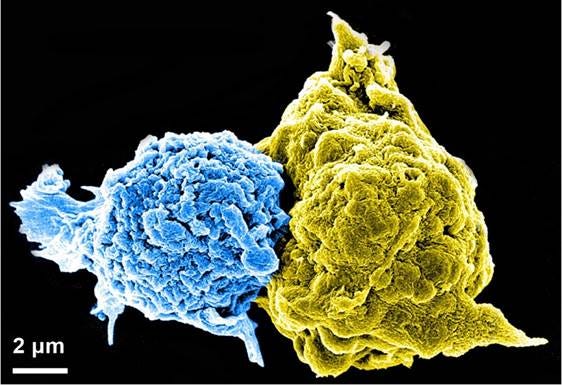
The CAR-NK cell Immunological Synapse. One CAR-modified NK92 cell (blue) interacts with a tumor cell (yellow) through an IS. Modified from Liu D. et al. Protein & Cell, 2017.
I find it helpful to think of this entire system as a language.
Every cytokine is a kind of word. Every combination of cytokines creates a sentence. And just like spoken language, immune communication has dialects, accents, and context. A single signal can mean entirely different things depending on where it happens, how long it lasts, which cells are listening, and whether those cells are already busy with something else. timing and spatial context matter.
A local whisper between two cells might strengthen a specific immune response, while a broader signal could recruit a whole community of cells into action.
This is why immune intelligence matters so much. Intelligence in the immune system is not about aggression or intensity. It is the ability to interpret signals accurately. It is knowing when to activate and when to settle. It is distinguishing friend from foe. It is the capacity to hand off information, educate younger immune cells, and keep the whole network cohesive even while multitasking.
When communication breaks down, the system struggles.
Messages get misinterpreted. Cells may act when they should be resting or ignore something that needs attention. This kind of confusion underlies many patterns we see today, from chronic inflammation to fatigue to autoimmune misfires. Not because the immune system is weak, but because it has lost clarity.
And this is where herbalism becomes such a beautiful partner. Many plants do not stimulate the immune system in the way most people expect. They nourish the communication network. They support the body’s ability to send, receive, and interpret signals. They reinforce the quiet structural conversations happening between cells. They help the system listen better.
Immune intelligence is the steadying force that allows the body to respond to life instead of reacting to every stimulus. It is subtle and powerful, and it offers us a very different way of working with herbs. Instead of trying to push the system harder, we begin asking how we can help it understand what it is already trying to do.

How Modern Life Disrupts Immune Clarity
The body is built to handle moments of stress. A sudden shock or challenge activates an elegant cascade of hormones and immune signals that help us mobilize energy, sharpen focus, and respond to danger. In the short term, this response is adaptive. It is the reason our ancestors survived. The trouble begins when the signals never stop.
Stress is not just an emotional experience. It is a biochemical event. When the body senses a stressor, the sympathetic nervous system and the HPA axis move into action. Adrenaline, noradrenaline, and cortisol rise. Immune cells rush into circulation. Pro-inflammatory cytokines increase to prepare the body for defense. This is the classic fight or flight pattern. It is useful in small bursts, but over time it begins to distort the immune system’s internal language.
Short-term stress can actually enhance certain immune functions. Studies show that acute stress increases the activity of NK cells and macrophages and even boosts inflammatory signaling for a brief window. The body is primed for immediate action.
But chronic stress tells a very different story.
When cortisol stays elevated for too long, it begins to interfere with the growth and activity of T cells. Lymphocytes become less responsive. Antibody production decreases. Communication inside the immune network grows muddy. The system becomes both overactivated and under-effective at the same time.
This is why chronic stress often pairs with inflammation, poor recovery, frequent colds, or a general sense that the body is working harder than it should. The immune system has not shut down. It has lost clarity.
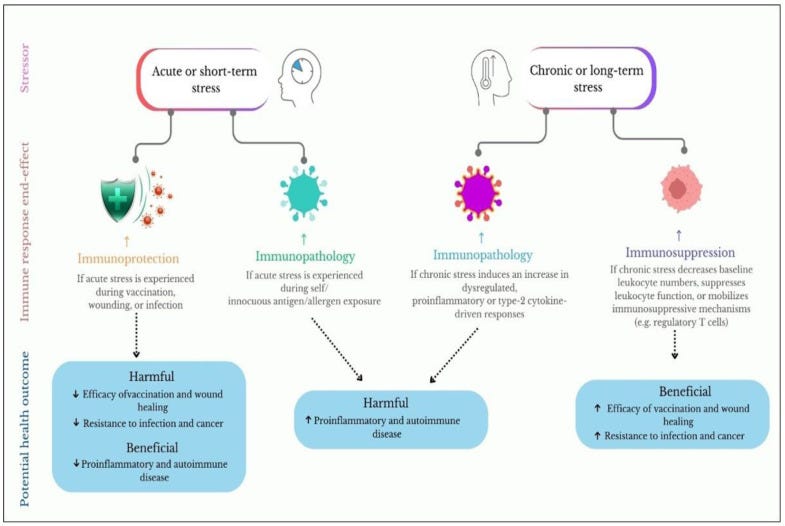
Immunology of Stress
Sleep disruption adds another layer. The immune system relies on circadian rhythms to decide when to repair, when to surveil, and when to rest. Research on individuals with chronic insomnia shows significant dysregulation of the HPA axis along with reduced lymphocyte activity, especially in response to vaccination. Without restorative sleep, immune cells cannot calibrate themselves. Timing unravels, and the communication network becomes less precise.
The sympathetic nervous system adds its own influence. Adrenaline and noradrenaline can increase innate immune responses in the moment, but chronic activation begins to suppress adaptive immunity. T cells and B cells lose sensitivity. Receptors downregulate. The immune system becomes more reactive to immediate stimuli and less capable of long-term, coordinated defense. It is the equivalent of running every day at a sprint. Eventually the body cannot keep up.
Digestive health and nutrient availability also shape this landscape. Immune cells need specific nutrients for energy, repair, and signaling. When the gut is inflamed or the microbiome is disrupted, immune messages become distorted. The gastrointestinal tract houses a major portion of the immune system, so chronic irritation reverberates outward. It does not take much to create background noise that the rest of the system must work around.
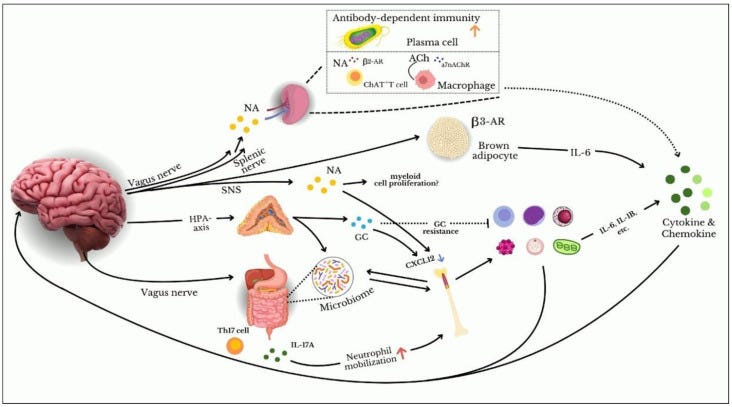
Pathways connecting stress to immune function.
And then there is the reality of modern living. Environmental chemicals, air quality, chronic light exposure, sensory overwhelm, and an endless flow of information all contribute to internal noise. None of these factors act alone. They pile onto each other. They create static in the immune network.
When you look at the whole picture, a pattern emerges. The immune system is not weak in modern bodies. It is overwhelmed by mixed signals. It is multitasking constantly, responding to stress while trying to wind down inflammation somewhere else, repairing tissue while monitoring the gut, reacting to a hundred stimuli that our ancestors rarely encountered.
This is where immune modulation becomes essential. Herbs that steady the system help reduce the static.
They support clearer communication and healthier thresholds.
They make space for the body to prioritize what truly matters.
And this is where plants like Reishi and Astragalus begin to offer their wisdom.
The rest of this article is for paid subscribers, and it is one of my favorite deep dives I have written so far.
After the paywall, we explore the heart of immune modulation through two incredible plant allies. I take you through how Reishi reorganizes immune communication and why it is more of a wise elder than a stimulant. We move into Astragalus and look at how it strengthens resilience from the ground up, supporting both innate and adaptive immunity while nourishing the gut immune axis.
If you have been wanting to understand immunity in a way that goes beyond “boosting,” this section was written with you in mind. It is research informed, herbalist centered, and grounded in the kind of gentle clarity that makes herbal medicine feel both accessible and deeply intelligent.
If you feel called to support this work and continue reading, you can upgrade anytime. Paid subscribers help keep this space alive and allow me to keep creating long form, science rich herbal education for our community.
Thank you for being here.
